Back
Back





2025 Supreme(All) 3621
2025 AHC(LKO) 79401
IN THE HIGH COURT OF ALLAHABAD AT LUCKNOW
RAJESH SINGH CHAUHAN, ABDHESH KUMAR CHAUDHARY, JJ.
Jitendra Pal – Appellant
Versus
State of U.P. – Respondent
Criminal Appeal No. 2259 of 2017
Decided On : 27-11.-2025
Advocates Appeared :
For the Appellants : Akash Dikshit, Neeraj Singh, Rajesh Kumar Sharma
For the Appellants/Petitioners: Shri Neeraj Singh, Shri Akhilendra Kumar Goswami
For the Respondents: Shri Umesh Verma
In a murder conviction based on circumstantial evidence, multiple corroborative factors, including the last seen theory and absence of alternative explanations, can establish guilt beyond reasonable doubt.
Headnote:(A) Indian Penal Code, 1860 - Section 302 - Criminal appeal against conviction for murder - Convicted for life imprisonment and fine of Rs. 20,000/- in default additional imprisonment - Case founded on circumstantial evidence - Last seen theory corroborated by witnesses - Absence of motive but sufficient circumstantial evidence to establish guilt beyond reasonable doubt. (Paras 5-34)
Facts of the case:
Appellant accused of strangulating his wife, Anita, following a domestic dispute; body found in a field the day after she was last seen with him.
Findings of Court:
Conviction upheld based on established circumstantial evidence, including last seen theory and absence of credible alternative explanations by the accused.
Issues: Whether the prosecution proved the case beyond reasonable doubt through circumstantial evidence; validity of last seen together theory.
Ratio Decidendi: The court emphasized that circumstantial evidence must create an unbroken chain pointing to guilt, noting the established presence of the accused at the scene and failure to provide a plausible explanation for the circumstances surrounding the death.
Result: Appeal dismissed, maintaining conviction and sentence.
JUDGMENT :
ABDHESH KUMAR CHAUDHARY, J.
1. Heard Shri Neeraj Singh and Shri Akhilendra Kumar Goswami, learned Counsels for the appellant, as well as Shri Umesh Verma, learned A.G.A. for the State.
2. The present Criminal Appeal has been filed against the impugned judgment and order dated 25.08.2017, passed by the learned Trial Court in Sessions Trial No. 205 of 2015, arising out of Case Crime no. 124 of 2015, whereby the Appellant has been convicted under Section 302 I.P.C. and sentenced to undergo Rigorous Imprisonment for Life and fine of Rs. 20,000/- in default mof payment of fine, additional Rigorous Imprisonment for one year.
CASE OF THE PROSECUTION
3. The factual matrix leading up to the filing of the present Criminal Appeal is delineated herein below:
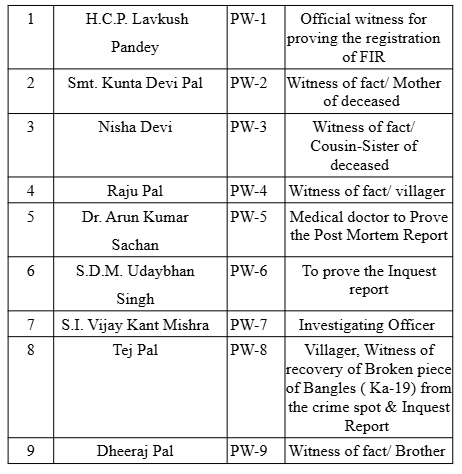
3.1) In the present case, with respect to an incident occurred on 09.03.2015, a written tehrir was filed with Police Station Ajgain, District Unnao, by the informant namely Smt. Kunta, mother-in-law of the Appellant on 10.03.2015, with the averments that her daughter namely Anita (deceased) had been married to the Appellant-Jitendra Pal, about two years ago. On 09.03.2015, the appellant brought his wife Anita to the informant’s house at Sheetal Kheda, around 11 AM and after dropping the deceased at her parental home, took the informant (mother-in-law) to Makhdoom Nagar, also known as Ludhausi, Safipur, District Unnao, for attending a family wedding. After dropping the informant at the venue of the said wedding, the appellant returned back to the informant’s home at Sheetal kheda and stayed with her wife Anita therein and thereafter, left the informant’s house on the same night, along with the deceased carrying her jewellery and cash on a motor- cycle.
3.2) In the next morning i.e. on 10.03.2015 the informant received an information that Anita was found lying dead in a wheat field outside village Teliyani. Upon receiving this information, informant along with other family members arrived at Teliyani, Hasanganj, District Unnao and found ligatures marks on her daughter's neck, indicating a strangulation. Informant has alleged in the said Tehrir that the appellant along with the help of someone, strangulated her daughter and then dumped her body in the wheat field of the village Teliyani. The informant has further alleged that the appellant was having an affair with another woman, which led to the said incident with her deceased daughter, Anita. She also stated that the appellant was lastly seen on 09.03.2015, around 8 pm, while returning to theinformant’s house after leaving her at her mayka, by one Nisha, who is the appellant’s cousin father-in-law’s daughter.
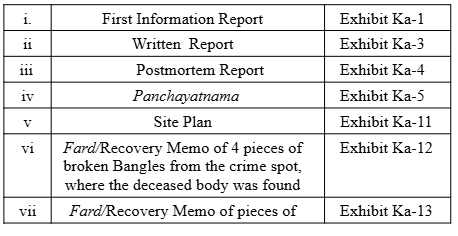
3.3) Based on the aforesaid given written information, Case Crime No. 124 of 2015, under Section 302 of the Indian Penal Code, was registered against the appellant (Exhibit Ka-1) at Police Station Ajgain, District Unnao. Police arrived at the scene and took possession of the body of the deceased and upon the direction of Magistrate, the local Police Officer prepared the ‘Panchayatnama’ and sent the dead body to the mortuary for postmortem. In the postmortem report (Exhibit Ka-4), the medical officer found the cause of death to be suffocation, which was likely due to the neck being strangulated by a noose.
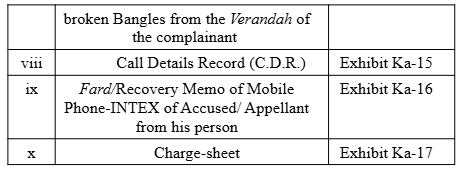
3.4) During investigation by the police, the crime scene of the incident was inspected and a site-map was prepared by the Investigating Officer. The statements of witnesses and other witnesses’ familiar with the incident were also recorded under Section 161 Cr.P.C., and after collecting evidences, the investigation was culminated in submission of Charge-sheet under Sections 302 I.P.C. against the appellant.
3.5) Cognizance was taken in the matter by the concerned Magistrate whereafter, case was committed to the Court of Session vide order dated 23.05.2015 and the case was registered as Sessions Trial No. 205 of 2015 (State vs. Jitendra Pal) arising out of Case Crime No. 124 of 2015 under Section 302 Indian Penal Code, Police Sta