Back
Back





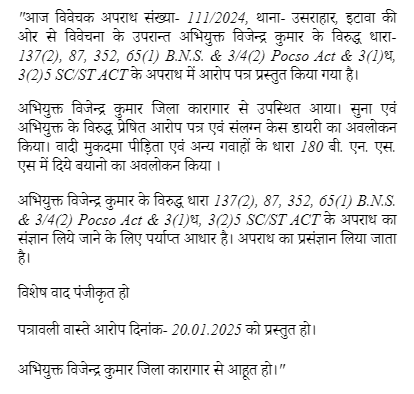
2026 Supreme(All) 152
HIGH COURT OF JUDICATURE AT ALLAHABAD
Avnish Saxena,J.
Vijendra Kumar - Applicant
Versus
State Of U.P. And Others – Respondents
APPLICATION U/S 528 BNSS No. - 36420 of 2025
Decided On : 27-01-2026
For the Applicant : Divyanshu Pathak, Hemant Shukla
For the Respondent: G.A.
Non-compliance with mandatory document supply under Section 230 B.N.S.S. constitutes a violation of the right to fair trial, rendering the charge framed by the trial court void.
Headnote:(A) B.N.S.S. - Sections 230, 261, 262 - Application under Section 528 - Accused-applicant contended that charging process violated mandatory provisions of Section 230, which mandates supply of police report and documents to the accused - Court found non-compliance with Section 230 constituted a violation of the principle of a fair trial, leading to the quashing of the charge framed by the trial court. (Paras 5-9)
(B) Right to Fair Trial - The failure to comply with legal requirements undermines an accused’s ability to defend effectively, reinforcing the necessity of adhering strictly to procedural safeguards in criminal proceedings. (Paras 7-9)
Facts of the case:
An application was filed challenging the framing of charges by the trial court, asserting that copies of police documents were not provided to the accused as mandated by Section 230 B.N.S.S. The trial court had fixed a date for charge framing without such compliance.
Findings of Court:
The charge framed by the trial court was found to contravene Section 230 B.N.S.S., thus void; the accused was entitled to receive the documents and move for discharge thereafter.
Issues: The court addressed whether the trial court had complied with Section 230 B.N.S.S. regarding the supply of documents and whether the charge framing process was defective due to this non-compliance.
Ratio Decidendi: The court held that non-compliance with mandatory document supply is not merely a formality but fundamental to ensuring a fair trial; hence, the framing of charges was quashed.
Result: Application allowed.
| Table of Content |
|---|
| 1. basic procedural details of the case (Para 1) |
| 2. claims regarding non-compliance of legal provisions (Para 2) |
| 3. defense argues compliance was met (Para 3) |
| 4. consideration of rival submissions (Para 4) |
| 5. legal requirements for providing documents (Para 5) |
| 6. details on the cognizance order and compliance (Para 6 , 7) |
| 7. framing of charge and right to move for discharge (Para 8) |
| 8. implications of non-compliance on trial proceedings (Para 9) |
| 9. procedure for providing documents to accused (Para 10) |
| 10. order allowing the application under section 528 (Para 11) |
JUDGMENT :
AVNISH SAXENA, J.
1. Learned A.G.A. has filed the counter affidavit. Sri Shive Datta Yadav, learned counsel for the opposite party no.4 appears and files vakalatnama as well as the counter affidavit. The same are taken on record.
2. Sri Divyanshu Pathak, learned counsel for the accused-applicant appears and submits that he does not want to file rejoinder affidavit in reply to the counter affidavit filed by the State as well as the opposite party no.4. He submits that sole ground of moving the present application under Section 528 B.N.S.S. is the framing of charge by the trial court without the mandatory compliance of Section 230 B.N.S.S., which mandates that the copy of police report and other documents shall be provided to the accused-applicant and further submits that the order of taking cognizance dated 06.01.2025 passed by the Special Judge POCSO Act, Etawah in Special Case No.22 of 2025 (State of U.P. Vs. Vijendra Kumar), arising out of Case Crime No.111 of 2024, under Sections 137(2), 87, 352, 65(1) B.N.S. and Sections 3/4(2) of POCSO Act as well as Sections 3(1)Dha, 3(2)5 of S.C./S.T. Act, Police Station Usarahar District Etawah, has not made any mention in the order that the copies be provided to the accused-applicant. He further submits that Sections 261 and 262 of B.N.S.S. provides for an opportunity of accused to move the discharge application and provides a limitation for the same, whereas, the trial court without providing the documents and the copy of police report to the accused-applicant has fixed the date for framing of charge and therefore, has not complied the mandatory provisions of the Act. Hence, seeks interference of this Court.
3. Sri Shive Datte Yadav, learned counsel for the opposite party no.4 and learned A.G.A. for the State have stated that the trial court has provided the copies of police papers and documents, which has been received by the accused-applicant on the margin of the order shown at page no.95 of the application. Both of them have stated that the order dated 06.01.2025 shows that the court has taken cognizance in the presence of the accused on 06.01.2025 and sufficient time was provided to the accused to move the discharge application, but has not been moved by the accused, which led to the framing of charge on 04.04.2025. Further submits that the applicant has belatedly moved the present application and therefore, the application is devoid of merits and liable to be dismissed.
4. This Court has taken into consideration the rival submissions made by the parties and perused the record.
5. Section 230 B.N.S.S. provides that the court concerned shall provide the copies of documents and police papers relied on by the prosecution not beyond 14 days from the date of production or appearance of the accused. The provision of Section 230 B.N.S.S. is reiterated underneath:-
"Section 230. Supply to accused of copy of police report and other documents. In any case where the proceeding has been instituted on a police report, the Magistrate shall without delay, and in no case beyond fourteen days from the date of production or appearance of the accused, furnish to the accused and the victim (if represented by an advocate) free of cost, a copy of each of the following:—
(i) the police report;
(ii) the first information report recorded under section 173;
(iii) the statements recorded under sub-section (3) of section 180 of all persons