
 Back
Back





IN THE HIGH COURT OF JUDICATURE AT ALLAHABAD LUCKNOW BENCH
RAJESH SINGH CHAUHAN, RAJEEV BHARTI, JJ.
Angad Yadav – Appellant
Versus
State of U.P. and Others – Respondents
Criminal Misc. Writ Petition No. 848 of 2026, Criminal Misc. Writ Petition No. 5870 of 2025, Criminal Misc. Writ Petition No. 10859 of 2025
Decided On : 19-03-2026
| Table of Content |
|---|
| 1. history of the case and previous appeals (Para 1 , 2 , 3) |
| 2. petitioner seeks short term bail (Para 4 , 5 , 6 , 7 , 8) |
| 3. arguments for and against petitioner's bail (Para 9 , 10) |
| 4. representation decision overview (Para 11 , 12) |
| 5. legal definitions of parole (Para 13 , 14 , 15) |
| 6. conditions for granting parole (Para 16 , 17 , 18 , 19) |
| 7. considerations for parole based on criminal history (Para 20 , 21 , 22) |
| 8. conclusion and order of the court (Para 23 , 24) |
JUDGMENT :
RAJEEV BHARTI, J.
1. Heard Shri Ayodhya Prasad Mishra, learned counsel for the petitioner and Shri Bipul Kumar Singh, learned State Counsel, appearing on behalf of the respondent-State.
2. All the aforesaid writ petitions pertain to the same petitioner as also the grievance of the petitioner is similar, therefore, with the consent of learned counsel for the parties, all these petitions are being decided by a common order.
3. At present the petitioner is in jail in connection with Crime No. 835 of 1995, as he was convicted and sentenced to undergo life imprisonment under Section 302/34 I.P.C. with a fine of Rs.20,000/- by learned trial court, i.e. VIII Additional Sessions Judge, Lucknow in S.T. No.579 of 1996. Being aggrieved against the conviction order, the petitioner approached this Court by way of filing Criminal Appeal No.1044 of 2020, which was dismissed by a Division Bench of this Court vide order dated 16.03.2021. Being aggrieved against the dismissal of appeal, the petitioner approached the Hon'ble Supreme Court and filed Special Leave to Appeal (Crl.) No. 1922 of 2022, which was also dismissed vide order dated 11.03.2022, copy of which is annexed as Annexure No.C.A.1 to the counter affidavit filed on behalf of State in Crl. Misc. Writ Petition No.10859 of 2025, hence the order passed by the learned trial court has been affirmed.
4. On 20.05.2025 a representation has been moved on behalf of the petitioner before the State Authorities under Section 432 of the Code of Criminal Procedure, 1973 (hereinafter referred to as 'Cr.P.C.') seeking short term bail on the ground of petitioner's multiple ailment, old age and humanitarian grounds for a period of two months. Thereafter on 26.06.2025 the petitioner approached this Court by way of filing Crl. Misc. Writ Petition No.5870 of 2025 seeking the following main prayers:-
(a) issue writ, order/orders or direction in the nature of mandamus commanding the opposite parties to consider the representation for grant of his release for short period dated 20.05.2025 submitted before respondents on humanitarian ground as early as possible and till disposal of his representation dated 20.05.2025, he may be permitted to furnish bonds for his release for such period as this Hon'ble Court may deem fit and proper before the court concerned or till disposal of his representation dated 20.05.2025 contained as Annexure No. 1 to the writ petition, in the ends of justice;
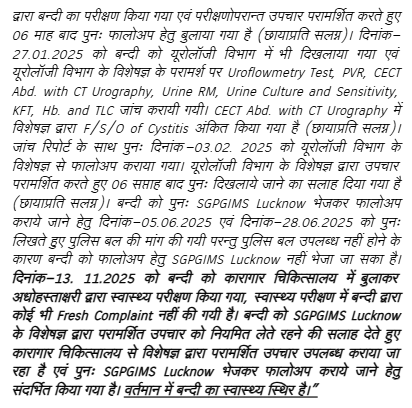
5. Learned State Counsel in his counter affidavit submitted that the representation dated 20.05.2025 made on behalf of the petitioner was rejected vide order dated 04.06.2025. The same is being reproduced hereinbelow:-
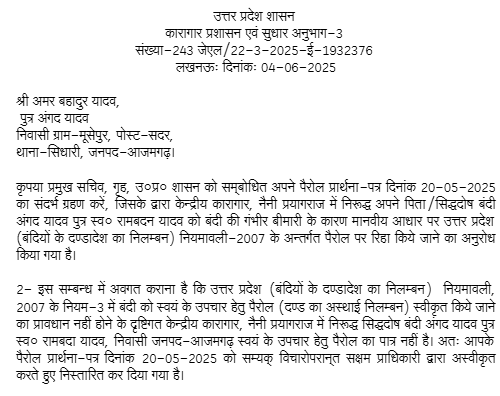
6. Challenging the order dated 04.06.2025, the petitioner again approached this Court by way of filing Crl. Misc. Writ Petition No.10859 of 2025 with the following main prayer(s):-
"(a) issue writ, order/orders or direction in the nature of certiorari to quash the order dated 04.06.2025 vide No.243 J.L./22-3-2025-E-1932376 passed by Respondent No.6 contained as Annexure No.1 to the writ petition;
(b) to issue writ, order/orders in the nature of mandamus commanding the state authorities concerned to release the petitioner on parole/short-term bail whatsoever this Hon'ble Court may kindly be deemed fit and proper in the ends of justice."
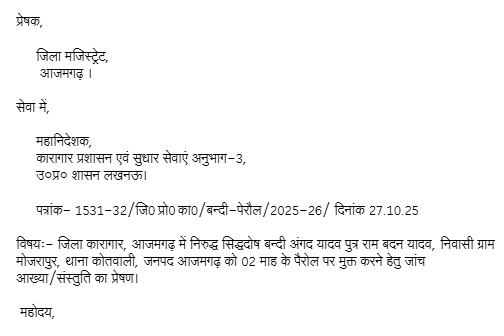
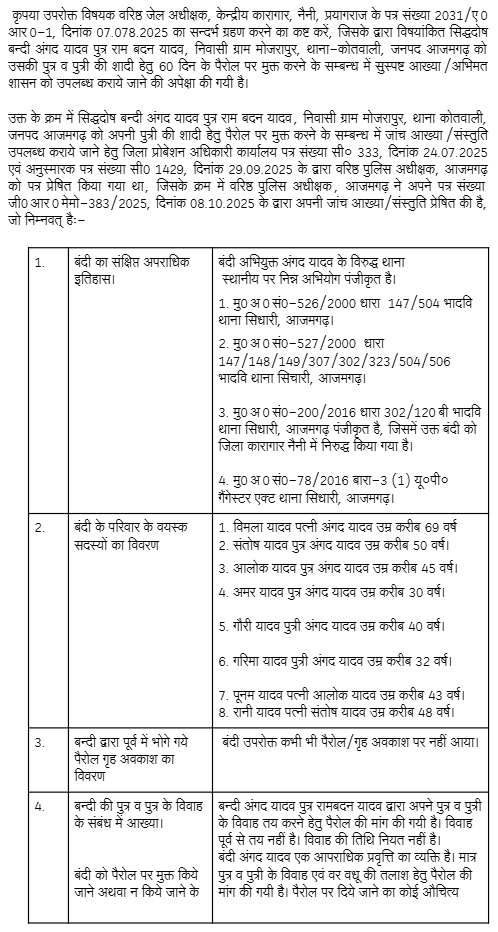
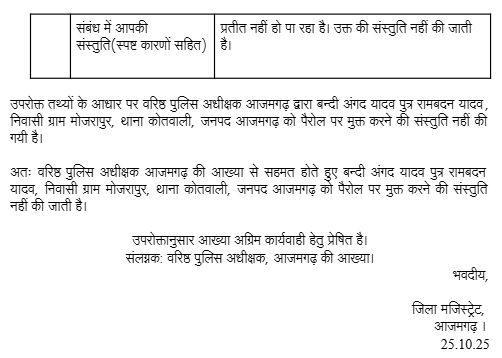
7. Thereafter another representation dated 05.07.2025 was preferred on behalf of petitioner before the State Authorities for grant of short term bail/parole on the ground of settling the marriage of petitioner's

AI
Parole is not guaranteed for convicts with serious offenses; public safety and the nature of criminal history are crucial factors in denial of short-term bail.

Parole serves to maintain family ties and facilitate rehabilitation; denial must be justified by substantial evidence of risk to public order or security.

Parole is a conditional release aimed at the reformation of convicts, and denial based solely on non-recommendation by authorities without substantial justification is impermissible.

Parole – Convicts have right to breathe fresh air for short periods – Any objection raised by local inhabitants/relative cannot be sole determinative basis for refusing parole.
Releasing authority must independently assess parole applications beyond district non-recommendation; good conduct prisoners entitled to temporary release for family ties despite serious offence, abs....
Parole cannot be denied solely for heinous offence; must be based on endangering state security or public order. Good conduct, agricultural need, local support warrant grant despite non-recommendatio....
Parole cannot be rejected solely for heinous nature of offence; must consider good conduct, reformation tendency, family ties maintenance, and absence of threat to public order or society.
Parole rejection invalid if solely based on offence nature without evidence of threat to state security or public order; releasing authority must independently assess good conduct and reform potentia....
Parole cannot be denied solely based on the nature of the conviction; maintaining family ties and demonstrating good conduct are paramount for rehabilitation and reform.



An indispensable Tool for Legal Professionals, Endorsed by Various High Court and Judicial Officers
Please visit our Training & Support
Center or Contact Us for assistance

Scan Me!
India’s Legal research and Law Firm App, Download now!


For Daily Legal Updates, Join us on :



 Back to top


