
 Back
Back





HIGH COURT OF JUDICATURE AT ALLAHABAD
ANISH KUMAR GUPTA, J.
Ram Swaroop Shukla – Appellant
Versus
State of U.P. and Others – Respondents
WRIT A. No. 27948 of 2010
Decided On : 27-02-2026
| Table of Content |
|---|
| 1. factual background of lekhpal's termination post firs and inquiry (Para 1 , 2 , 3 , 4 , 5 , 6 , 7 , 8 , 9 , 10 , 11) |
| 2. petitioner claims inquiry violated natural justice sans oral hearing (Para 12 , 13 , 14 , 15) |
| 3. state argues no oral hearing needed without proposed witnesses (Para 16 , 17) |
| 4. rule 7 outlines procedure for major penalty inquiries (Para 18) |
| 5. precedents require oral inquiry, evidence in disciplinary proceedings (Para 19 , 20 , 21 , 22 , 23) |
| 6. implicit oral hearing duty vitiates inquiry; termination quashed (Para 24 , 25 , 26) |
JUDGMENT :
ANISH KUMAR GUPTA, J.
1. Heard Sri Santosh Kumar Srivastava, learned counsel for the petitioner and Sri Girijesh Kumar Tripathi, learned Additional Chief Standing Counsel for the State.
2. The instant petition has been filed by the petitioner herein seeking quashing of the order dated 17.12.2009, passed by respondent no.3, whereby the services of the petitioner herein were terminated and also seeking quashing of the order dated 30.04.2010, whereby the appeal preferred by the appellant herein was dismissed by the respondent no.2.
FACTS
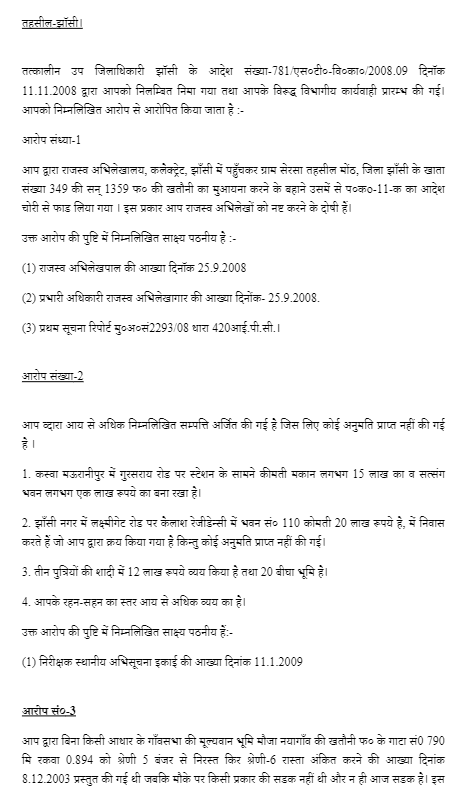
3. The brief facts of the case are the petitioner herein was appointed on the post of Lekhpal in the year, 1980 and in the year, 2008, he was posted in the area of Domagor of Tehsil and District- Jhansi. On 04.10.2008, an F.I.R. being Case Crime No. 686 of 2008 under Sections 419, 420, 467, 471, 477-A and 120B I.P.C. was registered at the behest of the Revenue Inspector, Shri Buddhi Prakash, making out the allegations that the petitioner has treated one Brij Kishore as dead and passed a mutation order in favour of Rajendra Singh and Hari Mohan. In the aforesaid case, after investigation a final report was submitted on 21.10.2008.
4. In the final order it was categorically observed by the Investigation Officer (IO) that since the said Brij Kishore had left his house in the year, 1988 and has taken Sanyas and renowned the world, but his sons and relatives continued to search for him sufficiently for long period upto 1997. When the said Brij Kishore could not be traced out by them, in the year 1997 his sons and relatives have performed his last rites treating he is dead and thereafter they have applied for mutation of their names in place of his father. Since, the entire village has accepted that said Brij Kishore has died, in such circumstances it is further observed that Village Pradhan has also certified that he is dead. However, later on in the year, 2006, said Brij Kishore came in the village in the form of a Sadhu and did not raise any objection with regard to the mutation of his property in the name of his legal heirs i.e., his sons. Since, the neighbors of the land belonging to the sons of the said Brij Kishore, wanted to purchase the land from Hari Mohan etc., which they have refused to sell. Having regard to this he has made the complaints to the Higher Officials, therefore, it was concluded that there was no criminality attached to the action taken by the petitioner herein in passing the mutation order in favor of the legal heirs of the said Brij Kishore, on the basis of the Death Certificate issued by the Village Pradhan.
5. Subsequent to the filing of the aforesaid final report, another F.I.R. being Case Crime No. 2293 of 2008 under Section 420 I.P.C. was lodged against the petitioner herein alleging therein that the petitioner herein had torned the order iŒdŒ&11 with regard to the Khata No. 349, whereby an alive person was shown as dead and name of his heirs were mutated.
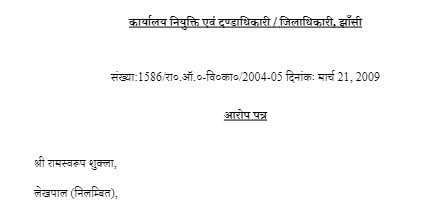
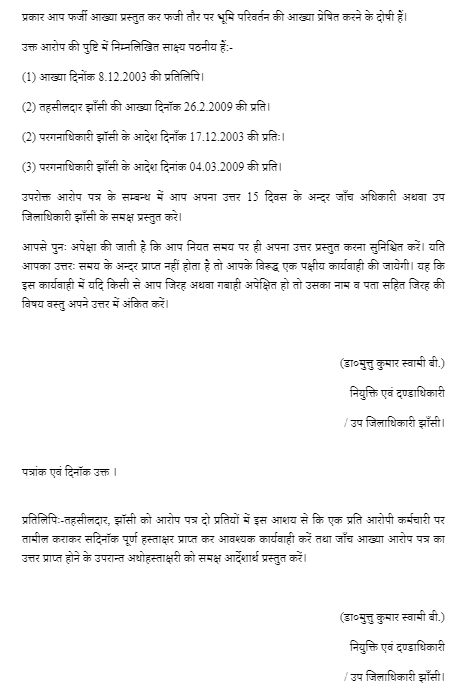
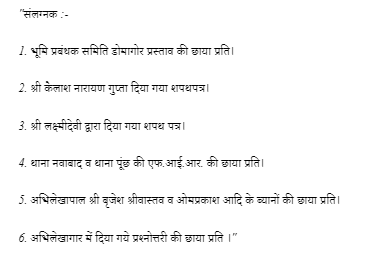
6. The criminal proceedings of the aforesaid case was stayed by this Court on a Criminal Misc. Application under Section 482 Cr.P.C. No. 17392 of 2009 filed by the sons of the said Brij Kishore. Subsequent thereto, vide order dated 11.11.2008, the petitioner herein was suspended on the allegation that he has torned the order iŒdŒ&11-d relating to Khata No. 349 of the year, 1359 Fasli, while inspecting the aforesaid file. Thereupon, on 21.03.2009, the inquiry o
AI
Disciplinary inquiry under 1999 Rules vitiated without oral hearing opportunity to delinquent, even absent proposed witnesses by either side, as implicit in rules for natural justice compliance.

The court established that an oral inquiry is essential in disciplinary proceedings, and its absence violates natural justice, invalidating any resultant punishment.
Rule 7(vii) provides that where charged government servant denies charges, enquiry officer shall proceed to call witnesses proposed in charge sheet.

The failure to follow prescribed inquiry procedures and principles of natural justice invalidates disciplinary actions against government servants.
Disciplinary proceedings must adhere to principles of natural justice, including the right to a fair hearing and the requirement for oral evidence. Failure to comply renders the proceedings and resul....

The central legal point established in the judgment is the requirement of evidence to prove charges in a disciplinary proceeding, the need for adherence to natural justice principles, and the entitle....
Disciplinary proceedings must adhere to procedural rules and principles of natural justice, ensuring the charged employee has the opportunity to defend themselves.

Disciplinary proceedings vitiated without oral evidence proving documents, even ex-parte; inquiry officer must independently assess evidence sufficiency as quasi-judicial authority, upholding natural....



An indispensable Tool for Legal Professionals, Endorsed by Various High Court and Judicial Officers
Please visit our Training & Support
Center or Contact Us for assistance

Scan Me!
India’s Legal research and Law Firm App, Download now!


For Daily Legal Updates, Join us on :



 Back to top


