
 Back





2026 Supreme(All) 525
HIGH COURT OF JUDICATURE AT ALLAHABAD
VIKAS BUDHWAR, J.
Uttar Pradesh State Textile Corporation - Petitioner
Versus
Debt Recovery Appellate Tribunal and others – Respondents
Writ C. No. 6398 of 2021
Decided On : 26-05-2026
Important Points
Subject
Civil Law - Procedural Law and Limitation
Act Referred
Headnote
(B) Appellate Jurisdiction - Ex-parte orders - Recall applications - When a party fails to attend proceedings due to factors beyond their reasonable control, it is essential to provide an opportunity to present a case on merits, provided the delay is not marked by gross negligence - Appellate bodies are required to balance procedural discipline with equitable considerations to prevent irreparable injustice. (Paras 32-34)
Facts of the case:
The petitioner, a corporate body initially declared sick, faced complete cessation of operations and loss of staff for an extended period. Subsequent to management restoration, the petitioner sought to recall an ex-parte appellate order that had significantly enhanced the interest component of a debt recovery claim. The appellate tribunal rejected the request for condonation of delay despite the petitioner's argument regarding the systemic difficulties that prevented timely representation during the litigation.
Findings of Court:
The court found that the refusal to condone the delay failed to account for the unique administrative paralysis the entity faced. It determined that the circumstances were not indicative of a deliberate or reckless abandonment of legal rights, but rather a byproduct of the entity's distressed state.
Issues: The primary issue was whether the appellate tribunal correctly rejected the application for delay condonation, thereby depriving the petitioner of an opportunity to contest an ex-parte interest enhancement order, without considering the mitigating circumstances of corporate sickness.
Ratio Decidendi: Procedural rules, including the law of limitation, are instruments of justice and not ends in themselves. When a litigant is hindered by systemic corporate failure rendering representation impossible, courts must adopt a liberal approach to condoning delay to ensure that the final determination is reached after a fair hearing on merits, subject to reasonable costs.
Result: The writ petition was allowed; the challenged order was set aside and the matter was remanded to the appellate tribunal for disposal on merits.
For the Petitioner: Abhinava Krishna Srivastava, Dhirendra Narain Awasthi, Kartikeya Saran, Rajesh Kumar Singh, Sandeep Arora, Siddhartha Krishna Bakhshi, Ujjawal Satsangi
For the Respondents: Anadi Krishna Narayana, Ashish Kumar Srivastava, Krishna Mohan Asthana, Maneesh Mehrotra, Sandeep Arora.
| Table of Content |
|---|
| 1. factual history regarding corporate insolvency, bifr proceedings, and drt/drat litigation. (Para 3 , 4 , 5 , 6 , 7 , 8 , 9 , 10 , 11 , 12 , 13 , 14 , 15 , 16 , 17 , 18 , 19 , 20) |
| 2. contentions regarding delay in filing recall applications due to corporate sickness and procedural status. (Para 21 , 22 , 23 , 24 , 25 , 26 , 27) |
| 3. analysis of circumstances justifying the condonation of delay and the exercise of judicial discretion. (Para 28 , 29 , 30 , 31 , 32 , 33 , 34 , 35 , 36) |
| 4. judicial order remitting the matter to the appellate tribunal for decision on merits with cost implications. (Para 37 , 38) |
JUDGMENT :
VIKAS BUDHWAR, J.
IN RE: AMENDMENT APPLICATION NO.21 OF 2025
1. Sri Rakesh Pandey, learned Senior Counsel assisted by Sri Abhinav Krishna Srivastava do not press the amendment application.
2. The amendment application is dismissed as withdrawn.
ORDER ON PETITION
FACTS
1. Heard Sri Rakesh Pandey, learned Senior Counsel assisted by Sri Abhinav Krishna Srivastava for the writ petitioners, Sri Rahul Agarwal, learned Addl. Advocate General assisted by Sri Anshul Nigam for Respondent no.9/State and Sri Anurag Khanna, learned Senior Counsel assisted by Sri Sandeep Arora for Respondent no.3.
2. A joint statement has been made by learned counsels for the rival parties that since affidavits have been exchanged between the parties and they do not propose to file any additional affidavit, the writ petitions be decided on the basis of the documents available on record.
3. With the consent of the parties, the writ petition is being decided at the admission stage.
4. The case of the writ petitioner, Uttar Pradesh State Textile Corporation through its Managing Director, having its registered office at 1, Smith Square, 14/72, Civil Lines, Kanpur-208001, is that it is a Government company incorporated under the Companies Act, 1956, and its entire share capital is owned by the Government of Uttar Pradesh. Earlier, the writ petitioner had five textile units in Meerut, Jhansi, Sandila, Kashipur, and Jaspur. For the purposes of running the above-mentioned five mills, the petitioner company obtained credit facilities to the tune of Rs.16,50,00,000 from the respondent Consortium Bank. A chart showing the credit facility availed by the petitioner company is being quoted herein under:-
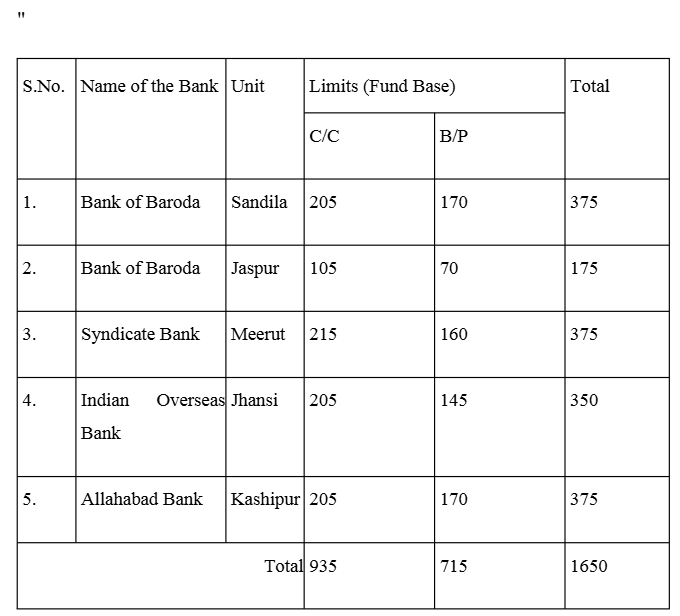
5. As per the writ petitioner, on 18.09.1993, the credit facilities stood renewed and, lastly, it was raised to Rs. 2,17,00,00,00. It is claimed that the leader of the Consortium Bank was Bank of Baroda and the second leader was Syndicate Bank.
6. As the ill luck it may be, in the year 1994-95, the units of the petitioner- company went into losses and the production came to a standstill. Due to incurring huge losses, the petitioner-company became sick, attracting the provisions of the Sick Industrial Companies (Special Provisions) Act, 1985, and vide order dated 02.02.1995 passed by the Board of Industrial and Financial Reconstruction, (in short BIFR), the petitioner was declared a sick company.
7. On account of the fact that the petitioner company became sick, the staff of the petitioner-company were offered the benefits of VRS lay off and the management of the petitioner-company was handed over to U.P. State Spinning Company Limited. However, U.P. State Spinning Company Limited also became a sick company and there were only three regular employees retained in the company for looking after the works of it and of the petitioner-company. Since the petitioner-company could not maintain financial discipline, so the respondent-bank approached the Debt Recovery Tribunal, Allahabad, while invoking the provisions of the Recovery of Debts Due to Banks and Financial Institutions Act, 1993, by filing O.A. No. 123 of 2000 and 161 of 2000. In the meantime, on account of bifurcation of the State of Uttar Pradesh, while carving out a new State of Uttarakhand in the year 2000, out of the five units, two units of the petitioner-company, i.e. Kashipur and Jaspur, were transf









