
 Back
Back





HIGH COURT OF JUDICATURE AT ALLAHABAD, LUCKNOW
RAJNISH KUMAR, ZAFEER AHMAD, JJ.
Jagdish – Appellant
Versus
State of U.P. – Respondent
Criminal Appeal No. 1533 of 2017
Decided On : 27-05-2026
| Table of Content |
|---|
| 1. overview of prosecution case, procedural history, and evidence presented at trial. (Para 1 , 2 , 3 , 4 , 5 , 6 , 7 , 8 , 9 , 10 , 11 , 12 , 13) |
| 2. summary of rival contentions regarding evidence, last-seen theory, and plea of alibi. (Para 14 , 15 , 16 , 17 , 18 , 19 , 20) |
| 3. judicial assessment of last-seen evidence and evaluation of credibility of alibi claims. (Para 21 , 22 , 23 , 24 , 25 , 26 , 27 , 28) |
| 4. legal requirements and standards for conviction based on 'last-seen together' and circumstantial evidence. (Para 29 , 30 , 31 , 32 , 33) |
| 5. adjudication on motive, fir delay, medical corroboration, and burden of proof regarding alibi. (Para 34 , 35 , 36 , 37 , 38 , 39 , 40 , 41 , 42 , 43 , 44 , 45 , 46 , 47 , 48 , 49 , 50 , 51) |
| 6. final synthesis of evidence leading to conviction and sentencing orders. (Para 52 , 53 , 54 , 55 , 56 , 57 , 58) |
JUDGMENT :
Rajnish Kumar, J.
(1) The instant criminal appeal under Section 374 of the Code of Criminal Procedure, 1973 (here-in-after referred to as “Cr.P.C.”) has been filed by the accused/convict/appellant, Jagdish, assailing the judgment and order dated 29.10.2014 passed by Special/Additional Sessions Judge, Court No.4, Raibareli, in Sessions Trial No. 536 of 2008; State Versus Jagdish, emanating from Case Crime No. 145 of 2008, under Sections 302 of the Indian Penal Code, 1860 (here-in-after referred to as “I.P.C.”), Police Station Fursatganj, district Raebareli, whereby learned trial Court convicted and sentenced the accused/appellant to undergo under Section 302 I.P.C. to life imprisonment and a fine of Rs.10,000/-. In default of payment of fine to undergo additional one year’s simple imprisonment. It has also been provided that on payment of fine, the same would be disbursed to the children of the deceased.
(2) The prosecution case, in brief, is that complainant, Ramdeen, had submitted written report (Ext. Ka.1) at police station Fursatganj, district Raebareli, on 30.04.2008, alleging therein that he is resident of village Khairhana, police station Fursatganj. His in-laws’ house is in village Tinera, hamlet of Tendua. He along with his children is living in village Tinera. His daughter Anita Devi was married about three years ago to Jagdish son of Babulal, resident of village Guru Ka Purwa, hamlet of Tendua. His daughter is the mother of a child. After the birth of a girl child, his son-in-law remains angry with his daughter and used to say to his wife to give the government money Rs. 1400/- received on the birth of girl. On 29.04.2008, at about 8:00 in the evening, his son-in-law came to his house and stayed there. His daughter prepared food and served it to him. After some time, he (accused Jagdish) told to his daughter that he needed to go for defecation and asked her to bring water in a mug (lota). His daughter, being simple in nature, brought water. He, then, told her to come along with the mug (lota) of water. Both, his daughter and his son-in-law, went towards the northern fields. Today on 30.04.2008, small children of village came to his house and informed his wife that the dead body of her daughter Anita Devi was lying in the field of Dadan. He and his wife went there and saw their daughter lying dead. His son-in-law has killed his daughter by pressing her neck with his hands and there were several injuries on her body and blood had also come out. Report may be written and necessary action may be taken.
(3) On the basis of aforesaid written report (Ext. Ka.1), F.I.R., bearing Case Crime No. 145 of 2008, under Section 302 I.P.C. was registered at police station Fursatganj, district Raebareli on 30.04.2008 at 10:30 A.M.
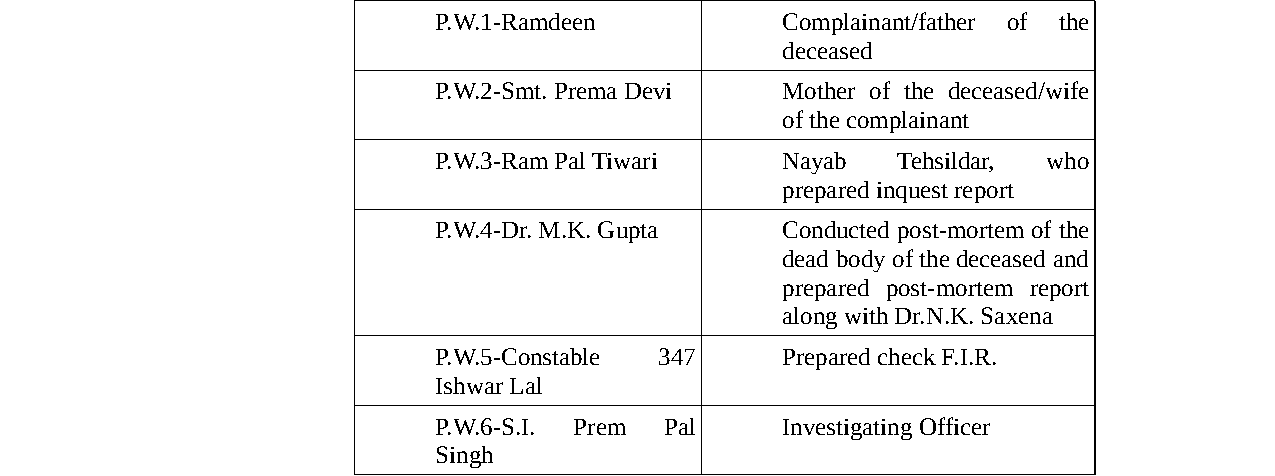
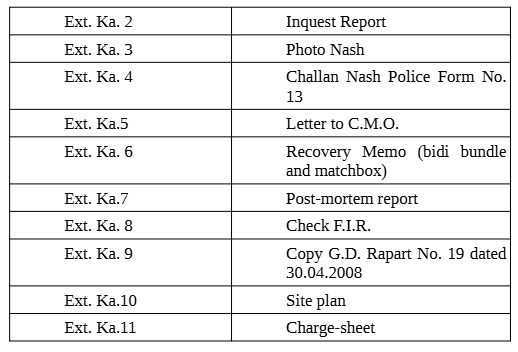
(4) The investigation was conducted by S.I. Prem Pal Singh. He, after recording the statement of complainant, his wife Prema Devi and other witnesses, had prepared the site plan on the pointing out of complainant on 30.04.2008 itself. On 30.04.2008, Naib Tehsildar Tiloi Rampal Tiwari had prepared the inquest report of the dead body of the deceased

AI

In a murder conviction based on circumstantial evidence, multiple corroborative factors, including the last seen theory and absence of alternative explanations, can establish guilt beyond reasonable ....
In criminal cases based on circumstantial evidence, a complete and conclusive chain establishing guilt beyond reasonable doubt is necessary; mere suspicion is insufficient.


The court upheld the conviction under IPC Section 302, emphasizing that circumstantial evidence must form a complete chain, proving guilt beyond reasonable doubt without the accused providing an adeq....

The sufficiency of circumstantial evidence and the need for a complete chain of evidence to establish guilt beyond reasonable doubt.



An indispensable Tool for Legal Professionals, Endorsed by Various High Court and Judicial Officers
Please visit our Training & Support
Center or Contact Us for assistance

Scan Me!
India’s Legal research and Law Firm App, Download now!


For Daily Legal Updates, Join us on :



 Back to top


