
 Back
Back





IN THE HIGH COURT OF UTTARAKHAND AT NAINITAL
RAKESH THAPLIYAL, J.
Udasin Karshni Narain Ashram and others. – Appellant
Versus
Mahendra Taneja. - Respondent.
Civil Revision No. 97 of 2022
Decided On : 27-03-2026
| Table of Content |
|---|
| 1. details of plaintiffs' claims and tenant's defense. (Para 2 , 3 , 4 , 5) |
| 2. arguments regarding the validity of the trust and construction. (Para 7 , 8 , 9 , 10) |
| 3. reliance on evidence and admissions affecting case outcome. (Para 11 , 12 , 13 , 14) |
| 4. procedural obligations of the defendant in eviction suits. (Para 15 , 19 , 20) |
| 5. court's findings on the ownership and trust issues. (Para 21 , 22 , 23) |
| 6. court's critique of the trial court's judgment. (Para 24 , 25 , 26 , 27) |
| 7. final judgment on the appeal. (Para 28) |
| 8. conclusion and order in the case. (Para 29) |
Judgment :
Rakesh Thapliyal, J.
1. The instant civil revision has been preferred under Section 25 of the Provincial Small Cause Courts Act, 1887 against the judgment and decree dated 31.08.2022 passed by learned Addl. District & Sessions Judge, Haridwar in SCC Suit No. 05 of 2014 titled as “Udasin Karshni Narain Ashram Trust (Regd.) and others Vs. Mahendra Taneja” whereby suit of the plaintiffs / revisionists for recovery of rent, damages and eviction has been dismissed.
2. Relevant facts of the case necessary for adjudication of the issue involved in this revision are as follows:
3. Plaintiffs / revisionists preferred a suit for recovery of arrears of rent, damages and eviction against the defendant / respondent inter alia with the averments that plaintiff no. 1 is the Trust, plaintiff no. 2 is Managing Trustee and plaintiff no. 3 is the Manager of the revisionist Trust. It is contended in the plaint that respondent-defendant is the tenant of plaintiff Trust in two shops i.e. shop no. 4 and 5 and rent was paid only upto 31.07.2012 and thereafter, for August and September, 2012 rent was due but not paid and the shops in question are new construction and since the same is owned by plaintiffs it is used for public religious and charitable purposes and as such, the provisions of the U.P. Act No. 13 of 1972 are not applicable. It was further pleaded by the plaintiffs in the SCC Suit that since there was default in payment of arrears of rent on the part of the defendant respondent, as such, a notice was served upon him on 22.09.2012 through the counsel of the defendant thereby terminating the tenancy on expiry of one month notice from the date of receipt of the notice but defendant respondent refused to accept the notice and plaintiffs ultimately preferred the suit with the following reliefs:
“i. To pass a decree for eviction in favour of the plaintiff and against the defendant to the effect that the defendant hands over actual possession of the suit property within the time stipulated by the court to the plaintiffs.
ii. To pass a decree in favour of the plaintiffs and against the defendants to the effect that the defendants to pay arrears of rent of Rs. 4110 to the defendant.
iii. To pass a decree in favour of the plaintiff and against the defendant of the effect that the defendant pay the mesne profits from 01.01.2012 to 05.01.2014 i.e. Rs. 86400/- and Rs. 200 from the date of filing of suit till the date of actual possession towards unauthorized use and occupation.”
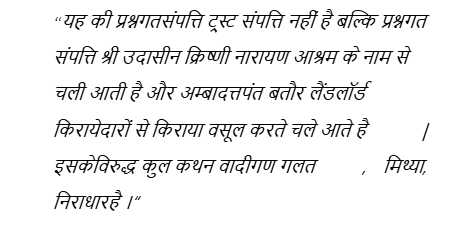
4. In the aforesaid plaint, the defendant respondent filed the written statement and denied all the averments, as made in the plaint and questioned the maintainability of the suit as well as locus standi of the plaintiff Trust in instituting the suit. In the written statement, there is no denial with regard to landlord tenant relationship and in fact, defendant admitted such relationship and he also stated that payment of rent upto 31.07.2012 was made, however, it was contended that rent for subsequent months were remitted via money order due to landlord’s refusal to accept the same and as such, denied arrears of rents or default in paying the rent. Apart from this, defendant – respondent took a specific plea questioning the title and ownership of the Trust over the property in question and specifically pleaded that property in question is not “Trust Property” since the same belongs to “Udasin Karshn
AI
A tenant cannot deny the landlord's title once the landlord-tenant relationship is established; the tenant must prove lawful deposit of owed rent, and properties used for charitable purposes are exem....


The court upheld the trial court's finding that the landlord was a charitable trust exempt from eviction laws, affirming that previous judgments establishing legal character are relevant.
The failure to consider crucial evidence and make specific findings can render a judgment perverse and warrant its quashing.
The Revisional Court's wide jurisdiction under Section 25 of the Provincial Small Cause Courts Act, 1887 allows it to decide the suit on merits if there is sufficient evidence on record, without the ....

The burden of proof lies with the petitioners to establish the non-applicability of the Uttar Pradesh Act No.13 of 1972, and estoppel does not apply against statutory provisions.
The court ruled that the trust in question was a private trust, rejecting claims of it being a public charitable trust, and upheld the applicability of the U.P. Urban Buildings Act.
The main legal point established in the judgment is the interpretation of the definition of 'building' under the UP Urban Buildings Act and the jurisdictional aspects of suits before the Small Causes....



An indispensable Tool for Legal Professionals, Endorsed by Various High Court and Judicial Officers
Please visit our Training & Support
Center or Contact Us for assistance

Scan Me!
India’s Legal research and Law Firm App, Download now!


For Daily Legal Updates, Join us on :



 Back to top


