


1. Challenge to transfer of under-trial prisoner from one central jail to another without court permission. (Para 1 , 2 )

 Back
Back





IN THE HIGH COURT OF MADHYA PRADESH AT JABALPUR
Vishal Dhagat, J.
Shri Haji Abdul Razzak – Petitioner
Versus
The State Of Madhya Pradesh And Others – Respondents
Writ Petition No. 37391 of 2024
Decided On : 07-05-2025
1. Challenge to transfer of under-trial prisoner from one central jail to another without court permission. (Para 1 , 2 )
2. Petitioner argues transfer without court permission violates law; State defends under prison rules and statutory power. (Para 2 , 3 )
3. Petition disposed with directions: transfer valid unless trial court specified a particular jail; liberty to apply. (Para 16 , 17 )
No. Section 29 only applies to convicted prisoners. An under-trial prisoner is not covered by that provision, so transfer cannot be ordered under it. (Para 5 , 7 , 8 )
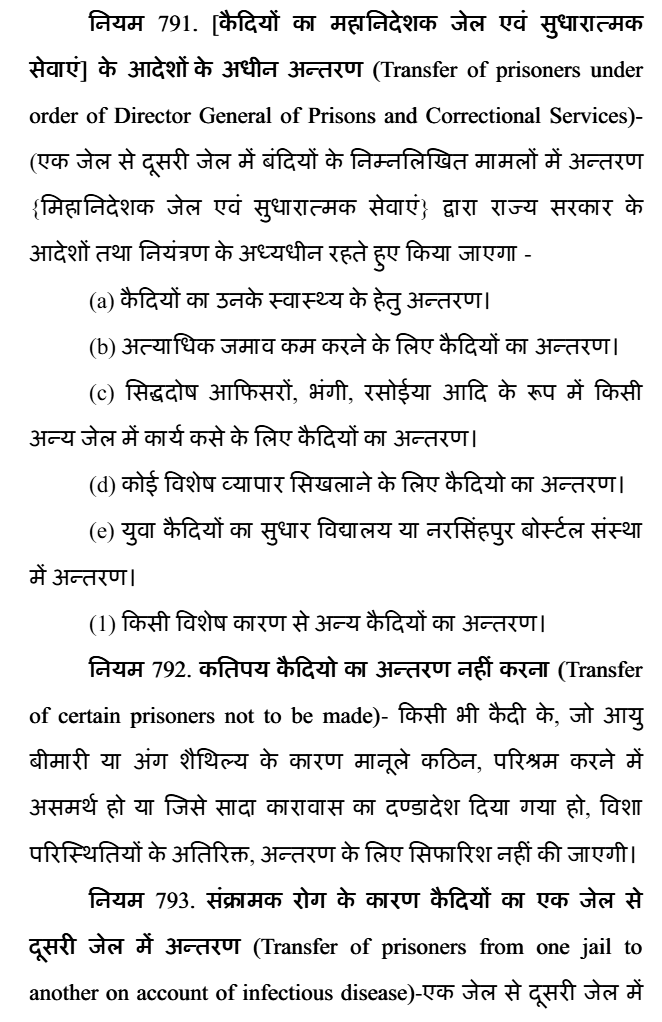
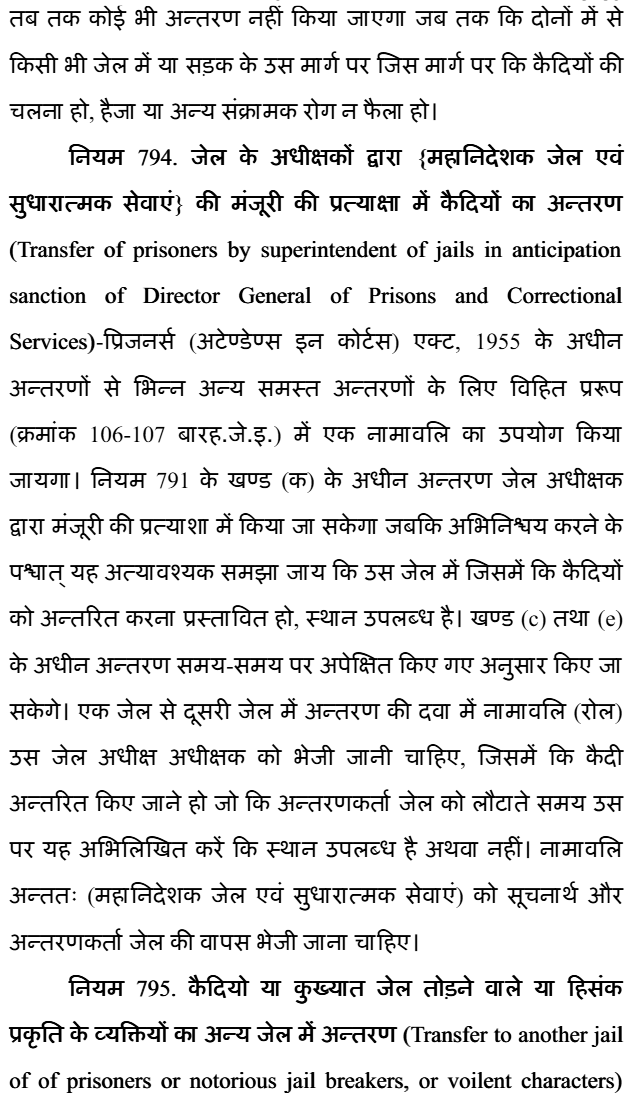
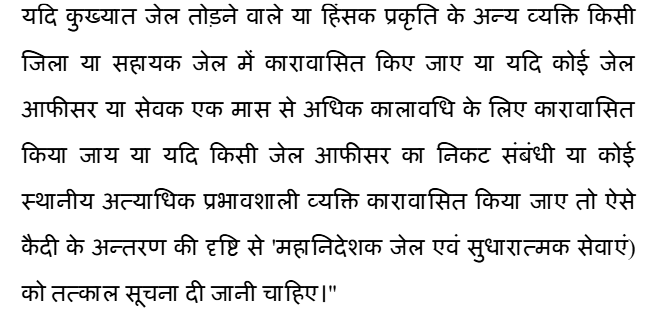
Rules 791 to 795 do not distinguish between under-trial and convicted prisoners, but Section 59 of the Prisons Act, 1894 does not empower the State to frame rules for transfer of under-trial prisoners. (Para 10 , 11 , 12 )
Section 417 allows the State to decide the place of imprisonment only if no court order under Sections 167 or 309 of Cr.P.C. specifies a particular jail for the under-trial. (Para 14 , 15 )
If the trial court has directed custody in a specific jail, transfer requires court permission. Without such a direction, the State may order transfer under its administrative power. (Para 15 , 16 )
ORDER :
VISHAL DHAGAT, J.
Petitioner has filed this petition under Article 226 of the Constitution of India challenging order dated 19.11.2024 contained in Annexure-P/28 by which petitioner was transferred from Netaji Subhas Chandra Bose Central Jail Jabalpur to Central Jail Bhopal.
2. Learned Senior Counsel appearing for petitioner submitted that order is malafide and arbitrary in nature. Petitioner is placed under judicial custody by order of Court. Removing prisoner outside the territorial jurisdiction of trial Court violates Sections 187 and 232 BNSS 2023 and Article 14 and 21 of Constitution of India. No reason is assigned in passing of impugned order. Action is drastic in nature, therefore, adequate Justification ought to have been given in the order. Impugned order dated 19.11.2024 was supplied to petitioner in Court room during course of argument on admission on 05.12.2024. It is submitted that said communication of order of transfer is as ex post facto, hence, illegal. Such an order is not conceived under Regulation 791 of MP Prison Rules 1968, Section 26 of Prisons Act, 1894 and Section 29 of Prisoners Act 1900. Petitioner was remanded in judicial custody by C.J.M. Jabalpur in FIR No.249/2024. Impugned order was not communicated to petitioner or his relatives and he was shifted to Central Jail Bhopal. Petitioner is being deprived of right to raise objection against his transfer. Senior counsel appearing for petitioner has relied upon the judgment passed by Apex Court in case of State of Maharashtra and other Vs. Saeed Sohail Sheikh reported in (2012) 13 SCC 192. Placing reliance upon paragraph No.19, 20 and 23, it is submitted that transfer of prisoner in terms of Section 29(1) of the Prisoners Act of 1900 is permissible only in distinct situation covered by clause A to D thereof. Said provision does not deal with under trial prisoner. Transfer of an under trial prisoner is also not permissible under Section 29(2) of Act of 1900. Section 29(2) empowers Inspector General of Prisons to direct a transfer but such transfer of a prisoner who is confined in circumstances mentioned in Section 29(1) of the Act of 1900. Respondent could not have transferred under trial prisoner in terms of order of Inspector General of prison under Section 29 of the Prisoners Act 1900. As per rational of provision of Sections 167 and 309 of Cr.P.C., continue detention of prisoner in jail during trial or injury is legal and valid only under authority of Court, prison where under trial is detained, is a prison identify by the competent Court either in terms of Sections 167 or 309 of the Cr.P.C. In these circumstances, transfer of a prisoner from any such place of detention will be permissible only with the permission of the Court under whose warrant the under trial has been remanded to custody. Power to exercise by Court permitting or refusing transfer of an under trial prisoner is judicial in nature and not ministerial. Exercise of ministerial power is out of place in situations where quality of life or liberty of citizen is affected. Transfer of prisoner to distant place may affect him adversely. On strength of aforesaid judgment and argument, learned Senior Counsel appearing for petitioner submitted that order of transfer dated 19.11.2020 contained in Annexure- P/28 is bad in law and deserves to be set aside. He further submitted that wife of petitioner is suffering from Cancer and she has to visit prison at Bhopal to meet her husband. It is very difficult for her to go to Bhopal for meeting her husband. Right of under trial prisoner to meet his wife and relatives is also jeopardized due to said transfer. Further, petitioner is adversely affected in defending his case.
3. Learned Government Advocate appearing for the State submitted that a detailed order has been passed by this Court on 01.04.2025 and Government Advocate was directed to produce material on basis of which petitioner was transferred. Looking into the material is for purposes tha
AI

Point of Law : Removal and discharge of prisoners - There is no doubt that fundamental right of an under-trial prisoner under Article 21 of Constitution is not absolute. His rights of visitations as ....

Power to appoint place of imprisonment - Transfer of prisoners from one place of detention to another is permissible only with permission of Court under whose warrant an undertrial has been remanded ....

Transfer of under-trial prisoners requires judicial reasoning and fair procedure; arbitrary transfers violate rights and must be quashed.

(1) Intra-State prison transfer of prisoners – Sustainability – Transfer of convict prisoner from one prison to another is purely an administrative decision and same cannot be interfered with by cour....

Judicial oversight is required for prisoner transfers under the Prisoners Act, ensuring that such decisions are not solely administrative and respect the rights of the incarcerated.


(1) A crime against an individual is to be considered as a crime against a State and public, at large. Petition filed under Section 406 of Code of Criminal Procedure, is maintainable at instance of S....

Point of law: Public orders, publicly made, in exercise of a statutory authority cannot be construed in the light of explanations subsequently given by the officer making the order of what he meant, ....



An indispensable Tool for Legal Professionals, Endorsed by Various High Court and Judicial Officers
Please visit our Training & Support
Center or Contact Us for assistance

Scan Me!
India’s Legal research and Law Firm App, Download now!


For Daily Legal Updates, Join us on :



 Back to top