


1. Petition under Article 226 seeking revised grade pay and pensionary benefits under Madhya Pradesh Pay Revision Rules, 2009, challenging an administrative order's later commencement date. (Para 1 , 3 , 7 , 8 )

 Back
Back





IN THE HIGH COURT OF MADHYA PRADESH AT GWALIOR
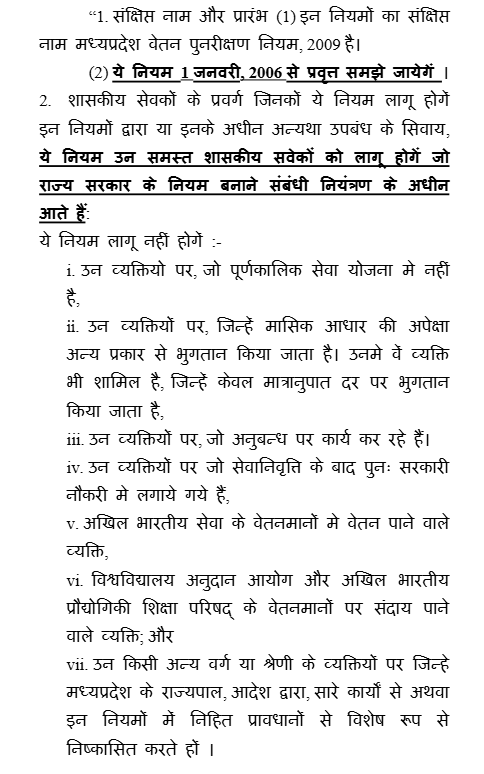
ANAND SINGH BAHRAWAT, J.
Anand Kumar Bohare – Petitioner
Versus
State Of M.P. And Others – Respondents
Writ Petition No. 7469 Of 2019
Decided On : 24-03-2026
1. Petition under Article 226 seeking revised grade pay and pensionary benefits under Madhya Pradesh Pay Revision Rules, 2009, challenging an administrative order's later commencement date. (Para 1 , 3 , 7 , 8 )
2. Petitioner asserted statutory pay revision rules have overriding effect and cannot be supplanted by detrimental administrative orders; State defended the later date as valid. (Para 2 , 4 , 5 , 9 )
3. Offending clause of the administrative order quashed; respondents directed to apply statutory pay revision benefits from the rules' commencement with consequential pension, arrears, and default interest. (Para 36 , 37 )
No. Executive instructions cannot amend, supersede, contradict, or supplant statutory rules; they may only fill gaps and supplement the rules, and must remain subservient to statutory provisions. (Para 13 , 14 , 16 , 17 , 18 , 19 , 20 , 21 , 22 , 23 , 24 , 25 , 26 , 27 , 28 , 29 , 30 , 31 , 32 )
Yes. The Rules apply to all State government servants from 1 January 2006 and have overriding effect, so an administrative order cannot deny the prescribed benefit. (Para 10 , 11 , 12 )
Yes. Applying a later effective date to one government servant, without reasonable ground, while the statutory rules apply from their commencement to all, is arbitrary, discriminatory, and contrary to equal pay for equal work. (Para 33 , 34 , 35 )
ORDER :
ANAND SINGH BAHRAWAT, J.
The present petition under Article 226 of the Constitution of India has been filed seeking following reliefs:
“(i) That, the present petition filed by the petitioner may kindly be allowed;
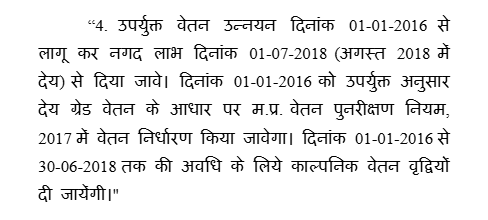
(ii) That, by issuance of the writ order or direction directing the respondents to extend the benefit of revised Grade Pay Rs.5400/- to the petitioner with effect from 1.1.2006 and Clause 4 of order Annexure P/2 may kindly be quashed/struck off the petitioner is also entitled for consequential benefits as the petitioner has been superannuated on 30.4.2017 so the pension and pensionary benefits may kindly be directed to be revised by extending the benefit of Grade Pay of Rs.5400/- from 1.1.2006, Rs.6600/- from 1.4.2006 and Rs.7600/- from 1.7.2014 and the outstanding arrears may kindly be directed to be paid along with interest at the rate of 12% per annum.
(iii) That, the respondents may kindly be directed to grant the third time scale to the petitioner from 1.7.2014 Rs.7600/-. and also granted the grade pay of
(iv) That, the respondents may kindly be directed to refix the pension of the petitioner after 1.1.2006.
(iv) That, any other just, suitable and proper relief, which this Hon'ble Court deems fit, may also kindly be granted to the petitioner. Costs be also awarded in favour of the petitioner.”
2. Petitioner submitted that relief pertaining to third time pay scale has already been extended to the petitioner, therefore, he has confined his relief only to grant the benefit of revised Grade Pay of Rs.5400/- to him w.e.f. 01.01.2006 and to quash Clause 4 of order dated 07.06.2018 (Annexure P-2).
3. Petitioner submitted that petitioner has retired from services in the month of April, 2017 from the post of Dy. Director Prosecution. Initially, petitioner was appointed on the post of Assistant Public Prosecutor, Class-II at Dewas. Thereafter, vide order dated 22.03.2007, petitioner was promoted on the post of District Public Prosecution Officer. He was further promoted on the post of Dy. Director Prosecution vide order dated 22.09.2012. During the service period, 6th Pay Commission came in force w.e.f. 01.01.2006 and as per 6th Pay Commission, petitioner's pay was fixed at pay Rs.16930+4200 = 21,130/- in the pay scale of Rs.9300-34800 + Grade Pay 4200/-.
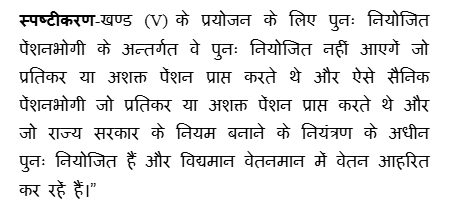
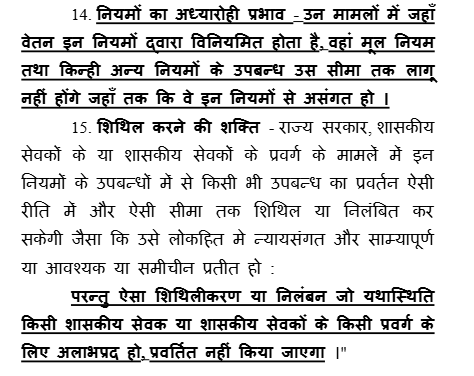
4. It is further submitted that as per Madhya Pradesh Pay Revision Rules, 2009 (in short “Rules, 2009”), all the Government Servants are required to get the benefit w.e.f. 01.01.2006 and Rule 14 provides that the Rules, 2009 is having overriding effect to other orders and submitted that as per Rule 15 of Rules, 2009, relaxation which is not beneficial for Government Servants, that cannot be relaxed or suspended and without considering the aforesaid aspect and contrary to Rules, 2009, a Committee has been constituted and as per committee recommendations, order dated 07.06.2018 has been issued, by which, as per Clause 4, the benefit of pay scale has been extended w.e.f. 01.01.2016 instead of 01.01.2006 and the benefit of such revised grade pay was sanctioned from 01.01.2016 and actual arrears were sanctioned to be given from 01.07.2018. Petitioner further submitted that the Rules, 2009 came into force w.e.f. 01.01.2006 and contrary to aforesaid, the order dated 07.06.2018 has been issued by the respondent and further submitted that Rule 15 of the Rules, 2009 provides that no order, which is detrimental to the benefit of employee or class of employee, shall be passed and Clause 4 of the impugned order is effected on petitioner's pay and it is not beneficiary/profitable to the petitioner, therefore, that cannot be issued and as the Rules, 2009 is having overriding effect over any other Orders/Rules, which may be passed by the State Government and further submitted that the Rules have statutory force and, therefore, cannot be overruled by an administrative order.
5. Per contra, learned Government Advocate submitted that the State Government, Finance Department, had accepted
AI



An indispensable Tool for Legal Professionals, Endorsed by Various High Court and Judicial Officers
Please visit our Training & Support
Center or Contact Us for assistance

Scan Me!
India’s Legal research and Law Firm App, Download now!


For Daily Legal Updates, Join us on :



 Back to top