1. Recruitment to public post — Written-qualified candidate — Non-submission of documents by cut-off despite extensions — Writ under Article 226 sought acceptance beyond deadline on illness ground. (Para 1 , 2 , 3 , 4 )
 Back
Next 


2026 Supreme(MP) 727
IN THE HIGH COURT OF MADHYA PRADESH AT INDORE
JAI KUMAR PILLAI, J.
Smt. Aaradhna Buj - Petitioner
Versus
The State of Madhya Pradesh and Others - Respondents
Writ Petition No. 39107 of 2024
Decided On : 21-01-2026
Advocates Appeared:
For the Petitioner: Shri Prasanna R. Bhatnagar, learned counsel.
For the Respondents:Ms. Drishti Rawal, learned Govt. Advocate, Shri Vindhyavashini Prasad Khare, learned counsel.
For the Petitioner: Shri Prasanna R. Bhatnagar, learned counsel.
For the Respondents:Ms. Drishti Rawal, learned Govt. Advocate, Shri Vindhyavashini Prasad Khare, learned counsel.
Terms of recruitment advertisements are sacrosanct; adherence to submission timelines is mandatory. Absent specific relaxation rules, medical grounds cannot justify delays, and participation under an interim order creates no vested right to appointment, ensuring compliance with Articles 14 and 16 of the Constitution of India.
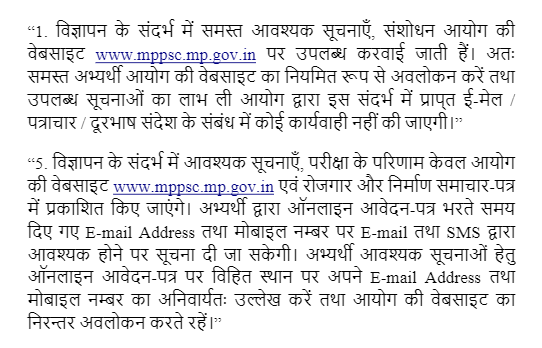
Headnote:(A) Constitution of India - Articles 14, 16 and 226 - Public Recruitment - Submission of documents - Adherence to timelines - Mandatory nature of advertisement terms - Terms of a recruitment advertisement are sacrosanct and cannot be diluted by judicial interpretation (Para 12). Responsibility to monitor the recruiting agency's website for results and instructions lies solely with the candidate (Para 12). Adherence to timelines for document submission is mandatory; failure to comply within the stipulated or extended period leads to cancellation of candidature to avoid uncertainties and prolonged selection processes (Paras 13, 16). Granting relaxation on medical or personal grounds in the absence of a specific enabling provision in the rules or advertisement violates the principles of equality and non-discrimination under Articles 14 and 16 (Paras 17, 18).
(B) Interim Orders - Effect on selection process - Participation in a selection process pursuant to an interim order of the Court does not confer any vested or equitable right upon the candidate. Such participation is at the candidate's own risk, and if the petition is ultimately dismissed, no relief can be granted based on such participation (Para 19).
Facts of the case:
A candidate participated in a selection process for a public post. Following the declaration of results, a specific deadline was set for the submission of documents, which was subsequently extended twice. The candidate failed to submit the documents within the original and extended timelines. A later representation citing medical grounds for the delay was rejected. An interim order had permitted the candidate to participate in the interview, with the result kept in a sealed cover.
Findings of Court:
The recruitment terms required candidates to regularly monitor the official website and adhere strictly to timelines. The failure to submit documents by the final cut-off date rendered the candidate ineligible. Medical grounds cannot be used to override mandatory recruitment conditions unless specifically provided for in the advertisement or rules. Furthermore, the selection process had already attained finality.
Issues: Whether the cut-off date for submission of documents in a public recruitment process is flexible on equitable or medical grounds; and whether participation in an interview under an interim order creates a vested right to appointment.
Ratio Decidendi: The court held that recruitment to public office must strictly follow the advertised procedure to ensure certainty, transparency, and equal opportunity. Terms of the advertisement are binding, and without a specific power of relaxation, the court cannot grant extensions, as doing so would violate the mandate of equality contained in Articles 14 and 16. Furthermore, participation under an interim order is conditional and does not create an enforceable right to appointment if the underlying petition is dismissed on merits.
Result: The writ petition is hereby dismissed being devoid of merit.
Legal Category Hierarchy
- administrative law
- constitutional law
- practice and procedure
Table of Contents
2. Candidate asserted illness excused delay and extended cut-offs showed flexibility; recruiting authority insisted timelines were mandatory, explanation was an afterthought, and interim participation gave no right. (Para 5 , 6 , 7 , 8 , 9 )
3. Writ petition dismissed; conditional interim order merged and conferred no vested right; pending applications disposed. (Para 25 , 26 , 27 )
4. Are the terms, conditions, and time-limits in a public recruitment advertisement binding on candidates and courts?
Yes. The advertised selection procedure and deadlines are mandatory and sacrosanct; a candidate participating with notice is bound by them. Courts cannot dilute or relax those terms by judicial interpretation unless the rules or advertisement expressly provide for relaxation, because doing so would violate Articles 14 and 16. (Para 11 , 12 , 13 , 14 , 18 , 24 )
5. What is the consequence of a candidate's failure to submit documents by the prescribed deadline after declaration of results?
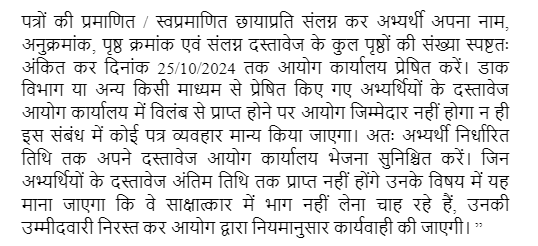
Failure to submit documents by the prescribed or extended deadline results in automatic cancellation of candidature; the candidate is deemed unwilling, and the recruiting commission becomes functus officio after the final date, with no correspondence on delay entertained. (Para 15 , 16 , 22 )
6. Can illness justify relaxation of a mandatory public-recruitment deadline?
No. In the absence of an express enabling provision in the advertisement or recruitment rules, illness is not a legally sustainable ground to override mandatory time conditions; individual relaxation would breach equality and discriminate against candidates who complied. (Para 17 , 23 )
7. Does participating in a selection process under an interim court order confer a vested right to appointment?
No. Participation pursuant to an interim order is at the candidate's own risk and creates no vested or equitable right. If the petition is dismissed on merits, the interim order merges with the dismissal and the concluded selection process is not reopened. (Para 19 , 21 , 25 )
8. Does the de minimis principle excuse every lapse by a candidate in a recruitment process?
No. The de minimis principle applies only to trivial clerical errors that confer no advantage and are not treated seriously by the recruiting authority; it does not excuse a clear breach of an expressly mandatory document-submission timeline. (Para 20 )
ORDER :
The present writ petition under Article 226 of the Constitution of India has been filed by the petitioner seeking a direction to the respondents, particularly Respondent No.2 (Madhya Pradesh Public Service Commission (PSC), to accept her documents beyond the prescribed cut-off date and to consider her candidature for appointment to the post of Assistant Professor (Botany) pursuant to Advertisement No. 17/2022 dated 30/12/2022.
2. It is the case of the petitioners that she belongs to Scheduled Tribe category possessing the requisite educational qualifications including clearing of State Eligibility Test (SET-2022), rendering her eligible for appointment to the post of Assistant Professor (Botany).
3. It is further contended by the petitioner that respondent No.2 issued an Advertisement No.17/2022 dated 30/12/2022 inviting applications for appointment to 126 posts of Assistant Professor (Botany). The petitioner submitted her online application on 12/04/2024 and appeared in the written examination conducted on 09/06/2024. The result was declared on 04/10/2024, wherein the petitioner was placed at Serial No.353 in the provisional merit list. Along with the result specific instructions were issued requiring provisionally selected candidates to submit their documents for verification on or before 25/10/2024, failing which their candidature would stand cancelled. The said period was extended twice, first with late fees of Rs.3,000/- and thereafter with late fees of Rs.25,000/- extending the final cut-off till 11/11/2024.
4. Further, the petitioner did not submit her documents either within the original period or within the extended periods. Subsequently, she submitted a representation dated 25/11/2024 citing her ill health as the reason for non-submission of documents which was rejected. Aggrieved thereby, the present writ petition was filed. By an interim order dated 16/12/2024, the petitioner was permitted to participate in the interview subject to final outcome of the petition.
5. Learned counsel for the petitioner contended that the petitioner is fully qualified and has successfully cleared the written examination, and therefore deserves consideration for appointment. It is argued that the petitioner was suffering from Mixed Connective Tissue Disease (MCTD), which prevented her from checking the result and submitting documents within time. Hence, the delay was neither deliberate nor intentional.
6. It is further submitted that since the Commission itself extended the last date multiple times on payment of late fees, the cut-off date cannot be treated as rigid or mandatory. Reliance has been placed on Vashist Narayan Kumar v. State of Bihar & Others, 2024 SCC OnLine SC 2 , 2024 (1) MPLJ 328, to contend that technicalities should not defeat substantive rights of a meritorious candidate. It is also contended that since the petitioner was permitted to appear in the interview by interim order and her result has been kept in sealed cover, denial of appointment would cause grave injustice.
7. Per contra, respondent No.2 (PSC) has contended that it is merely a recruiting agency and that the entire selection process is governed strictly by the terms and conditions of the advertisement and the instructions issued thereunder. It is submitted that the result dated 04/10/2024 clearly stipulated that all requisite documents were to be submitted on or before 25/10/2024, failing which the candidature of the concerned candidate was liable to be cancelled. Despite such an unequivocal stipulation, the petitioner failed to submit the documents within the prescribed time, even though two extensions were granted on payment of substantial late fees.
8. It has further been submitted that the petitioner remained inactive for a considerable period of about 37 days, i.e. from 04/10/2024 to 11/11/2024, and did not take any steps to comply with the requirements within the stipulated or extended time. Even thereafter, the petitioner merely submitted a represe