


1. Termination of contractual Sub-Engineer — Stigmatic order without departmental enquiry — Writ petition under Article 226. (Para 1 , 2 )

 Back
Back





IN THE HIGH COURT OF MADHYA PRADESH AT GWALIOR
ANAND SINGH BAHRAWAT, J.
Akal Singh – Petitioner
Versus
The State Of Madhya Pradesh Thr And Others – Respondents
Writ Petition No. 1549 of 2016
Decided On : 06-01-2026
1. Termination of contractual Sub-Engineer — Stigmatic order without departmental enquiry — Writ petition under Article 226. (Para 1 , 2 )
2. Petitioner: stigmatic termination without enquiry violates natural justice. State: services terminated under contractual terms after fact-finding enquiry. (Para 2 , 3 )
3. Writ allowed — impugned termination and appellate orders set aside — reinstatement — no backwages — liberty to proceed afresh. (Para 20 , 21 , 22 )
No. A stigmatic termination order cannot be issued without holding a regular departmental enquiry, as it entails serious consequences for the employee's future. (Para 5 , 6 , 7 , 8 , 9 , 10 , 11 , 12 , 13 , 17 )
An order is stigmatic if its language attributes misconduct, negligence, or inefficiency, or if evidence shows the termination was founded on allegations of misconduct, not merely contractual non-renewal. (Para 5 , 7 , 9 , 18 , 19 )
No. A quasi-judicial or administrative decision affecting a person prejudicially must record reasons; failure to do so is arbitrary and invalid. (Para 14 , 15 , 16 )
Yes. Reasonable opportunity includes the right to know charges, cross-examine witnesses, and make representation against proposed punishment before a stigmatic termination. (Para 8 )
Yes. Where a stigmatic termination order is set aside, the court may reinstate the employee but deny backwages on this principle, while granting notional seniority. (Para 21 )
ORDER :
ANAND SINGH BAHRAWAT, J.
This petition, under Article 226 of Constitution of India, has been filed seeking the following relief (s):
“1. That, the order dated 7.8.2015 passed by Respondent No.2 (Annexure P/1) & order dated 31.12.2014 passed by Respondent No.5 (Annexure P/5) may kindly be quashed and petitioner be permitted to continue on the post.
2. That, cost of the petition may kindly be granted.”
2. Learned counsel for petitioner submits that initially petitioner was appointed on the post of Sub-Engineer on 6.11.2006 by the order of Collector-cum-District Program Co-ordinator, Chhatarpur. Thereafter, petitioner was transferred to Datia. It is further submitted that petitioner has performed his duties sincerely and honestly and they were extended time to time. It is further submitted that respondent No. 4 who was personally biased against petitioner issued a show-cause notice dated 15.12.2014 with an ulterior and oblique motive as his illegal demands were not satisfied by petitioner. Thereafter, petitioner submitted the reply and denied all the allegations mentioned in the show-cause notice and specifically contended that the amounts were withdrawn by Sarpanch and Secretary and petitioner had only verified the work. It is further submitted that so far as Lanju Aadiwasi's case is concerned he himself had filed affidavit before competent authority and Sarpanch who was removed on the basis of same allegations has already got interim relief. It is further submitted that without considering the reply submitted by petitioner and without conducting a regular departmental inquiry, the concerned authority passed the order dated 31.12.2014, which is non-speaking and unreasoned, thereby discontinuing the services of petitioner by not extending his contractual services.
It is further submitted by learned counsel for petitioner that the impugned order Annexure P-2 dated 31.12.2014 is stigmatic in nature and that has been passed without considering the reply of petitioner, however, the stigmatic order cannot be issued without holding a regular departmental enquiry. Learned counsel for petitioner raised other grounds also.
3. Per contra, learned Government Advocate, while vehemently opposing the submissions put forth by learned counsel for petitioner, submitted that as per condition mentioned in appointment order, the services of petitioner who has been appointed on contractual basis for a particular period may be terminated even before expiry of contractual period and even without giving any notice. Learned Government Advocate further submitted that detailed fact finding enquiry has been conducted in respect of the complaint of negligence committed by Secretary as well as Sarpanch towards his official duties and the fact finding enquiry report was submitted before Chief Executive Officer and on the basis of fact finding enquiry respondent has passed the impugned order.
4. Heard learned counsel for the parties and perused the record.
5. The impugned order dated 31.12.2014 (Annexure P/2) is a stigmatic order, relevant extract of which is reproduced below for ready reference and convenience:-
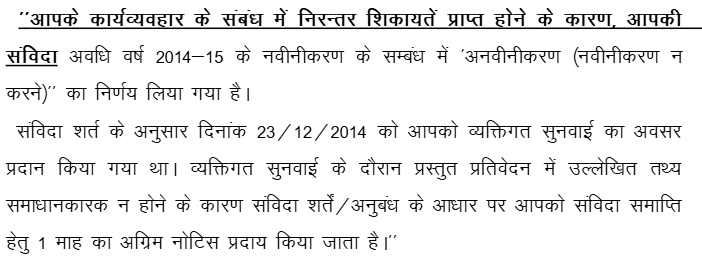
6. Before issuing impugned order dated 31.12.2014 Annexure P-2, the respondent has neither consider the reply to show-cause notice to petitioner nor regular department enquiry has been conducted and by stigmatic order services of petitioner have been terminated.
7. The services of petitioner have been terminated without holding any enquiry. Since impugned order Annexure P-2 dated 31.12.2014 is stigmatic in nature, therefore, regular departmental enquiry ought to have been held by respondents. The judgment passed by Co-ordinate Bench of this Court in WP No.23267/2019 (Omprakash Gurjar vs. Panchayat and Rural Development & Ors.), also the order dated 12.09.2023 passed in WP No.19117/2022 (Hukumchand Solanki vs. Panchayat and Rural Development & Ors.) and the order dated 19.07.2023 passed in WP No.14663/2022 (Arvind Malviya vs. State of MP & Ors.) are worth
AI



An indispensable Tool for Legal Professionals, Endorsed by Various High Court and Judicial Officers
Please visit our Training & Support
Center or Contact Us for assistance

Scan Me!
India’s Legal research and Law Firm App, Download now!


For Daily Legal Updates, Join us on :



 Back to top