Back
Back





2025 Supreme(Telangana) 946
IN THE HIGH COURT FOR THE STATE OF TELANGANA AT HYDERABAD
C.V. BHASKAR REDDY, J.
Dr.K.Manmohan Reddy - Appellant
Vs.
The State of A.P. rep. by Prl. Secretary to Government - Respondent
Civil Revision Petition Nos.5279, 5570, 5631, 5632, 5633, 5634, 5635, 5665, 5666, 5667, 5668, 5680, 5681, 5683, 5686, 5731, 5732, 5858, 6164, 6461, 6479, 6503, 6504 2016; 6, 210, 219, 377, 998, 999, 1070, 1071, 1188, 1588, 1882, 1938, 1951, 2046, 2437 and 3160 2017 and Writ Petition Nos.3860 of 2008, 6759 of 2017 and 11157 of 2019
Decided on : 06-10-2025
Advocate Appeared:
For the Appellant : C Hanumantha Rao
For the Respondent: GP For Revenue
Certainly. Based on the provided legal document, here are the key points summarized without referencing specific case law:
-
The proceedings involve complex disputes over land rights, tenancy status, and validity of transactions related to lands in Gachibowli Village, Hyderabad, with multiple petitions and revisions filed by tenants, landholders, and purchasers (!) (!) .
-
The core issue pertains to whether protected tenancy rights, recognized under the relevant tenancy laws, have been validly surrendered or extinguished through proceedings or transactions, including sales, compromises, and land ceiling declarations (!) (!) (!) .
-
Several orders and reports, including those by Revenue Divisional Officers and Land Reforms Tribunals, have historically recognized or questioned the status of tenants and the validity of surrender or alienation of land rights (!) (!) (!) .
-
The legal validity of sale deeds executed during pendency of tenancy proceedings, especially in violation of statutory procedures such as Section 38D, is a significant concern. Transactions not following prescribed procedures are considered void or invalid (!) (!) (!) .
-
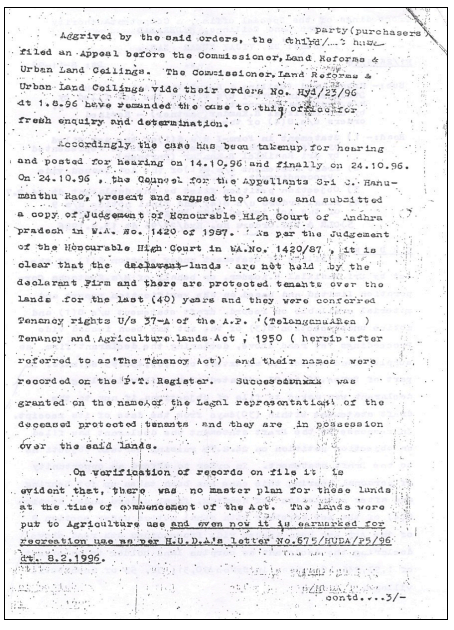
Notifications under land development laws, such as the notification for urban development, do not automatically extinguish tenancy rights unless specifically enacted under applicable law, and the rights vested under tenancy laws generally have overriding effect unless explicitly overridden by statutory notifications (!) (!) (!) .
-
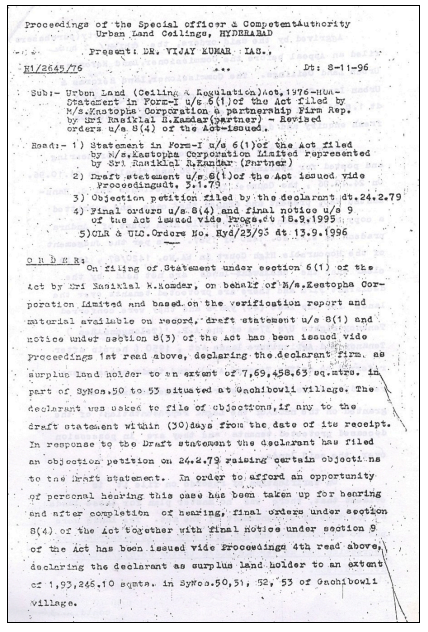
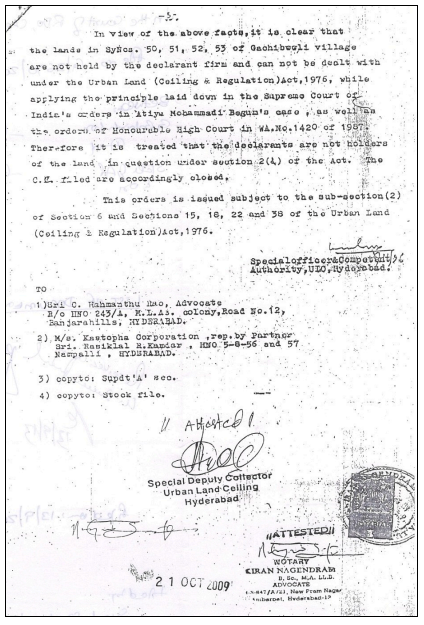
Orders and reports by authorities such as the Revenue Divisional Officer and Land Reforms Tribunal, which have been upheld in earlier proceedings, are considered binding and have attained finality. These orders include recognition of tenancy rights, surrender of rights, and determination of surplus land (!) (!) (!) .
-
The jurisdiction of revenue authorities to determine protected tenancy rights is limited to the scope of their statutory powers, and such powers do not extend to adjudicating title disputes or the validity of sale deeds executed in violation of statutory provisions (!) (!) .
-
The rights of protected tenants, once recognized and recorded in official registers, are protected unless valid surrender procedures are followed, and such rights are not extinguished by subsequent land ceiling or development notifications unless explicitly provided (!) (!) .
-
Sale transactions involving third parties that do not comply with statutory procedures, such as offering the land to protected tenants before alienation, are deemed invalid and do not affect the rights of the tenants or their successors (!) (!) .
-
The legal framework emphasizes that any transfer of land by a landholder to third parties without following statutory procedures, especially when protected tenancy rights are involved, is invalid and does not confer legal ownership or rights to the purchasers (!) (!) .
-
Orders passed by authorities that are based on reports or proceedings declared void or without jurisdiction are not sustainable. Such orders are subject to being set aside upon proper legal scrutiny, and the rights of the tenants as recognized in prior proceedings are to be maintained (!) (!) (!) .
-
The final orders in these proceedings uphold the rights of the tenants to ownership certificates under the relevant tenancy provisions, confining the extent of rights to the specific survey numbers and areas where valid tenancy and surrender procedures have been established (!) (!) .
-
The legal process underscores that rights acquired under the tenancy laws prior to land reclassification or urban development notifications remain protected unless explicitly nullified through lawful procedures. The rights of tenants are to be recognized and enforced in accordance with the statutory scheme (!) (!) .
-
The proceedings also highlight that the authorities’ powers are limited to the scope of their jurisdiction, and disputes over the validity of sale deeds or title are to be resolved through civil courts, not revenue authorities (!) (!) .
-
Overall, the legal findings favor the protection of recognized tenancy rights, invalidity of non-compliant transactions, and the importance of following statutory procedures for surrender, alienation, and recognition of tenancy rights. Orders based on proceedings declared void or without jurisdiction are set aside, reaffirming the rights of lawful tenants and the limited scope of revenue authorities in adjudicating title disputes.
ORDER :
C.V. BHASKAR REDDY, J.
The issues involved in these cases are intrinsically interconnected and therefore, they have been heard together and are being disposed of by this common order.
2. W.P.No.3860 of 2008 is filed seeking following relief:
“…to issue a Writ or order or orders more particularly one in the nature of Writ of Mandamus
i) to declare the exemption orders issued by the State Government in G.O.Ms.Nos.1816, dt.18.10.2005; 2183, dt.27.12.2005 etc., recommended by Special Officer and Competent Authority, Urban Land Ceiling, Hyderabad, approved building plans of Vice Chairman, HUDA(CDA), Hyderabad vide Lr.No. 13092/BP/CDA/2006, dt.15.5.2007 and the plan sanction approved for multi storied complex vide proceedings G/353/BP/2611/2007, dt.19.5.2007 of Deputy Municipal Commissioner, Serilingampally, Greater Hyderabad Municipal Corporation as illegal;
ii) to set aside the same as urged by the Joint Collector-1, Ranga Reddy District vide Lr.No.AO/W/264/75, dt.20.10.2007 as the respondents 12 to 33 have no right to transfer any inch of land in Sy.Nos. 35, 36, 37, 40, 42, 43, 44, 45, 46, 47 and 53 part of Gachibowli Village in view of the surrender of the tenancy claim in proceedings of the Tahsildar in proceedings No.A3/10805/64, dated 18.2.1965; A3/3749/65, dated 2.4.1965; A4/256/1966, dated 16.10.1966 and final list was also published stating that NIL tenancy and its confirmation through orders of Revenue Divisional Officer in LRW/47/75, dt.31.5.1975 and in view of the orders of Hon'ble Supreme Court in Civil Appeal Nos.6093/2006 and 7013/2006 and the status quo orders dt.8.9.2006 granted by the Hon'ble Supreme Court and consequentially;
iii) to direct the respondents 10 and 11 to stop all illegal construction over the disputed land and declare the fraudulent GPA of respondents 13 to 31 in favour of P.Venugopal Reddy the sale deeds bearing doc.Nos.2887/2003, to 2900/2003, executed on 10.3.2003 and sale deed bearing doc.nos. 4646/2001 to 4648/200, dt.27.6.2001, sale deed bearing doc.no.675/05, dt.29.8.2003, agreement of sale cum GPA doc.nos. 4513/2006, dt.22.6.2001, doc.no.10536/2006, dt.8.5.2005, development-cum-GPA doc.no.8355/06, dt.10.4.2006 and doc.no.4136/2006, dt.20.2.2006 and;
iv) declare the subsequent sale transactions in Sy.No.46 of Gachibowli Village are null and void in view of the fraud and statutory provision…”
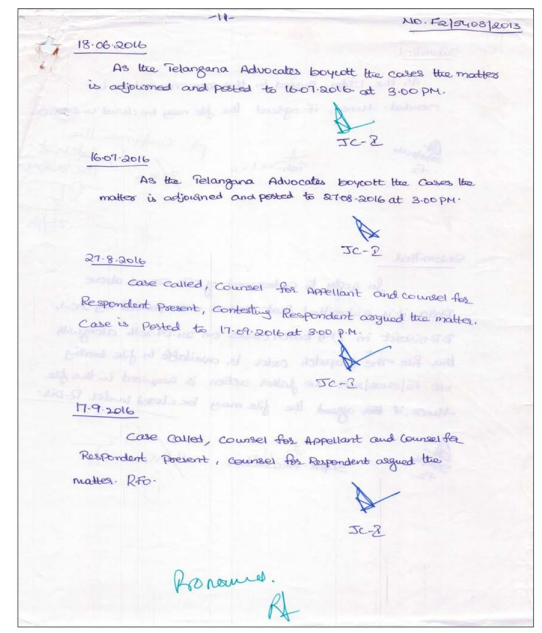
3. Civil Revision Petition Nos.5279, 5570, 5631, 5632, 5633, 5634, 5635, 5665, 5666, 5667, 5668, 5680, 5681, 5683, 5686, 5731, 5732, 5858, 6164, 6461, 6479, 6503, 6504 of 2016; 6, 210, 219, 377, 998, 999, 1070, 1071, 1188, 1588, 1882, 1938, 1951, 2046, 2437 and 3160 of 2017 under Section 91 of the Andhra Pradesh (Telangana Area) Tenancy and Agricultural Lands Act, 1950 (for short “the Tenancy Act, 1950”) are filed challenging the common order dated 24.09.2016 passed in Case No.F2/5408/2013 and batch, by the Joint Collector-I, Ranga Reddy District.
4. Mr.Yadaiah, (the petitioner, who filed C.R.P No.5279 of 2016), has filed Writ Petition No.6759 of 2017 seeking to declare the inaction on the part of officials of Greater Hyderabad Municipal Corporation (GHMC) in removing the illegal structures made by the unofficial respondents inspite of issuance of Notice No.2702/TPS/C- 11/WZ/GHMC/2017 as illegal, arbitrary and for other appropriate reliefs.
5. W.P.No.11157 of 2019 is filed by the petitioners seeking following relief:
“…to issue order or orders or direction or writ more particularly one in the nature of writ of Mandamus declaring the action of the 2nd respondent in passing impugned orders dt.24.09.2016 in F2/5408/2013 and batch setting aside orders of the 3rd respondent herein 15.10.2013 in proceeding No.G/2690/2013 as illegal, arbitrary and violative of Art14 21 and 300A of the Constitution of India and violative of principles of natural justice and consequently set aside the same and restore petitioners rights as per the orders dt.15.10.2013 in proceedings No.G/2690/2013 of the 3rd respondent…”
FACTS OF THE