
 Back
Back





IN THE HIGH COURT FOR THE STATE OF TELANGANA AT HYDERABAD
P.SAM KOSHY, SUDDALA CHALAPATHI RAO, JJ.
Anupama Chand – Appellant
Versus
Deputy Commissioner of Income Tax, Central Circle-4, Hyderabad – Respondent
Itta. Nos. 252, 253, 254, 255, 256, 257, 258, 259, 260, 261 & 262 of 2008, 136, 137, 138, 139, 140, 144 and 145 of 2010
Decided On : 30-01-2026
| Table of Content |
|---|
| 1. assessment appeals related to undeclared income. (Para 1 , 2 , 3 , 4 , 5 , 6) |
| 2. contentions relating to jurisdiction of cit(a) and procedural lapses. (Para 7 , 8) |
| 3. arguments regarding service and issuance of notices. (Para 12 , 17 , 24) |
| 4. judicial precedents asserting mandatory service of notice. (Para 13 , 14 , 15 , 18 , 19 , 20 , 21) |
| 5. court analysis of statutory requirements and consequences of non-compliance. (Para 30 , 31 , 32 , 33 , 39 , 40) |
| 6. final judgment on setting aside assessment orders. (Para 41 , 42 , 43 , 44) |
JUDGMENT:
Suddala Chalapathi Rao, J.
1. The present batch of (18) appeals is filed against the common order dt.15.02.2008 passed by the Income Tax Appellate Tribunal (hereinafter referred to as “the ITAT”) in respective appeals.
2. The details of the eighteen (18) appeals, the orders impugned, the assessment years involved, names of the appellants and the respondents, for convenience, are reproduced hereunder:
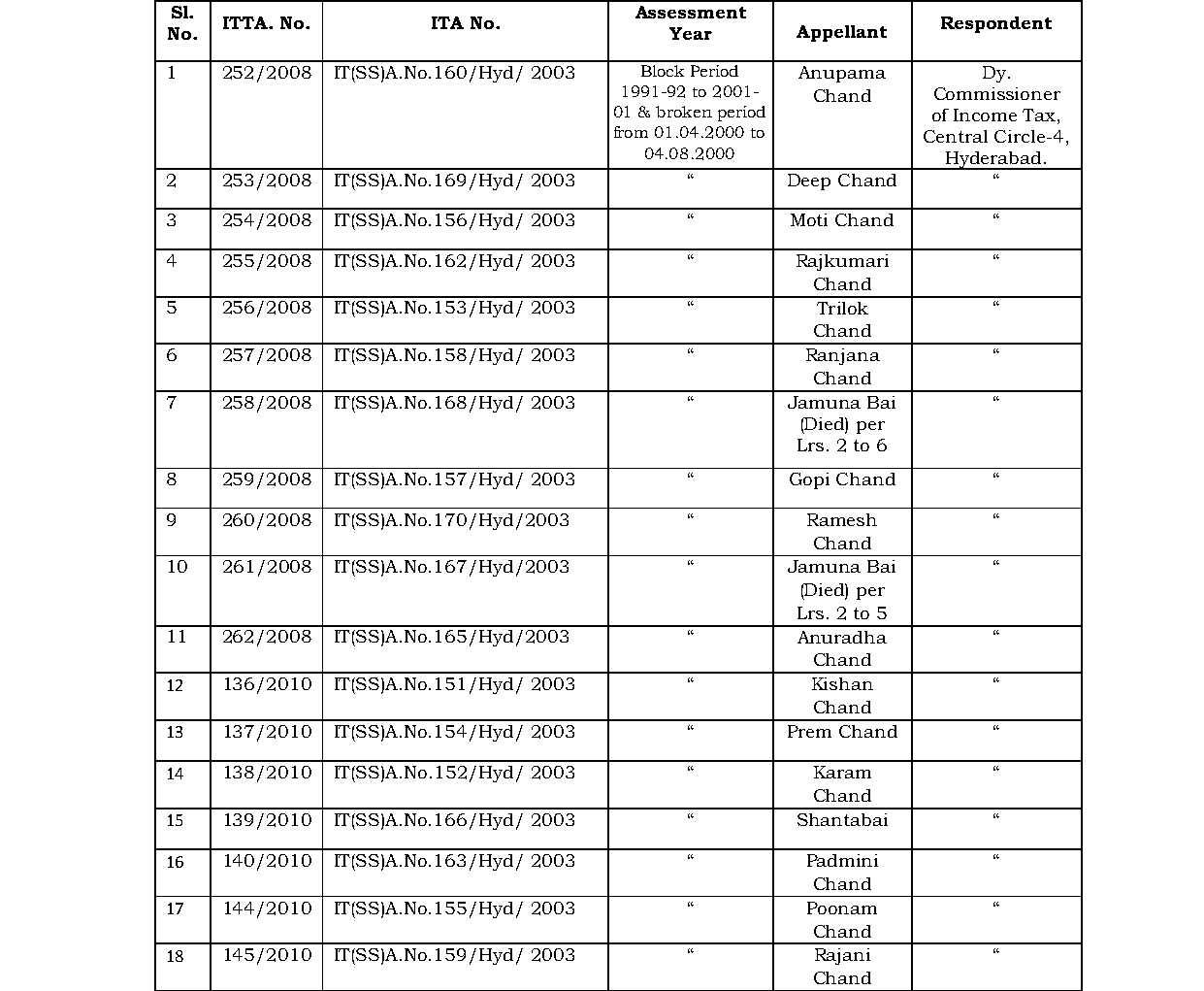
3. As all these eighteen appeals are similar in nature, arising out of identical factual circumstances and involving common questions of law emanating from eighteen separate assessment orders, which were carried in appeal before the Commissioner of Income Tax (Appeals) (for short ‘the CIT(A)’) and disposed of by separate orders, and since, notwithstanding minor variations in reasoning, the parties and the issues for consideration remained common and identical in all the cases, all the appeals have been heard analogously treating ITTA No.252 of 2008 as the lead case and are being disposed of by this common order.
Brief facts:
4. The brief facts of the case are that the appellants are individuals assessees deriving income from house property and such other sources of income. Further, on 04.08.2000, the Income Tax Department conducted search and seizure operations under Section 132 of the Income Tax Act, 1961 (hereinafter referred to as ‘the Act’) in the business premises of M/s Urvasi Enterprises (a partnership firm), M/s Urvasi Builders(an association of persons), M/s Sheeshamahal Enterprises Pvt. Ltd. (a company) and M/s The Commercial and Industrial Finance (P) Ltd. (a Company). Though no search warrant was issued and no search was conducted in the name of the respective appellants, however, the Assessing Officer initiated action on the appellants basing on the incriminating material alleged to have found in the search by issuing a notice under Section 158-BD of the Act on 19.12.2000 and assessed the undisclosed income pertaining to the block period of 10½ years i.e., from 01.04.1992 to 04.08.2000 (the date of search).
5. Thus, the block period consisted of assessment period of 10 assessment years from 1991-92 to 2000-01 and also for the broken period from 01.04.2000 to 04.08.2000. Consequent upon search, the respective appellants filed return in the prescribed form in Form No.2B on 09.01.2001 for the block period admitting ‘NIL’ undisclosed income under Section 158-B(b) of the Act. The Assessing Authority after issuance of notice under Sections 143(2) and 142(1) of the Act, taking into account all the relevant evidence, determined the undisclosed income for the block period as Rs.1,11,120/- (minor variations of amounts in other appeals) under Section 158-BC(c) r/w Section 143(3) and determined tax thereupon including surcharge and the assessment orders in the respective batch of appeals passing orders under Section 158-BD r/w 158-BC on 31.12.2002.
6. Aggrieved thereupon, all the assessees have filed appeals before the CIT(A) and the all the said appeals were dismissed by the CIT(A) on 21.10.2003, but however, the CIT(A) enhanced the undisclosed income and directed the Assessing Authority to take the said undisclosed income and collect the tax thereupon. Subsequently, all the assessees challenged the said appellate orders passed by the CIT(A) before the learned ITAT.
7. The brief contentions of the assessee before the Tribunal were that the CIT(A) has no jurisdiction to enhance the assessed
AI
Actual service of notice under Section 143(2) must occur within the statutory timeframe; mere issuance is insufficient for legal compliance, thus invalidating assessment proceedings.

Authorised officer may, during the course of the search or seizure or within a period of sixty days from the date on which the last of the authorisations for search was executed, make a reference to ....

Failure to issue notice u/s 143(2) after valid return (filed within COVID extensions) in reassessment proceedings renders assessment invalid and a nullity, as it is a mandatory jurisdictional require....

Issuance of notice u/s.143(2) is mandatory and sine qua non for valid reassessment u/s.143(3) r.w.s.147; its absence renders assessment void ab initio.

Failure to issue notice under Section 143(2) invalidates the assessment order, as it is a mandatory procedure under the Income Tax Act.


The court held that in cases of search under Section 132, the provisions of Section 153A apply mandatorily, overriding Section 147 and 148, unless incriminating material is found.



An indispensable Tool for Legal Professionals, Endorsed by Various High Court and Judicial Officers
Please visit our Training & Support
Center or Contact Us for assistance

Scan Me!
India’s Legal research and Law Firm App, Download now!


For Daily Legal Updates, Join us on :



 Back to top


