
 Back
Back





IN THE HIGH COURT OF KARNATAKA AT BENGALURU
G. Basavaraja, J.
Sri. Deepu @ Deepan - Appellant
Versus
The State of Karnataka By The Srirampuram Police Bangalore City - Respondent
Criminal Appeal No. 759 of 2013 (C)
Decided On : 03-11-2025
| Table of Content |
|---|
| 1. conviction and grounds for appeal (Para 4 , 6 , 8) |
| 2. arguments regarding trial court's judgment flaws (Para 9 , 11 , 12 , 13) |
| 3. judicial considerations on consent and evidence (Para 15 , 16) |
| 4. insufficiency of evidence for conviction (Para 21 , 22) |
JUDGMENT :
G. Basavaraja, J.
The appellant/accused has preferred this appeal against the judgment of conviction and order on sentence passed by the XLV Additional City Civil and Sessions Judge, Bengaluru City (CCH 46) in S.C. No.918/2007 dated 11.07.2013.
2. Parties in this appeal are referred to as per their rank before the Trial Court.
3. The brief facts leading to this appeal are that the Inspector of Police, Srirampura Police Station, laid the charge sheet against the accused for the offences punishable under Sections 376 and 417 of the Indian Penal Code (for short ' IPC ').
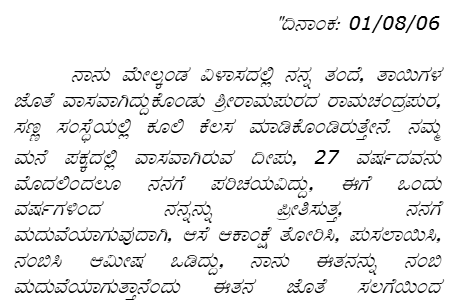
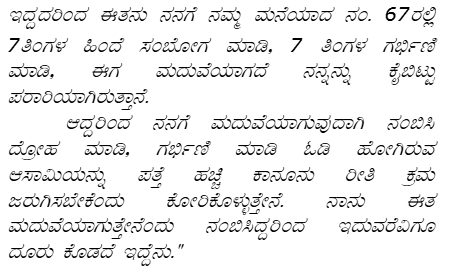
4. It is alleged by the prosecution that the accused and the prosecutrix were residing at Ambedkar Nagar, Srirampura, Bangalore. One year prior to 01.08.2007, the accused got acquainted with the prosecutrix, as he was staying near her house and used to visit the house of prosecutrix often. The accused promised the prosecutrix that he is in love with her and he would marry her and that promise developed a physical relationship. While the prosecutrix was alone in her house, the accused forcibly committed sexual intercourse with the prosecutrix, as a result, the prosecutrix became pregnant. On knowing about her pregnancy, the accused absconded from the place. Thereby, the accused has cheated the prosecutrix and caused loss to her reputation. Thus, he has committed the alleged offences.
5. After the filing of charge sheet, a case was registered in C.C. No.1135/2007. Thereafter, case was committed to the Court of Sessions, where it was registered in S.C. No.918/2007. Charges were framed against the accused for the alleged commission of the offences. The same were read over and explained to the accused. On understanding the charges, the accused pleaded not guilty and claimed to be tried.
6. To prove the case of the prosecution, 15 witnesses were examined as PW-1 to PW-15 and 9 documents were marked as Ex.P-1 to Ex.P9 and two reports were marked as Ex.C1 and Ex.C1(a). On closure of prosecution evidence, the statement of the accused under Section 313 of Cr.P.C. has been recorded, in which the accused has totally denied the evidence against him. However, he has adduced the evidence of DW1, Dr.Vinod Janardana Lakhappan.
7. The accused, in his written statement has stated that the Investigating Officer has falsely implicated him in this case. He further stated that he was not the father of the child. The blood samples were collected before the Court by the Doctors of K.C. General Hospital and thereafter, DNA test was conducted at the DNA Center, Madiwala. The Scientific Officer of the said Center has issued a report stating that the accused was not the biological father of the child-Vignesh, alleged to be the son of the prosecutrix.
8. The Trial Court, after considering the evidence, convicted the accused for the offences punishable under Sections 376 and 417 of IPC and sentenced the accused to undergo rigorous imprisonment for a period of seven years and to pay a fine of Rs.5,000/- for the offence under Section 376 . Further, the accused was sentenced to undergo simple imprisonment for a period of one year for the offence under Section 417 . Being aggrieved by the judgment of conviction and order on sentence, the appellant has preferred this appeal.
9. The learned counsel for the appellant submitted that the judgment of conviction and order sentence passed by the learned Sessions Judge is not maintainable and the same is liable to be set aside. It is contended that the learned Sessions Judge has passed the impugned judgment in a mechanical manner, without application of judicial mind and without properly analysing the evidence on record has blindly convicted the appellant for the offences punishable und
AI
The prosecution failed to prove the accused's guilt beyond reasonable doubt, as the trial court did not properly analyze evidence, particularly the DNA results excluding the accused as the biological....

A consensual relationship, even with a promise to marry, does not constitute rape if the other party is aware of the accused's marital status and consents willingly.

Consent obtained under a false promise of marriage from a minor is invalid, establishing the accused's guilt under relevant sexual assault laws.

Consent given under a misconception of fact does not equate to coercion; failure to marry post-consent does not invalidate original consent.

The central legal point established in the judgment is that a promise to marry leading to sexual intercourse, if proven to be a 'misconception of fact,' can lead to a conviction under Section 376 IPC....

Criminal Law - Charge of Rape - Conviction Upheld - Age of Prosecutrix - Victim was at her tender age when she met the appellant on her way to school. There is no evidence at all that they were in de....

Consent obtained under a false promise of marriage is invalid, constituting cheating under Section 417 of IPC.
Consent is determinative; insufficient evidence of victim's age undermines prosecution's case.

The conviction for rape under Section 376 IPC was overturned due to insufficient evidence of lack of consent and significant doubts raised by the circumstantial evidence.



An indispensable Tool for Legal Professionals, Endorsed by Various High Court and Judicial Officers
Please visit our Training & Support
Center or Contact Us for assistance

Scan Me!
India’s Legal research and Law Firm App, Download now!


For Daily Legal Updates, Join us on :



 Back to top


