Back
Back





2025 Supreme(Kar) 2009
IN THE HIGH COURT OF KARNATAKA AT BENGALURU
M. NAGAPRASANNA, J.
Sri Siddappa S/o Late Erappa - Appellant
Vs.
The State Of Karnataka - Respondent
Writ Petition No.22857 of 2024 (GM - CPC)
Decided On : 10-12-2025
Advocate Appeared:
For the Appellant :Sri R.K.Masur, Advocate
For the Respondent:Smt.Rashmi Rao, HCGP, Sri H.L.Pradeep Kumar, Advocate Sri M.V.Vedachala, Advocate
Compromise decrees can be set aside only upon strict proof of fraud; the obligation of non-alienation does not invalidate agreements for future transactions after the stipulated period. Schools of legal interpretation reinforce the finality of Lok Adalat awards unless proved otherwise.
Headnote:(A) Article 227 of the Constitution of India - Karnataka Land Reforms Act, 1961 - Sections 61 - Challenge to compromise decree and execution proceedings in respect of land granted with a non-alienation clause - Petitioners claim fraud and coercion in signing compromise document; however, no immediate objection was raised for 12 years - The Court held that the allegation of fraud needs strict proof, which was not established - Entry into agreement during the non-alienation period was not deemed a violation, as no sale was executed before expiry of 15 years. (Paras 4, 10, 61)
(B) Legal principles regarding the enforcement of a Lok Adalat's award - Such an award is considered final unless fraud can be demonstrably established and must not be set aside without sound reasoning. (Para 29)
(C) Principle of Government authority in acknowledging agreements beyond non-alienation provisions - Non-alienation does not preclude a future contract if it clearly stipulates execution post the designated period - No sale occurred until the 15-year period expired. (Paras 11, 12, 60)
| Table of Content |
|---|
| 1. overview of the case and parties involved. (Para 1 , 3) |
| 2. arguments regarding the nature of the agreement. (Para 4 , 5) |
| 3. court's analysis of validity and implications of the compromise. (Para 6 , 7 , 8) |
| 4. consideration of law guiding the enforcement of agreements. (Para 9 , 11 , 12) |
| 5. judicial standards for challenging lok adalat agreements. (Para 10) |
| 6. conclusion of case with court's final thoughts. (Para 14) |
ORDER :
M. NAGAPRASANNA, J.
The petitioners/defendants 1 to 5 who are the judgments debtors are at the doors of this Court calling in question entire proceedings pertaining to compromise decree dated 27-08-2011 passed in O.S.No.591 of 2011 and as a consequence thereof call in question entire execution proceedings in E.P.No.38 of 2012 and also seek a direction to reopen O.S.No.591 of 2011.
2. Heard Sri R.K. Masur, learned counsel appearing for the petitioners, Smt. Rashmi Rao, learned High Court Government Pleader appearing for respondents 1 to 4, Sri H.L.Pradeep Kumar, learned counsel appearing for respondent No.6 and Sri M.V. Vedachala, learned counsel appearing for respondent No.7.
3. Facts, in brief, germane are as follows: -
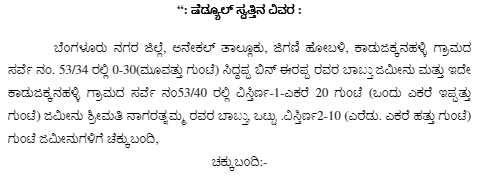
3.1. Before embarking upon consideration of the issue involved, I deem it appropriate to notice the protagonists to the lis. The 1st petitioner is one Siddappa, judgment debtor No.1, repository of the family; petitioner No.2 one Smt. Nagarathnamma, judgment debtor No.2 is the wife of the 1st petitioner; petitioner No.3, Smt. Nethravathi S, judgment debtor No.3; petitioner No.4, Smt. Nirmalamma, judgment No.4 and petitioner No.5, Smt. Renuka, judgment No.5 are all children of petitioners 1 and 2. Respondent No.7, key protagonist is the father of sister-in-law of petitioner No.2. He is the decree holder. Petitioners 1 and 2 were granted suit schedule lands. Pursuant to issuance of land grant certificates they were to cultivate the lands through saguvali chits. The 1st petitioner was granted 30 guntas of land in Sy.No.53/34 and the 2nd petitioner was granted 1 acre and 20 guntas of land in Sy.No.53/40. The revenue entries after such grant were mutated in the names of petitioners 1 and 2. They were put in physical possession of the property on the strength of aforesaid saguvali chits. 13 years pass by. The 7th respondent/decree-holder is said to have accepted the request of petitioners 1 and 2 to grant some loan owing to their financial difficulties.
3.2. It is the averment in the petition that the petitioners who were not educated, signed on the document, thinking that it was a loan document to be executed by them. So, they were taken to the office of the Sub-Registrar and the document is registered in the name of the 7th respondent. On two different dates, petitioners 1 and 2 received certain amounts of money from the hands of the 7th respondent to be the consideration of the document so executed. A suit then comes to be filed by the 7th respondent seeking specific performance of the contract and a consequent direction to the petitioners to execute the sale deed in favour of the 7th respondent in terms of the agreement that stood registered on 07-06-2010. Both the parties, four days thereafter, were referred to Lok Adalat and before the Lok Adalat on 27-08-2011 a compromise was arrived at on a compromise petition being preferred. The Lok Adalat accepts the compromise petition and decrees the suit in terms of the compromise entered into between the parties with a direction to draw up a decree on the said score. All these things happen during the period of non-alienation clause.
3.3. When the lands were granted in favour of petitioners 1 and 2, it was indicated that they should not alienate the property prior to the expiry of 15 years. The said period was to expire on 20-05-2012. Sale deed was not executed pursuant to the decree. On 11-10-2012, the 7th respondent files execution petition in Execution Petition No.38 of 2012. It is at that juncture the petitioners claim that they came to kn