
 Back
Back





IN THE HIGH COURT OF KERALA AT ERNAKULAM
RAJA VIJAYARAGHAVAN V, K. V. JAYAKUMAR, JJ.
Vazhuthanam Sri. Mahavishnu Bhakthajana Samithy – Petitioner
Versus
State Of Kerala Represented By The Secretary Department Of Revenue (Devaswom) – Respondent
WP(C) NO. 35811 OF 2025
Decided On : 07-04-2026
| Table of Content |
|---|
| 1. petitioners challenge shanthi's continuation despite vigilance issues. (Para 2 , 3) |
| 2. respondents deny claims, assert karaima rights and enmity. (Para 5 , 6 , 8 , 9 , 10) |
| 3. issues: maintainability and relief grantability. (Para 11 , 12 , 13 , 14 , 15 , 16) |
| 4. 21-year delay in challenging 2004 communication. (Para 17 , 18 , 19 , 20 , 21) |
| 5. delay and laches bar writ relief. (Para 22 , 23 , 24) |
| 6. no locus standi; disputed facts unfit for writ. (Para 25 , 26 , 27) |
| 7. no mandamus for disciplinary action; petition dismissed. (Para 28 , 29 , 30) |
JUDGMENT
K. V. Jayakumar, J.
This Writ Petition is filed under Article 226 of the Constitution of India .
2. The 1st petitioner is an association of devotees of the temple, namely Vazhuthanam Sree Mahavishnu Temple (for the sake of brevity, “the temple”), which is registered as Samithy under the Travancore-Cochin Literary, Scientific and Charitable Societies Registration Act, 1955 . The 2nd petitioner is the President of the said Samithy. Ext. P1 is the true copy of the Memorandum of Association and byelaw of the samithy dated 23.02.2025.
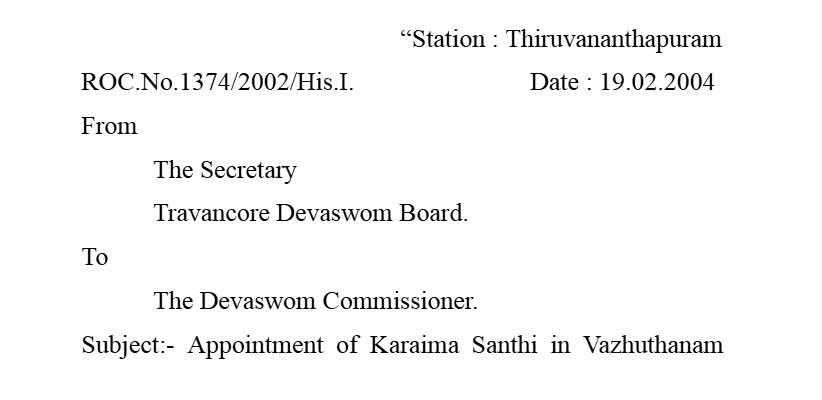
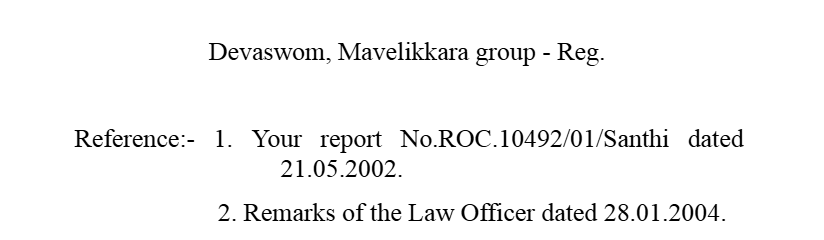
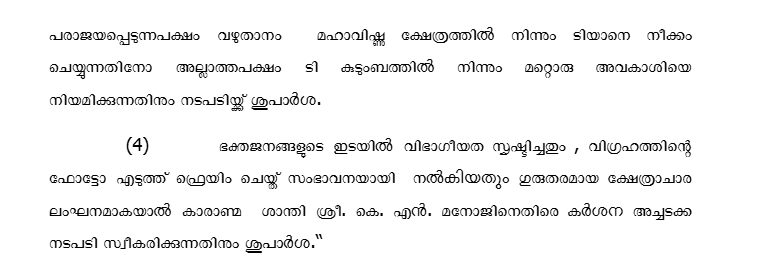
3. The petitioners state that the 9th respondent, Sri K.M. Manoj is the Melshanthi of the temple who is serving in the temple even after the age of superannuation, claiming to be a Karaima shanthi.
4, The petitioners assert that respondents 1 to 3 have not taken any action against the 9th respondent and allowed him to continue as Melshanthi of Vazhuthanam Sree Mahavishnu Temple, despite an adverse vigilance report issued against him in the enquiry conducted by the 5th respondent, the Chief Vigilance and Security Officer, TDB. With these assertions, the petitioners approached this Court seeking the following reliefs:
“(i) Call for the records leading to Ext.P8 and may set aside the same by issuing a writ of certiorari.
(ii) Issue a writ in the nature of mandamus or any other appropriate writ, order or direction directing the respondents 2 to 4 to initiate disciplinary action against the 9th respondent pursuant Ext. P6 and P11 reports and conclude the same within a time limit fixed by this Hon’ble Court.
(iii) Issue a writ in the nature of mandamus or any other appropriate writ, order or direction directing to remove the 9th respondent from the service of the 2nd respondent, because he is having no karaima right.”
5. The 2nd respondent, Travancore Devancore Board represented by its Secretary, filed a counter affidavit refuting the allegations in the writ petition. The 2nd respondent contended that the writ petition is not maintainable either in law or on facts. The 2nd respondent asserted that the petitioners have no locus standi to file this writ petition and to seek the reliefs.
6. It is stated in the counter that the 1st petitioner, being an association, is unauthorisedly interfering with the administration of the temple which is managed by the Travancore Devaswom Board. The 2nd respondent asserted that the 1st petitioner is a parallel committee or organisation which cannot function in the temple premises without the approval of the Board.
7. It is contended that the 9th respondent, Sri K. M. Manoj, is a member of Karippuram Illam, which holds the karaima right to depute Melshanthis to the temple, and that he has been serving in that capacity at the temple since 2004. It is stated in the counter affidavit that on 19.02.2018, the Vigilance Security Officer submitted a report stating that the 9th respondent failed to open the temple on time and also commented on his behaviour. Thereupon, a show cause notice was issued to him and he submitted a reply.
8. The learned Ombudsman has forwarded a copy of the complaint submitted by the 2nd petitioner against the 9th respondent, alleging that he is continuing in the job unauthorisedly, making false complaints, and disrupting the renovation activities of the temple. The 4th respondent, the Commissioner of Devaswom, has forwarded the complaint to the Assistant Devaswom Commissioner. The Assistant Devaswom Commissio

Writ petition dismissed for 21-year delay, lack of locus standi, and disputed facts unfit for Article 226 jurisdiction.

The availability of an alternative remedy of appeal before the Commissioner under Section 69 of the HR and CE Act rendered the writ petition not maintainable.

The court established that disputes regarding hereditary claims and functions related to temple duties should be resolved in civil court rather than through writ jurisdiction, emphasizing the secular....

The necessity for administrative bodies to provide clear reasoning for their decisions is fundamental to ensuring compliance with the principles of natural justice.

The main legal point established in the judgment is the requirement for relief sought in writ petitions to be within the scope of the general direction contained in the order of the Apex Court dated ....
Writ petitions concerning the administration of religious institutions must adhere to the statutory framework provided by relevant laws, rather than seeking relief through Article 226.
The court upheld the authority of the Administrative Committee in temple management and affirmed the validity of ongoing disciplinary proceedings against the appellant.



An indispensable Tool for Legal Professionals, Endorsed by Various High Court and Judicial Officers
Please visit our Training & Support
Center or Contact Us for assistance

Scan Me!
India’s Legal research and Law Firm App, Download now!


For Daily Legal Updates, Join us on :



 Back to top


