


 Back
Back





2025 Supreme(Mad) 2766
IN THE HIGH COURT OF JUDICATURE AT MADRAS
S.SRIMATHY, J.
Muthukumar – Appellant
Versus
Pari – Respondent
C.R.P(MD)Nos.706 & 986 of 2020
Decided On : 28-10-2024
For the Appellant : Mr.PT.S. Narendravasan
For Respondent: M/s.M. Sakundala Devi
A judgment must contain a concise statement of the case, points for determination, decision, and reasons, failing which it is deemed ex facie illegal. The High Court may set aside such judgments to ensure justice.
Headnote:(A) Civil Procedure Code - Section 2(9), Order 20 Rules 4(1) & (2) - Cryptic and unreasoned judgments - The trial court failed to analyze the merits of the suit for specific performance and did not justify the ex parte decree passed against the defendant - A judgment must contain a concise statement of the case, the points for determination, the decision thereon, and the reasons for such decision. (Paras 6, 9, 10, 11, 15)
(B) Jurisdiction of the High Court - Under Article 227, the High Court can interfere with ex facie illegal judgments - To ensure justice and avoid perpetuating illegality, the High Court may also provide opportunities for parties to contest. (Paras 15, 16)
Facts of the case:
The appellant challenged the trial court's ex parte decree in a suit for specific performance, alleging that the decree was passed without substantial reasoning or analysis of the case.
Findings of Court:
The trial court's judgment was found to be cryptic and failed to meet the requirements of the Civil Procedure Code, leading to the conclusion that the decree was ex facie illegal.
Issues: The court framed the issue regarding the mandatory contents of a judgment, particularly in cases of ex parte decrees.
Ratio Decidendi: The court mandated that judgments should comprehensively address all pertinent matters to fulfill procedural requirements; the judgment in question lacked these essential elements.
Result: Civil Revision Petitions allowed; the trial court's order set aside.
| Table of Content |
|---|
| 1. overview of civil revision petitions (Para 1 , 2 , 4) |
| 2. defendant's failure to appear and request for decree dismissal (Para 3 , 5) |
| 3. requirements for a valid judgment under cpc (Para 7 , 8 , 9) |
| 4. judgment requirements and criticisms of trial court's reasoning (Para 10) |
| 5. principles informing reversal of moving court judgments (Para 11 , 12 , 15) |
| 6. final ruling to set aside lower court's order, granting re-evaluation (Para 16) |
ORDER :
S.SRIMATHY, J.
1.The issue involved in both the Civil Revision Petitions are arising out of the suit filed in O.S.No.142 of 2001 and hence the following common order is passed.
2(i). The Civil Revision Petition in C.R.P.(MD)No.706 of 2020 is filed by the defendant in the suit to set aside the Fair and Decreetal Order, dated 01.02.2020 passed in E.A.No.41 of 2018 in E.P.No.10 of 2010 in O.S.No.142 of 2001 on the file of the Subordinate Court, Paramakudi. The said E.A.No.41 is filed inter alia praying to return of articles found in the inventory report dated 07.05.2013.
2.(ii). The Civil Revision Petition in C.R.P.(MD)No.706 of 2020 is filed by the defendant in the suit to set aside the Fair and Decreetal Order, dated 01.02.2020 passed in E.A.No.90 of 2013 in E.P.Nos.10 of 2010 in O.S.No.142 of 2001 on the file of the Subordinate Court, Paramakudi. The petition in E.A.No.90 of 2013 is filed under section 47 of CPC to dismiss the execution petition.
3. The defendant in the suit is the revision petitioner herein and the plaintiff in the suit is the respondent herein in both the revision petitions. For sake of convenience, the parties are referred as plaintiff and defendant as per the ranking in the suit.
4. The suit in O.S.No.142 of 2001 was filed for specific performance. The defendant after receiving notice had entered appearance and filed written statement. Thereafter failed to appear for trial. Hence, the defendant was called absent and exparte decree was passed. Based on the decree, the plaintiff had filed E.P.No.10 of 2010.
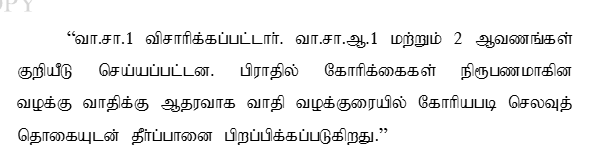
5. In the meanwhile, the defendant had preferred petitions to set aside the exparte decree along with delay condonation petition and the same were dismissed. Thereafter, the defendant had filed E.A. No.90 of 2013 taking a plea that even though it is an exparte decree the Trial Court ought to have discussed the case on his written statement and on merits. But the Trial Court has passed only three line judgment and the same is extracted hereunder:
7. Under section 2(9) of CIVIL PROCEDURE CODE the word “judgment” is defined, wherein it states “judgment means the statement given by the judge on the grounds of a decree or order”.
8. Under Order 20 Rules 4 (1) & (2) are also referable, which read as under:-
“4. Judgment












