


1. Challenge to Industrial Tribunal award allowing wage revision demands and arrears from date of demand. (Para 1 , 4 )

 Back
Back





IN THE HIGH COURT OF JUDICATURE AT MADRAS
Honourable Mrs.Justice N. MALA
THE MANAGEMENT OF – Appellant
Versus
UNITED LABOUR FEDERATION – Respondent
W.P.No.24999 of 2023 and W.M.P.No.24418 of 2023
1. Challenge to Industrial Tribunal award allowing wage revision demands and arrears from date of demand. (Para 1 , 4 )
2. Dispute over whether wage revision was justified and whether industry-cum-region principle and financial capacity were properly considered. (Para 5 , 6 , 11 )
3. Writ petition dismissed; Industrial Tribunal award upheld. (Para 24 , 25 )
Wage revision is justified if wages paid are not commensurate with the rise in cost of living, as determined by evidence. (Para 13 )
Industry-cum-region principle requires comparison with similar industries in the region, but if foundational data is absent, the Tribunal may adopt other reasonable methods. (Para 14 , 15 )
The tribunal must consider overall financial position including turnover, profits, depreciation as non-cash expense, and not be swayed by isolated losses. (Para 18 , 19 )
The tribunal has discretion to fix the effective date, often from the date of demand, and courts will not interfere unless the discretion is arbitrary. (Para 20 , 21 , 22 )
Certiorari is limited to correcting errors of jurisdiction or patent errors on the face of the record, not as an appellate remedy. (Para 23 )
ORDER
This writ petition is filed for a writ of Certiorari to call for the records in the award dated 23.05.2023 of the Industrial Tribunal in I.D.No.42 of 2017 and quash the same as illegal.
2. The petitioner will be referred to as the Company and the respondent will be referred to as the union.
3. The company is a Tier- II company employing more than 600 workers in its factory. The company is engaged in manufacture of automobile spare parts such as bearings, welding equipment supplies, gears and gear boxes, hoses, springs V-belts, etc. while so, the union raised 22 demands before the Assistant Commissioner of Labour, Conciliation - II, Sriperumbudur. The conciliation ended in failure as no settlement was reached. The conciliation failure report was submitted by the Conciliation Officer on 07.10.2016, to the Government of Tamil Nadu. The Government of Tamil Nadu rejected 12 demands out of the 22 demands, vide G.O.D.No.567 dated 14.09.2017 and referred 10 demands to the Industrial Tribunal. The Tribunal vide impugned award dated 23.05.2023 allowed the following demands:
(i) Demand No.1 Basic Salary
(ii) Demand No.2 Variable Dearness Allowance
(iii) Demand No.5 Conveyance Allowance
(iv) Demand No.8 Night Shift Allowance
(v) Demand No.9 Educational Allowance
4. The Tribunal further directed that the award shall be enforced with effect from 18.09.2015 i.e., date of demand and the dues to the workmen covered under the disputed shall be disbursed within a period of two months from the date of publication of the award. Aggrieved by the said award of the Tribunal, the company has filed the above writ petition for the aforesaid relief.
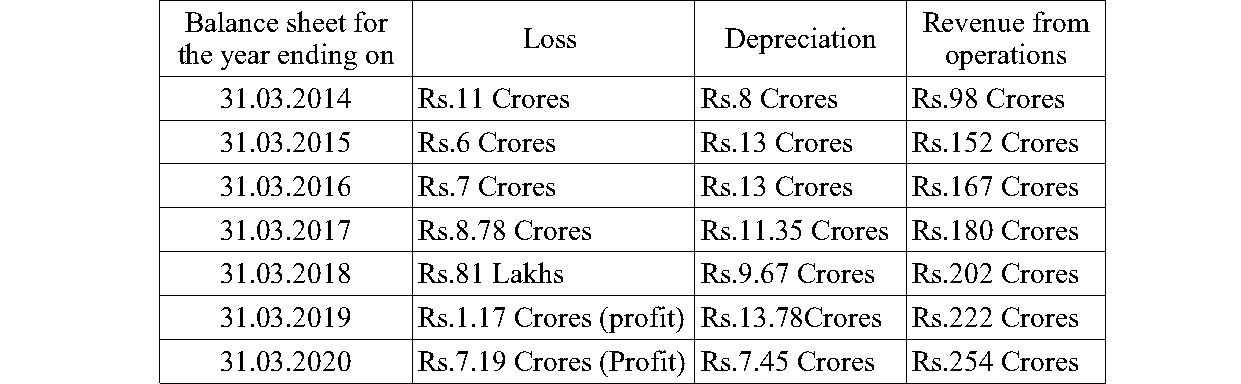
5. The learned counsel for the petitioner submitted that the Tribunal erred in allowing Demand Nos.1, 2, 4, 8 and 9. The counsel submitted that the Tribunal failed to apply the principle of industry-cum-region while fixing the wages on revision and further failed to consider the financial burden on the company for discharging the liability from the date of demand i.e., 18.09.2015. The learned counsel submitted that the award of the Tribunal, insofar as it relates to Demand Nos.1, 2, 4, 8 and 9 is erroneous and against the evidence on record. The learned counsel further submitted that the Tribunal failed to note that the balance sheets marked as Exhibit M53 to M58 clearly established that the company was incurring loss right from the year 2014-2015. The counsel submitted that the learned Judge erred in concluding that the company was making profit by merely taking the annual turnover, without making any provision for deductions or depreciations. The learned Counsel therefore submitted that the award of the Tribunal was illegal and deserved to be set aside.
6. The learned Senior counsel for the respondent submitted that the award of the Tribunal was a well considered and reasoned Award. The learned Senior counsel submitted that the Tribunal adopted the right principles while allowing fair wages and therefore, this Court exercising jurisdiction under Article 226 of the Constitution of India, should not interfere with the same as an Appellate Court. The learned counsel therefore submitted that the writ petition lacks merits and the same deserves to be dismissed.
7. I have considered the rival submissions made by the learned counsel on either side and perused the materials placed on record.
8. The primary contention of the learned counsel for the respondent is that there are absolutely no pleadings on the issue of financial burden of the Company in the counter statement filed to the claim petition, and therefore, in the absence of a basic pleading, the contention should be rejected at the threshold. The Hon'ble Supreme Court in the case of Shankar Chakravarti Vs. Britannia Biscuit Co.Ltd reported in 1979 SCR (3) 1165, held that “the rules of fair play demand that where a party seeks to establish a contention which if proved would be sufficient to deny relief to the opposite side, such a contention has to be specificall



An indispensable Tool for Legal Professionals, Endorsed by Various High Court and Judicial Officers
Please visit our Training & Support
Center or Contact Us for assistance

Scan Me!
India’s Legal research and Law Firm App, Download now!


For Daily Legal Updates, Join us on :



 Back to top