
 Back
Back





IN THE HIGH COURT OF JUDICATURE AT MADRAS
MANINDRA MOHAN SHRIVASTAVA, CJ., G.ARUL MURUGAN, J.
Reliance Jio Infocomm Ltd Rep by its Power of Attorney Holder Kumar Jayaraman – Petitioner
Versus
Union of India Through the Secretary, Department of Revenue – Respondent
WP Nos. 27038 and 28371 of 2025 and WMP Nos. 30334, 30336, 30338, 30341, 31776, 30330, 30332, 31768, 31770, 31771, 31772 and 31773 of 2025
Decided On : 05-03-2026
| Table of Content |
|---|
| 1. factual background of the case (Para 1) |
ORDER :
MANINDRA MOHAN SHRIVASTAVA, CJ.
In W.P.No.27038 of 2025, the challenge is to the validity of Rule 39(1)(a) of the Central Goods and Services Tax Rules, 2017 and Rule 39(1)(a) of the Tamil Nadu Goods and Services Tax Rules, 2017 in respect of two periods, viz., prior to 01.04.2025 and thereafter, as 01.04.2025 is the date on which the amendments to Section 20 of the Central Goods and Services Tax Act, 2017 and the Tamil Nadu Goods and Services Tax Act, 2017 were brought into effect. The petitioner also sought quashment of the show cause notice dated 27.6.2025.
2. In W.P.No.28371 of 2025, the petitioner calls into question the validity of Rule 39(1)(a) of the Central Goods and Services Tax Rules, 2017 and Rule 39(1)(a) of the Puducherry Goods and Services Tax Rules, 2017 in respect of two periods, viz., prior to 01.04.2025 and thereafter, as 01.04.2025 is the date on which the amendments to Section 20 of the Central Goods and Services Tax Act, 2017 and the Puducherry Goods and Services Tax Act, 2017 were brought into effect. The petitioner also prayed for setting aside the show cause notice dated 26.6.2025.
3. As the provisions under challenge in both the writ petitions are one and the same, we shall take up W.P.No.27038 of 2025 as lead case to decide the issues raised.
4.1. An apércu of the facts relevant reads thus: The petitioner, a company incorporated under the Companies Act, 1956, is engaged in the business of providing telecommunication services and was granted separate GST registrations in each State and Union Territory from where it supplies telecommunication services. According to the petitioner, each such registration is treated as a distinct person.
4.2. It is averred that the CGST/TNGST laws provide for a concept of Input Service Distributor (ISD) and in cases where an assessee has several units and there are common service providers, it is necessary that the credit in respect of input services is distributed so that the entire credit is not taken by the Head Office alone. The Input Tax Credit (ITC), as per law, is to be distributed pro rata on the basis of turnover of the individual units in the preceding financial year. As each branch office in a State has to be separately registered, the petitioner has 36 registrations in almost all the States/Union Territories.
4.3. It is stated that before 01.04.2025, Section 20 of the CGST Act did not empower the Central Government to prescribe the time limit within which the ISD was required to distribute credit. The power to do so was introduced with effect from 01.04.2025 by insertion of the phrase “within such time and subject to such restrictions and conditions as may be prescribed” in (2) of the CGST Act. It is further stated that, as per the said amendment, ITC has to be distributed by an ISD in the same month as the date of the underlying input service invoice.
4.4. The plea of the petitioner is that, for the period prior to 01.04.2025, respondent Nos.2 and 3 do not have the power to prescribe a time limit for distribution of ITC by an ISD unit and, therefore, the provisions of Rule 39(l)(a) of the CGST Rules/TNGST Rules purportedly stipulating that the ITC has to be distributed in the same month as the month in which the underlying input service invoice was issued, are beyond the scope and powers vested by the parent legislation.
4.5. It is the further case of the petitioner that the purported stipulation that ITC has to be distributed in the same month as the month in which the underlying input service was issued is not only impossible to fulfill, but also arbitrary and unreasonable, as the ISD is not only required to determine to which recipient unit the input service invoice is attributable to, but also whether the said input service invoice pertains to eligible credit or ineligible credit and whether the conditions under the CGST Act/TNGST Act have been fulfilled qua such invoices. When Section 16 (4) of the
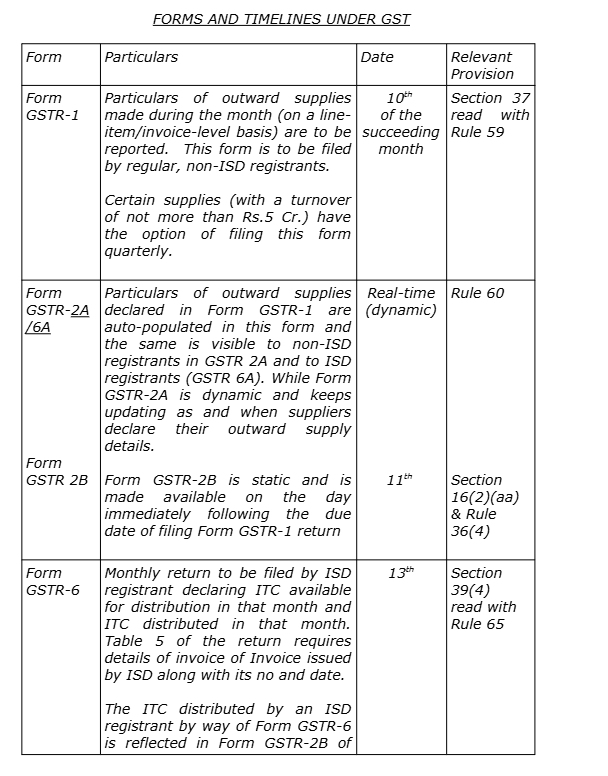
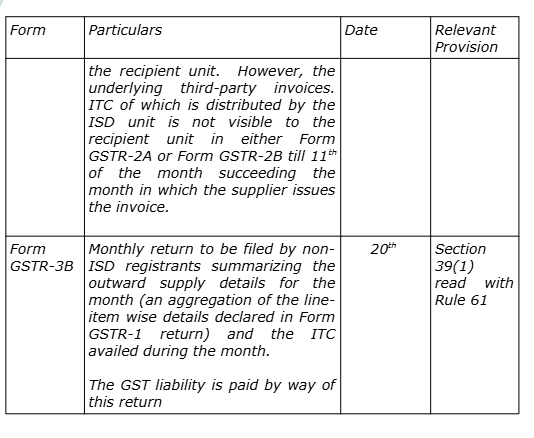
The court holds that distribution of Input Tax Credit must comply with eligibility conditions under Section 16 of the CGST Act, reinforcing that arbitrary distribution timelines are invalid.

The court ruled that Rule 39(1)(a) of the CGST Rules is ultra vires Section 20 of the CGST Act, prohibiting the imposition of mandatory timelines on Input Tax Credit distribution rights.

An entity discharging tax liability under the reverse charge mechanism qualifies as the 'recipient' entitled to input tax credit. The Input Service Distributor mechanism was optional prior to legisla....


Section 16(4) of the CGST Act is constitutionally valid and does not violate Articles 14, 19(1)(g), or 300A of the Constitution.

Input Tax Credit (ITC) is a concession/benefit/rebate and the legislature is within its competency to impose certain conditions, including time prescription for availing such right.



An indispensable Tool for Legal Professionals, Endorsed by Various High Court and Judicial Officers
Please visit our Training & Support
Center or Contact Us for assistance

Scan Me!
India’s Legal research and Law Firm App, Download now!


For Daily Legal Updates, Join us on :



 Back to top


