
 Back
Back





IN THE HIGH COURT OF JUDICATURE AT MADRAS
C. Saravanan, J.
Union Bank of India, (Erstwhile – Andhra Bank), Stressed Assets Management Branch, Represented by its Chief Manager - Petitioner
Versus
Commissioner, Income Tax Department – Respondent
W.P.Nos.1587 and 1593 of 2024 and W.M.P.Nos.1616, 1617, 1624 and 1625 of 2024
Decided On : 16-03-2026
ORDER :
C. Saravanan, J.
These two Writ Petitions pertain to the very same property. However, the reliefs sought for in these Writ Petitions are against the Order of Attachment of the 1st Respondent in the respective Writ Petitions namely, the Commissioner, Income Tax Department and the Assistant Commissioner of Commercial Tax, Commercial Tax Department.
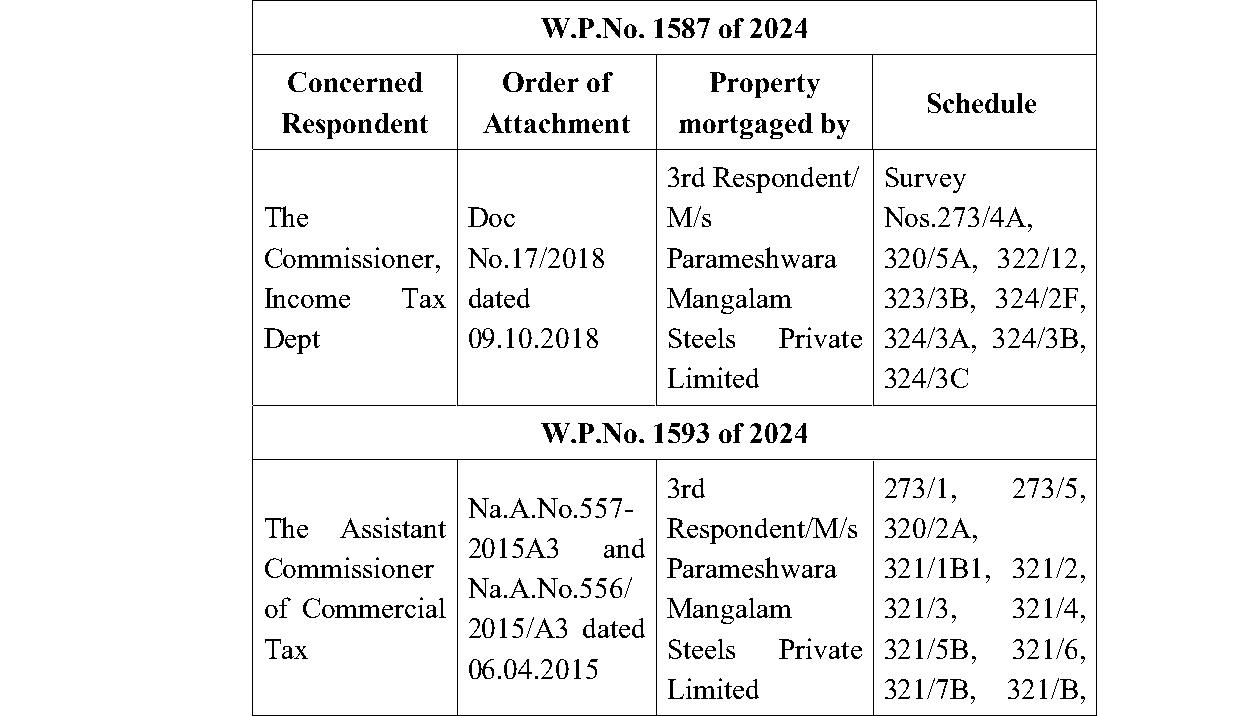
2. In W.P.No.1587 of 2024, the Petitioners have sought for a declaration that the Order of Attachment dated 09.10.2018 passed by the 1st Respondent/the Commissioner, Income Tax Department registered as Document No.17/2018, reflecting on the Encumbrance Certificate on the file of the 2nd Respondent/the Sub-Registrar which is subsequent to the mortgage executed in favour of the Petitioners Banks and to consequently direct the 2nd Respondent/the Sub-Registrar to register the Sale Certificate dated 23.06.2023 issued by the 1st Petitioner Bank/Union Bank of India in favour of the 8th Respondent, namely, Mr.Subbarayan Deivasigamani.
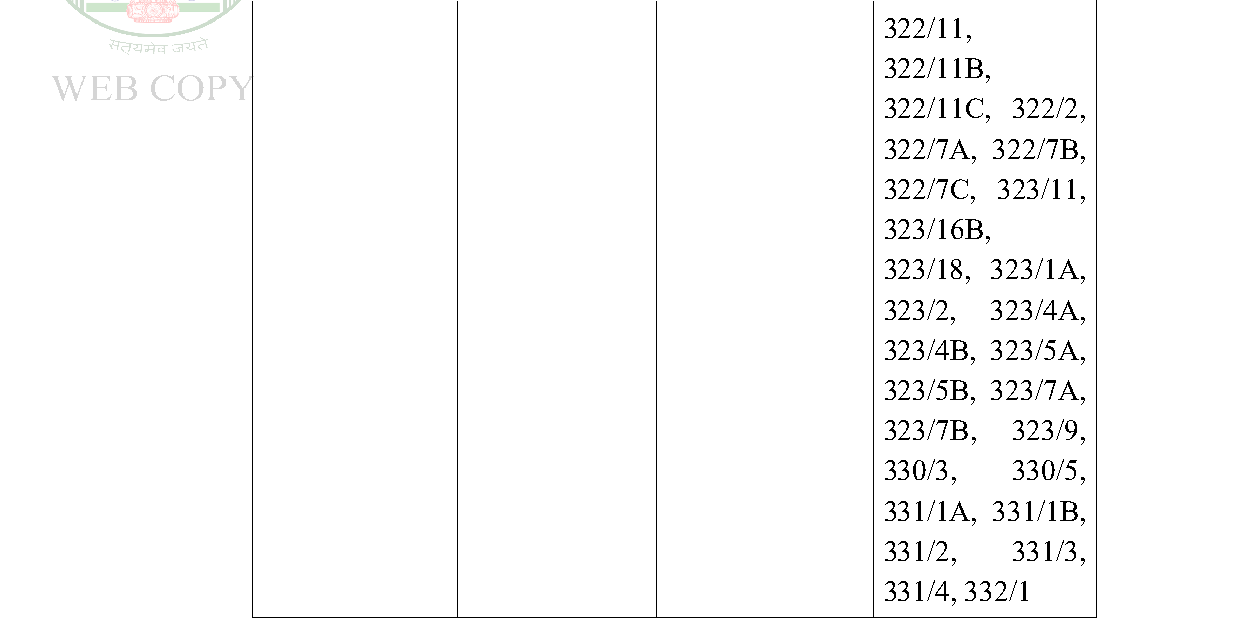
3. In W.P.No.1593 of 2024, the Petitioners have sought for a consequential relief to declare that the Order of Attachment dated 06.04.2015 of the 1st Respondent/Assistant Commissioner of Tax therein, which is also subsequent to the mortgage executed in favour of the Petitioners Bank and to direct the 2nd Respondent/the Sub-Registrar to register the Sale Certificate dated 23.06.2023 issued by the 1st Petitioner Bank/Union Bank of India in favour of the 8th Respondent/Mr.Subbarayan Deivasigamani.
4. The Petitioners Banks, as consortium of Banks, had lent money to the 3rd and 4th Respondents, where 5th, 6th and 7th Respondents stood as ‘Guarantors’. To secure the said loans, the 3rd Respondent had mortgaged several properties in favour of the consortium of the 1st Petitioner/Andhra Bank.
5. The consortium of secured creditors originally consisted of two Banks, namely Andhra Bank (presently Union Bank of India) and Punjab National Bank. Subsequently, the 1st Petitioner/Andhra Bank merged with the 2nd Petitioner/Punjab National Bank.
6. Thus, the Petitioners Banks became a Secured Creditor under the Securitization and Reconstruction of Financial Assets and Enforcement of Security Interest (SARFAESI) Act, 2002.
7. Facts on record reveal that the Petitioners Banks pursuant to the loan facility availed by the 3rd and 4th Respondents which were secured by the mortgage of subject properties by the 3rd and 4th Respondents, where 5th, 6th and 7th Respondents stood as ‘Guarantors’ was registered in the CERSAI Portal on 09.09.2011 which is the Central Registry of Securitization Asset Reconstruction and Security Interest of India within the meaning of Section 20(1) of the Securitization and Reconstruction of Financial Assets and Enforcement of Security Interest (SARFAESI) Act, 2002. A copy of the CERSAI Report has been filed by the Petitioners before this Court in the Additional Typed Set of Documents on 15.12.2025 during the course of the hearing.
8. Section 20(1) of the Securitization and Reconstruction of Financial Assets and Enforcement of Security Interest (SARFAESI) Act, 2002 is extracted hereunder:-
“20.Central Registry.—
(1) The Central Government may, by notification, set up or cause to be set up from such date as it may specify in such notification, a registry to be known as the Central Registry with its own seal for the purposes of registration of transaction of securitisation and reconstruction of financial assets and creation of security interest under this Act.”
9. The loan accounts of 3rd and 4th Respondents were later classified as Non-Performing Assets (NPAs) leading to initiation of proceedings under the Securitization and Reconstruction of Financial Assets and Enforcement of Security Interest (SARFAESI) Act, 2002 and the Rules made thereunder.
10. In this background, the Andhra Bank (presently, Union Bank of India) issued a Sale Notice under Section 13(1) of the Securitization and Reconstruction of Financial Assets and Enforcement of Security Interest (SARFAESI)

Section 26(E) of the SARFAESI Act and Section 31B of Act 51 of 1993, there cannot be any doubt that the rights of a secured creditor to realize the debts due and payable by sale of assets over which ....


A mortgagee bank's sale certificate cannot be denied registration due to prior attachment orders, as secured creditors' rights under the SARFAESI Act prevail over tax attachment claims.

Secured creditors have priority over debts, permitting registration of sale certificates despite existing civil court attachments, with purchasers taking the property subject to said attachments.
Secured creditors under SARFAESI Act have priority over all other debts, including tax attachments, affirming the necessity of registering Sale Certificates in favor of auction purchasers.
There cannot be any doubt that the rights of a secured creditor to realize the debts due and payable by sale of assets over which security interest is created, would have priority over all the debts.
The SARFAESI Act affirms secured creditors' priority over state debts, overturning any conflicting tax attachments regarding sold properties.

The main legal principle established in the judgment is the priority of the secured creditor over government dues as per the SARFAESI Act, particularly in relation to the registration with CERSAI and....
The main legal point established in the judgment is the priority of the secured creditor's dues over other creditors' claims, as determined by the SARFAESI Act and relevant case law.



An indispensable Tool for Legal Professionals, Endorsed by Various High Court and Judicial Officers
Please visit our Training & Support
Center or Contact Us for assistance

Scan Me!
India’s Legal research and Law Firm App, Download now!


For Daily Legal Updates, Join us on :



 Back to top


