
 Back
Back





BEFORE THE MADURAI BENCH OF MADRAS HIGH COURT
G.R. Swaminathan, K. Rajasekar, JJ.
M/s.Omega Traders - Petitioner
Versus
Assistant Commissioner, Office of the Assistant Commissioner of GST & Central Excise – Respondent
WA(MD)No.746 of 2025 and CMP(MD)No.5111 of 2025
Decided On : 17-04-2026
| Table of Content |
|---|
| 1. this intra-court appeal is directed against the common order dismissing the writ petition. (Para 1) |
| 2. the appellant processes raw tobacco, seeking reclassification under gst following regulatory bans. (Para 2 , 3 , 4 , 5) |
| 3. legal representatives presented arguments based on historical classification and regulatory compliance. (Para 6 , 7) |
| 4. court reviewed procedural aspects concerning alternative remedies available to the appellant. (Para 8 , 9 , 10 , 11) |
| 5. court ruled on the absence of manufacturing, reaffirming unmanufactured tobacco classification. (Para 12 , 21) |
| 6. final judgment allowed the appeal and set aside previous orders. (Para 22) |
JUDGMENT :
G.R. SWAMINATHAN, J.
This intra-court appeal is directed against the common order dated 24.10.2024 dismissing WP(MD)No.5414 of 2021 filed by the appellant herein. The writ petition filed by the appellant was taken up for disposal along with a few more writ petitions and given a common disposal by the learned Single Judge.
2.The appellant is engaged in the tobacco business. Their activity comprises the following : procuring raw tobacco from farmers, processing by drying, stripping and thereafter dipping it in jaggery water and subsequently mincing and packing for subsequent sale. Dipping the raw tobacco in jaggery water is called liquoring. This process is resorted to prevent mould and also to preserve the natural flavor of the tobacco.
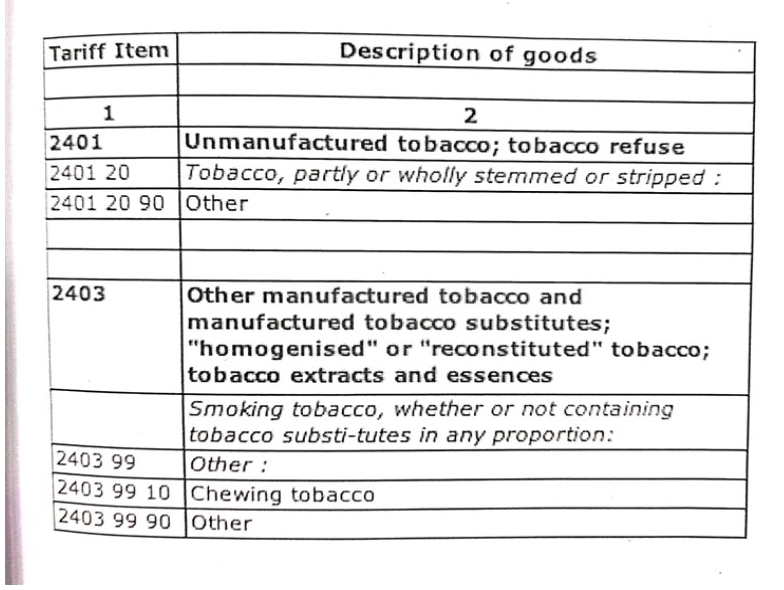
3.Initially, the appellant was adding further ingredients to tobacco after it was processed as mentioned above like chilli/mint/other flavors and essences and marketed the product as “chewing tobacco” classifying the same under Central Excise Tariff Heading (hereinafter referred to as “CETH”) 2403 99 10. During May 2017, Government of Tamil Nadu issued a notification dated 23.05.2017 vide Gazette No.146, whereby, manufacture, storage, transport, distribution or sale of gutkha, pan masala, chewing tobacco and any other food products containing tobacco or nicotine as ingredients were prohibited. In view of the change in the legal regime, the appellant stopped the addition of the flavors and essences to their product and started selling the same as “unmanufactured tobacco”. Notwithstanding the fundamental change in the character of the product, the appellant continued to classify the same under CETH 2403 99 10.
4.GST came into force on 01.07.2017. Products falling under CETH 2403 99 10 were levied with compensation cess to the tune of 160% apart from the other usual levies. The appellant and other traders, thereupon, gave a representation for classifying their goods under CETH 2403 99 90. The Superintendent of GST and Central Excise, Pudukottai - 1 Rage vide reply dated 17.07.2017 called upon the appellant to maintain the earlier classification ie., CETH 2403 99 10. Compensation Cess for goods classified under CETH 2403 99 90 attracted 96%. The assessees including the appellant did not accept the classification insisted by the department. Hence, Memorandum dated 29.01.2019 followed by another letter dated 30.06.2019 was issued calling upon the appellant’s representative to appear along with certain documents. The appellant’s representative appeared for enquiry on more than one occasion and answered the queries raised by the department. Not satisfied with the stand taken by the assessee, notice dated 04.07.2019 was issued calling upon the assessee to show cause as to why the product manufactured and cleared by the appellant should not be re-classified under CETH 2403 99 10 and HSN 2403 99 10 respectively for the purpose of Central Excise duty and GST. The assessee was also called upon to offer their explanation as to why an amount of Rs.1,90,730/- being the short payment compensation cess should not be demanded from them. The appellant responded with their explanation dated 22.07.2019. The appellant’s explanation was rejected and order dated 31.03.2020 was passed holding that the product manufactured and cleared by the appellant was class
The court established that the classification of tobacco products relies on the presence of manufacturing activity; absence of such activity necessitates classification as unmanufactured tobacco unde....


The court established that the burden of proof on classification disputes lies with the Revenue, affirming that misclassification can lead to penalties, while reclassifications must reflect actual pr....

Where both the assessee and the excise department have consistently classified a product under a specific tariff heading for years in returns and official orders, the department is precluded from uni....

The main legal point established in the judgment is that the product in question is made from plastic granules and cannot be treated as textile articles, as uniformly adopted by the Appellate Authori....


In a classification dispute, the extended period of limitation cannot be invoked and the process of distillation does not amount to manufacture.
The process of roasting Rava does not amount to manufacture under Section 2(f) of the Central Excise Act, thus no excise duty is applicable.



An indispensable Tool for Legal Professionals, Endorsed by Various High Court and Judicial Officers
Please visit our Training & Support
Center or Contact Us for assistance

Scan Me!
India’s Legal research and Law Firm App, Download now!


For Daily Legal Updates, Join us on :



 Back to top


