1. Suit for specific performance of agreement to sell lands — Alleged fraudulent agreement — Application for production of original account books — Non-compliance alleged — Dismissal of suit under Order XI Rule 21 CPC. (Para 2 , 3 )
 Back
Next 





2026 Supreme(Raj) 587
IN THE HIGH COURT OF JUDICATURE FOR RAJASTHAN AT JODHPUR
SANDEEP SHAH, J.
Legal Representatives of Shri Om Prakash S/o Shri Rang Lal – Appellant
Versus
Balwant S/o Shri Sheochand – Respondent
S.B. Civil Misc. Appeal No. 1393 of 2008
Decided On : 26-02-2026
Advocates Appeared:
For the Appellant : Gopi Ram Goyal
For the Respondents: Amit Saran, Raj Bishnoi, S.S. Gour
For the Appellant : Gopi Ram Goyal
For the Respondents: Amit Saran, Raj Bishnoi, S.S. Gour
Dismissal of a suit under Order XI Rule 21(1) CPC is inapplicable to non-compliance with production orders passed under Order XI Rule 14. Such stringent penalties require proven wilful default, obstinacy, or contumacy and should be used only as a last resort.
Headnote:(A) Code of Civil Procedure, 1908 - Order XI Rules 11, 12, 14, 15 and 21(1) - Non-compliance with order for discovery and production of documents - Power to dismiss suit or strike out defence - The penalty under Order XI Rule 21(1) relates specifically to non-compliance with orders to answer interrogatories (Rule 11), discovery of documents (Rule 12), or inspection of documents (Rule 15). Since Rule 14, which deals with the production of documents, is not mentioned in Rule 21, non-compliance with an order passed under Order XI Rule 14 does not attract the penalties of dismissal of the suit or striking out the defence (Paras 13.1 and 13.2).
(B) Order XI Rule 21(1) - Scope and Application - The power to dismiss a suit or strike out a defence is a stringent measure and must be exercised with caution as a last resort. Such an order should not be made unless the court is satisfied that there was wilful default, obstinacy, or contumacy on the part of the party in disregarding the order of the court (Paras 14 and 19).
Facts of the case:
Plaintiffs filed a suit for specific performance of an agreement to sell land. The defendants sought production of original account books. A consent order was passed directing the plaintiffs to produce the documents. The plaintiffs produced the books in their possession but stated that certain other books belonged to their father and were not in their power or possession. Despite a previous observation by the trial court and the High Court that the defendants could seek secondary evidence or an adverse inference, the trial court subsequently dismissed the suit under Order XI Rule 21(1), citing wilful non-compliance with the production order.
Findings of Court:
The court found that while the original order for production was cited under Rule 12, its substance and language directed the production of documents, making it an order under Order XI Rule 14. Consequently, Order XI Rule 21(1) was not applicable. Additionally, the court observed that there was no evidence of wilful default, as the plaintiffs had produced the records available to them and clearly explained why other records could not be produced.
Issues: (1) Under what circumstances can the power under Order XI Rule 21(1) CPC be exercised by the trial court? (2) Whether, in the facts of the present case, the power under Order XI Rule 21(1) CPC could have been invoked?
Ratio Decidendi: The court ruled that Order XI Rule 21(1) is limited to non-compliance with Rules 11, 12, and 15, and does not extend to Rule 14. Furthermore, the dismissal of a suit is only permissible in extreme cases of wilful disregard of court orders, not for the mere non-production of documents that are not in the party's possession.
Result: Appeal allowed; the order dated 03.09.2008 passed by the learned Additional District Judge, Bhadra, is quashed and set aside.
Legal Category Hierarchy
- practice and procedure
-
property law
-
sale of land
- specific performance (Para 2)
-
sale of land
Table of Contents
2. Appellants argued no wilful default and order was under Rule 14, not Rule 12; respondents argued wilful non-compliance and maintainability under Rule 21. (Para 9 , 10 )
3. Order dated 23.03.2006 was under Order XI Rule 14, not Rule 12; Rule 21 applies only to orders under Rules 11, 12, or 15; no wilful default established. (Para 13 , 14 , 15 , 16 , 17 , 19 , 20 )
4. Order XI Rule 21 CPC is inapplicable to non-compliance with an order under Rule 14 for production of documents; wilful default and contumacy are prerequisites. (Para 13 , 14 , 15 )
5. Appeal allowed; impugned order quashed; trial to proceed expeditiously; respondents at liberty to seek adverse inference or secondary evidence. (Para 21 , 22 , 23 )
6. Does Order XI Rule 21 CPC apply to non-compliance with an order for production of documents under Order XI Rule 14?
No. Rule 21 applies only to failure to comply with orders to answer interrogatories (Rule 11), discovery of documents (Rule 12), or inspection (Rule 15). Non-compliance with an order under Rule 14 is outside its scope. (Para 13 , 14 , 15 )
7. What is the distinction between 'discovery of documents' under Order XI Rule 12 and 'production of documents' under Order XI Rule 14?
Discovery under Rule 12 requires an affidavit stating which documents are in possession or power; production under Rule 14 is a direction to produce specific documents. They operate in different fields, as confirmed by Forms 4 and 6 of Appendix C. (Para 13 , 16 )
8. What conditions must be satisfied before a court can dismiss a suit or strike out a defence under Order XI Rule 21 CPC?
The court must record satisfaction that there was a specific order under Rules 11, 12, or 15, that it was not complied with, and that the default was wilful, showing obstinacy or contumacy. The power is a last resort, exercised only in extreme cases. (Para 14 , 15 , 19 )
9. Does incorrect citation of a legal provision in an application or order affect the validity of the order?
No. The actual language and substance of the order determine the provision under which it is passed; wrong quoting does not change its nature. Here, despite citing Rule 12, the order was effectively under Rule 14. (Para 15 , 21 )
JUDGMENT :
SANDEEP SHAH, J.
1. By way of filing the present Civil Miscellaneous Appeal under Order XLIII Rule 1(f) CPC, 1908, the appellants–plaintiffs have challenged the order dated 03.09.2008 passed by the learned Additional District Judge, Bhadra in Civil Suit No. 08/2003 (Om Prakash & Ors. v. Balwant & Ors.), whereby the application filed by the respondents/defendants under Order XI Rule 21(1) CPC was allowed and the suit was dismissed on the ground of alleged non-compliance, of the order dated 23.03.2006 passed by learned Trial Court, by the appellants.
Factual Matrix:-
2. Succinctly stated, the facts are that the appellants–plaintiffs filed a suit alleging therein that the lands, particulars whereof are in paragraphs no.1 and 2 of the plaint, were owned by respondent Nos.1 and 2, who had agreed to sell the same to the appellants for a total consideration of Rs.6,30,000/-. Pursuant to the verbal agreement, a written agreement dated 09.04.2001 was executed, and the appellants–plaintiffs paid a sum of Rs.5,57,000/- by different cheques, with a specific understanding that the balance amount of Rs.73,000/- would be paid at the time of registration of sale deed. The period for execution of the sale deed was fixed as two years. According to the appellants–plaintiffs, they regularly contacted the respondents–defendants, and the defendants asked the appellants–plaintiffs to be present for registration on 01.04.2003, however, the respondents–defendants did not turn up.
2.1. Upon inquiry initiated by the appellants–plaintiffs at the office of the Patwari on 17.06.2003, they came to know that respondent Nos.1 and 2 had filed a suit for transfer of the lands in favour of their sons and wives and, by virtue of a judgment and decree dated 20.09.2002, the lands in question had been transferred in the names of respondent Nos.3 to 7, i.e., the sons and wives of respondent Nos. 1 and 2. Further, the revenue records also reflected the names of respondent Nos.3 to 7. Consequently, the appellants–plaintiffs filed a suit for specific performance of the agreement dated 09.04.2001 along with other reliefs on 03.07.2003.
3. After receipt of notice, the respondents filed a written statement, alleging that the appellants and their father, Shri Ranglal, originally resided at Village Nethrana but later shifted to Bhadra, where they were running a cloth shop and an electrical equipment shop on the Bhadra main road. It was further alleged that the appellants were engaged in the business of purchasing grains from farmers. The defendants stated that since 1995–96, they had also been selling their produce to the appellants and on 09.04.2001, they approached the appellants for a sum of Rs.1,10,000/- as they were in need of money. The appellants advanced the said amount; however, under the pretext of preparing certain documents for income tax purposes, the appellants fraudulently obtained their signatures on the agreement in question. The respondents–defendants further stated that they had repaid the entire amount taken on 09.04.2001 and, despite the same, the appellants were showing an outstanding amount of Rs.4,48,416/-. Thus, they prayed for dismissal of the suit.
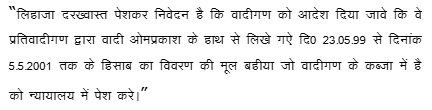
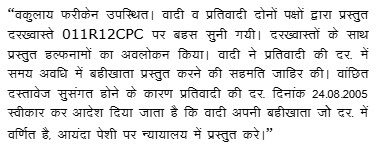
3.1 That on 24.08.2005, respondent Nos.1 and 2 filed an application under (without specifying any Provision/Rule/Order, under which the same was filed), stating therein that, as asserted in the written statement, the defendants had been engaged in business transactions with the appellants since the year 1995–96. To substantiate the same, appellant Om Prakash had provided photocopies of the account books to the defendants for the period from 23.05.1999 to 05.05.2001, which formed part of the record of the case, wherein the entry dated 09.04.2001 was also reflected. It was further asserted that the said entry was made by appellant-Om Prakash himself and that the original record was in his possession. It was thus contended that there was a requirement to produce the original record, as the statements of