
 Back
Back





HIGH COURT OF JUDICATURE FOR RAJASTHAN BENCH AT JAIPUR
INDERJEET SINGH, ASHOK KUMAR JAIN, JJ.
Managing Director, The Urban Cooperative Bank Limited - Appellant
Versus
The Judge, Industrial Tribunal, Jaipur - Respondent
D.B. Special Appeal Writ No. 751 of 2017
Decided On : 16-03-2026
JUDGMENT :
1. Instant DB Special Appeal under Rule 134 of the Rajasthan High Court Rules, 1952 has been filed by the appellant, (hereinafter referred to as "the employer"), aggrieved from the judgment dated 10.03.2017 passed in SB Civil Writ Petition No.1959/2006, titled as "Managing Director, Urban Cooperative Bank Ltd. vs. Judge, Industrial Tribunal, Jaipur".
2. The brief facts of the case are that the Respondent No.2, an Organization of Rajasthan Cooperative Sector Employees Union submitted a demand charter to the employer on 18.02.1982 and after that services of the some of the members of Union were terminated and they were discontinued by present appellant from 01.09.1982. A dispute was raised and after failure in conciliation, a reference was made by the State Government under Section 10A of the Industrial Disputes Act, 1947, (hereinafter referred to as "the Act of 1947"), as under:
"Whether the action of the employer Managing Director, Urban Cooperative Bank Limited, Nehru Bazar, in terminating the services of 30 workmen mentioned in the list was justified and correct, and if not, what relief they were entitled to?"
3. A statement of claim was filed by the respondent union on behalf of 15 out of 30 workmen in respect of whom the dispute was raised. Five other workmen had filed separate statement of claims. A reply was filed by the appellant employer.
4. The Industrial Tribunal answered the reference on 01.04.1991 by holding that the termination order was legal and justified and the termination order did not fall within the definition of retrenchment and was covered under Section 2(oo)(bb) of the Act of 1947.
5. One of the workmen, Trilok Chand, separately challenged his termination and an award was passed in his favour on 22.08.1989 by the Industrial Tribunal, thus declaring termination as unfair and illegal.
6. Two separate writ petitions were filed, firstly S.B. CWP No.3956/1991 by the workmen against the award dated 01.04.1991, and secondly S.B. CWP No.3048/1990 by the employer against the award in favour of Trilok Chand dated 22.08.1989.
7. A Coordinate Bench of this Court allowed both the writ petitions on 22.04.1994 and set aside the awards dated 01.04.1991 and 22.08.1989 and remitted the matter back to the Industrial Tribunal to decide the same afresh.
8. The Tribunal, while reconsidering the reference, decided the same on 16.10.1995 and passed an award against the workmen. Respondent No.2 again filed S.B. CWP No.3698/1996 against the said award and, vide judgment dated 05.01.1999, a Coordinate Bench of this Court again set aside the award dated 16.10.1995 and remanded the matter back to the Tribunal.
9. A D.B. Special Appeal (Writ) No.123/1995 was preferred by the employer bank and the same was decided on 24.11.2003 observing that some of the issues were not dealt with by the learned Single Judge.
10. Thereafter, SB Civil Review No.30/2004 was preferred by the appellant employer bank, which was dismissed on 27.01.2005. Finally, the award dated 19.07.2005 was passed by the Industrial Tribunal in following manner:
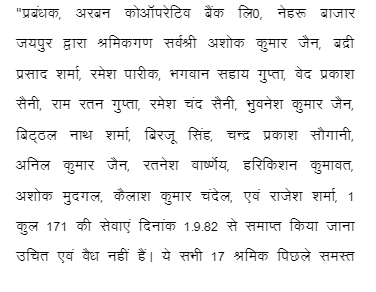
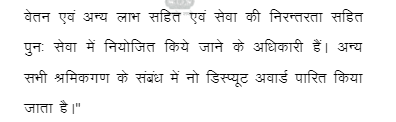
11. In view of award, termination of 17 workmen was declared as unfair and illegal and they were reinstated with back wages and continuity of service. Against the said award, the bank employer appellant herein, preferred S.B. CWP No.1959/2006, which was dismissed on 10.03.2017 with cost of Rs. 50,000/- to be paid by the employer bank and be distributed equally to the workmen who are members of the respondent union.
12. The instant SAW has been preferred and the same is being considered on merits.
13. Learned Senior Advocate appearing on behalf of the employer bank submitted that on two occasions a reference was decided in favour of the appellant bank, but after the remand by this Hon'ble Court a fresh award in favour of workmen was passed by the Tribunal. He further submitted that the Tribunal in its findings has clearly held that the appellant bank (employer) has complied with the mandatory provisions of Section 25F

Reinstatement of workmen after illegal termination is not automatic; monetary compensation may be granted instead based on specific circumstances and legal precedents.


Once violation of Sections 25(F), (G) and (H) of the Industrial Disputes Act is established, reinstatement should follow, as per the decision in Gauri Shanker vs. State of Rajasthan.
Violation of provisions under Sections 25F and 25H of the ID Act led to the direction for reinstatement without backwages.
Labour Law - Reinstatement in services – It is trite law that when termination is found to be illegal because of non-payment of retrenchment compensation and notice pay as mandatorily required under ....
In a case where Section 25-F of the Act applies the workman is bound to prove that he had been in continuous service of 240 days during twelve months preceding the order of termination; in a case whe....



An indispensable Tool for Legal Professionals, Endorsed by Various High Court and Judicial Officers
Please visit our Training & Support
Center or Contact Us for assistance

Scan Me!
India’s Legal research and Law Firm App, Download now!


For Daily Legal Updates, Join us on :



 Back to top


