
 Back
Back





HIGH COURT OF JUDICATURE FOR RAJASTHAN, BENCH AT JAIPUR
SANJEEV PRAKASH SHARMA, ACJ., BIPIN GUPTA, J.
M/s Kanchan India Limited, Through Its Managing Director - Appellant
Versus
M/s Shalimar Electricals, Through Statavdhari Shri Satyanarayan, Son of Late Shri Ramchandra Ajmera – Respondent
D.B. Civil First Appeal No. 152 of 2020
Decided On : 21-05-2026
| Table of Content |
|---|
| 1. overview of trial facts and judicial history of the dispute. (Para 1 , 2 , 3 , 4) |
| 2. conflicting contentions regarding unilateral invoice interest clauses. (Para 5 , 6) |
JUDGMENT :
Bipin Gupta, J.
1. The present Civil First Appeal has been preferred by the defendant-appellant assailing the judgment dated 23.10.2019, passed by learned Commercial Court, Ajmer in Civil Suit No. 189/2018 (124/2014) CIS No. 123/2018, whereby the suit instituted by the plaintiff-respondent for recovery of amount has been partly decreed against the defendant-appellant.
2. The controversy, in a narrow compass, is that a suit came to be filed by the plaintiff-respondent against the defendant- appellant for recovery of amount to the tune of Rs.10,24,017/-, contending therein that on 18.03.2008, the plaintiff-respondent, who was a dealer of M/s. Schneider Electric India Pvt. Ltd., received a purchase order from the defendant-appellant for supply of electric switchgear worth Rs. 60,43,356/-. The supplies were effected from 22.04.2008 till 19.05.2008. However, the defendant- appellant did not take delivery of the goods and, therefore, the plaintiff-respondent was compelled to store the goods at its premises/godown. Upon being asked the reason for not taking delivery of the goods, the defendant-appellant replied that the requirements had changed and, therefore, a fresh purchase order would be placed according to the new requirements.
2.1 On 13.08.2008, a fresh purchase order was issued for material amounting to Rs.44,51,000/-. In compliance with the fresh purchase order, material worth Rs.44,00,000/- was supplied from 20.08.2008 to 10.12.2008. However, the defendant-appellant paid only an amount of Rs.40,00,000/-. Thus, a remaining amount of Rs. 4,00,000/- was due and payable.
2.2 The plaintiff-respondent, in his plaint, claimed that in its books of account, against the said purchase order, a principal amount along with agreed interest amounting to Rs.8,30,774/- was outstanding. It was also pleaded that, against the purchase order dated 18.03.2008, since the material was not taken by the defendant-appellant, the plaintiff-respondent had to pay a penalty to M/s. Schneider Electric India Pvt. Ltd., amounting to Rs.1,93,243/-. Thus, a suit was filed for recovery of total amount of Rs.10,24,017/-.
2.3 The defendant-appellant filed a detailed written statement admitting the fact of the purchase order for supply of switchgear worth Rs.60,43,356/-. It was further contended that the material supplied pursuant to the subsequent purchase order was not of standard quality and, therefore, a debit note of Rs.4,00,000/- was issued to the plaintiff-respondent. It was also contended that the penalty allegedly paid by the plaintiff-respondent to M/s. Schneider Electric India Pvt. Ltd., amounting to Rs.1,93,243/-, could not be recovered from the defendant-appellant, in absence of any privity of contract. On the aforesaid grounds, dismissal of the suit was prayed for by the defendant-appellant.
3. On the basis of the pleadings of the parties, the learned Commercial Court framed as many as eleven issues which reads as under:
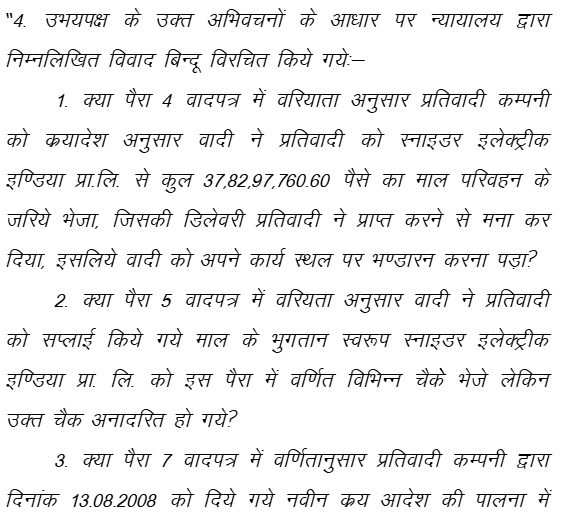
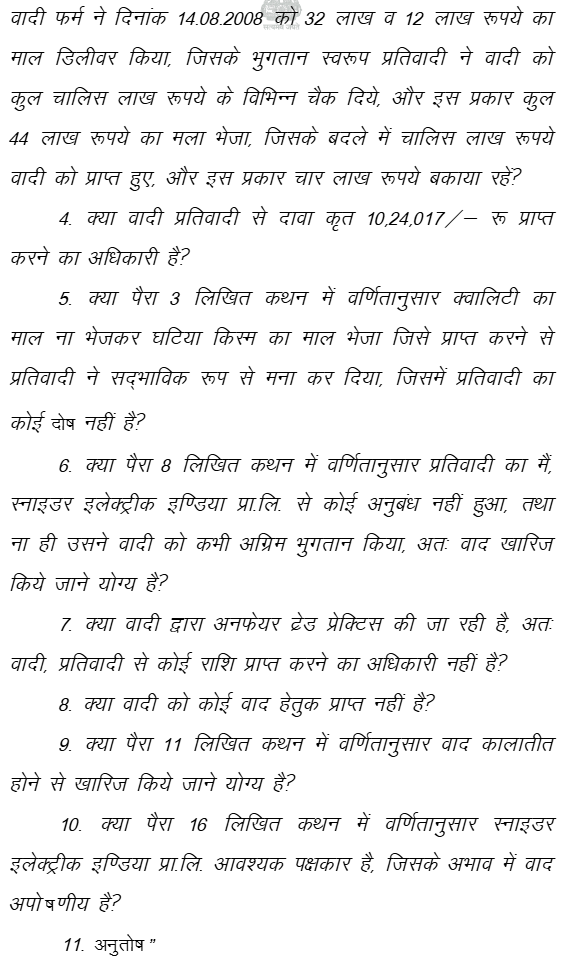
3.1 In support of its pleadings, the plaintiff-respondent examined two witnesses and produced various documents in evidence. On the other hand, the defendant-appellant examined only one witness in support of his case.
3.2 Issue Nos.1 and 3 were decided in favour of the plaintiff. Issue No.2 was decided against the plaintiff. Issue No. 4 was partly allowed in favour of the plaintiff wherein the it was held entitled to receive the outstanding amount of Rs.4,00,000/- along with agreed interest @ 24% from the date of service of notice i.e. 01.12.2011. Issue No. 5 was decided against defendant. Issue No. 6 was partly allowed in favour of the defendant. Lastly, Issue Nos. 7 to 10 were also decided against defendant.
3.3 Upon appreciation of the oral and documentary evidence available on record and on the basis of finding of the issues, the learned Commerci
AI


The main legal point established in the judgment is that the Interest on Delayed Payment to Small Scale and Ancillary Industrial Undertakings Act, 1993 does not apply to transactions prior to its enf....


Court upheld contractual interest of 18% from pre-suit period while awarding 9% future interest post-decree, reflecting equitable considerations of a commercial transaction.


Pre-suit interest is impermissible under CPC unless stipulated by contract or statute; interest rates must align with statutory limits.


(1) Interest payment is essentially compensatory in nature.(2) Rate of Interest should not be excessive.



An indispensable Tool for Legal Professionals, Endorsed by Various High Court and Judicial Officers
Please visit our Training & Support
Center or Contact Us for assistance

Scan Me!
India’s Legal research and Law Firm App, Download now!


For Daily Legal Updates, Join us on :



 Back to top


