1. Non-payment of salary — Claim of constructive dismissal — Industrial Relations Act 1967. (Para 4 , 5 , 6 , 7 , 8 , 9 )
 Back
Next 


2026 MarsdenLR 2334
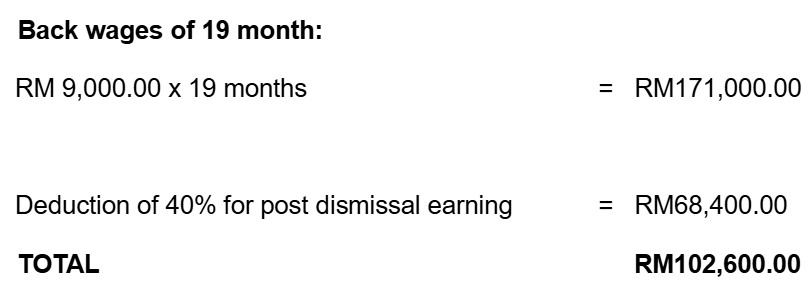
INDUSTRIAL COURT MALAYSIA
Mohamad Hafez Bin Abdul Rahman – Appellant
Versus
Alphacapital (M) Berhad – Respondent
7/4-350/25
Constructive dismissal is established when an employer commits a fundamental breach of the employment contract, such as non-payment of salary, which goes to the root of the contract, regardless of whether the employer's conduct was merely unreasonable.
Headnote:(A) Industrial Relations Act 1967 - Sections 20(3), 29(d), 29(g), 30(5), and 30(6A) - Employment Act 1955 - Constructive dismissal - Non-payment of salary - Fundamental breach of contract - The test for constructive dismissal is the "contract test" rather than the "unreasonableness test"; it is established if the employer is guilty of a breach that goes to the root of the contract or has evinced an intention no longer to be bound by it (Paras 12, 15, 17).
(B) Burden of proof - Where the fact of dismissal is in dispute, the burden is on the employee to establish that they were dismissed (Para 13).
(C) Standard of proof - The standard required in the Industrial Court is the balance of probabilities (Para 14).
Facts of the case:
An employee holding a senior executive position failed to receive the monthly salary as stipulated by law. Upon raising the issue, the employee was suggested by the chief executive to consider resigning. The employee subsequently claimed constructive dismissal. The employer alleged poor performance and misconduct, but provided no evidence to support these claims during the proceedings.
Findings of Court:
The failure to pay salary constitutes a fundamental breach of the employment contract as it goes to the root of the agreement. The allegations of poor performance and misconduct were found to be baseless afterthoughts intended to justify the dismissal, as no evidence was produced to support them.
Issues: Whether the employee was constructively dismissed without just cause or excuse due to the non-payment of salary and the subsequent conduct of the employer.
Ratio Decidendi: Non-payment of salary is a fundamental term of an employment contract; failure to adhere to this term constitutes a breach that goes to the root of the contract, justifying the employee in regarding the contract as terminated and themselves as dismissed.
Result: Claim allowed.
Legal Category Hierarchy
-
labor and employment law
-
industrial relations
-
industrial court and tribunal procedures
- ex parte hearing
-
industrial court and tribunal procedures
-
employment contract
- constructive dismissal
-
salary and benefits
- non-payment of salary
-
termination and dismissal
- just cause and remedy
-
industrial relations
Table of Contents
2. Constructive dismissal due to non-payment of salary — Employer's contention of poor performance as justification for resignation. (Para 5 , 6 , 20 , 25 )
3. Non-payment of salary constitutes a fundamental breach of contract — Allegations of poor performance without evidence are considered baseless afterthoughts. (Para 20 , 21 , 22 , 23 , 24 , 25 )
4. Constructive dismissal requires a fundamental breach of contract going to the root of the agreement, with the employee resigning pursuant to said breach. (Para 12 , 15 , 17 , 19 , 24 )
5. Claim allowed — Dismissal without just cause or excuse — Award of back wages subject to deduction for gainful employment. (Para 26 , 28 , 29 , 30 )
6. What constitutes constructive dismissal in industrial law?
It occurs when an employer is guilty of a breach that affects the foundation of the contract or evinces an intention no longer to be bound by it, allowing the employee to regard the contract as terminated. (Para 12 , 15 , 17 , 19 )
7. What is the contract test in constructive dismissal cases?
The court applies the contract test rather than the unreasonableness test, focusing on whether the employer's conduct constituted a breach going to the root of the contract or showed an intention to no longer be bound by it. (Para 15 , 17 )
8. Does the non-payment of salary amount to a fundamental breach of employment?
Yes, payment of salary is a fundamental term of the employment contract, and failure to pay salary is a fundamental breach that goes to the root of the contract. (Para 24 )
9. What are the prerequisites to prove constructive dismissal?
The prerequisites are: a breach of contract term or intention not to be bound; the breach must be fundamental; the employee must leave pursuant to the breach; and the employee must leave at an appropriate time. (Para 19 )
10. How is the burden of proof handled when the fact of dismissal is disputed?
Where the fact of dismissal is in dispute, the workman must establish that he was dismissed; if successful, the burden shifts to the employer to prove the dismissal was with just cause or excuse. (Para 13 )
AWARD
1. This Court takes cognizance of the following bundles and cause papers filed ;
I. Statement of case
II. Claimant’s Bundle of Document (CLB 1)
III. Witness Statement of the Claimant (CLWS1)
2. On the first E-Mention date of 11.3.2025, both the Company and the Claimant did not log in. On the 2nd E-Mention date on 25.3.2025, the Claimant logged in however the Company failed to log in. The Direction was given to file the pleadings and documents. The Hearing was fixed for 3.12.2025. The court attempted to contact the Company vide 2 Company email address on 9.12.2025 (Enclosure 29, 30 and 31). The Company search (Enclosure 10) dated 20.3.2025 shows the status of the Company as existing. The Court further attempted to serve Form G (Enclosure 13) to all Company’s Directors however the A R Card returned unclaimed. The Claimant represented himself in this matter and requested for an ex-parte Hearing. The Court proceeded to hear the matter on ex-parte pursuant to Section 29(d) & (g) of the Industrial Relations Act 1967 and the Court is mindful of the role in ex-parte hearing.
3. In the case of WONG BROTHERS’ BUILDING CONSTRUCTION -v- CHOO CHEE SIAM (2005)1 MELR 792, where the Learned Chairman quoted from the book ‘ Law of Industrial Disputes‘ by OP Malhotra Volume 3rd Edition at page 716, where it was stated that ‘ A rule empowering the tribunal to proceed ex-parte if the party is absent and sufficient cause is not shown for his absence , would not enable it either to do away with the inquiry or straight away pass on an award without giving finding on the merit of the dispute. In other words, the absence of a party does not entail the consequence that an award will straight away be made against him.’
BRIEF FACTS
4. The Claimant commenced his employment with the Company effective from1.6.2022. The Claimant’s last held position was Chief Operating Officer with a salary of RM 9,000.00. On 7.6.2024, the Claimant and some of his subordinates did not receive their May 2024 salary as stipulated by the Employment Act 1955. The Claimant brought this issue to Intan Nursyazana (“the Group’s General Manager”).
5. On 7.6.2024, the Claimant sent an email at 9.19p.m to the Chief Executive Officer and the Company Director, Mr. Syed Mahadzir Fadaak (“the CEO”) with regards to the non-payment of the salary. At 9.31pm, the CEO replied to the email and stated that the Claimant should consider resigning from his position without mentioning or reference made to the outstanding salary.
6. On 11.6.2024, the Claimant sent another email to the Company stating that he was constructively dismissed due to the email sent by the CEO previously. Within 1 hour, at 5.59pm, the General Manager replied and informed the Claimant that the suggestion to resign was made as a result of the performance feedback. Furthermore, to obtain a comprehensive evaluation of the Claimant’s work, the Claimant was asked to write officially.
7. On 12.6.2024, the Claimant proceeded to serve a letter to request for the evaluation of work. Subsequently, the Claimant was called in for a meeting attended by the General Manager and Group Head of Compliance Puan Rozaini Razak. In the meeting the Claimant was asked to change his stance from being constructively dismissed to ‘resign due to dissatisfaction’ of delayed payment of salary. The issue of outstanding salary was not resolved in the meeting neither did the Company provide any solution.
8. The Claimant stood by his ground of being constructively dismissed and proceeded to hand in the written notice with the hope of being paid for notice in lieu (3 months).On 13.6.2024 at 7.53am, the Claimant responded to the General Manager’s email and sought to work from home due to financial constrain and parking being barred from access. On 13.6.2021 at 5.59pm, the Claimant received an email titled ‘acceptance of resignation’ and was informed of ‘ early release’ from employment and the Claimant’s last day in office would be on 14.6.2024 and his official final wo