1. Claim for undercharged electricity bills due to meter tampering at consumer's premises. (Para 1 , 9 , 10 , 11 , 22 , 23 , 24 , 25 , 26 , 27 )
 Back
Next 





2026 MarsdenLR 6171
DALAM MAHKAMAH SESYEN SELAYANG
NORAZLIN BINTI OTHMAN, J
TENAGA NASIONAL BERHAD – Plaintiff
Versus
QUANTUM IMAGE SDN BHD – Defendant
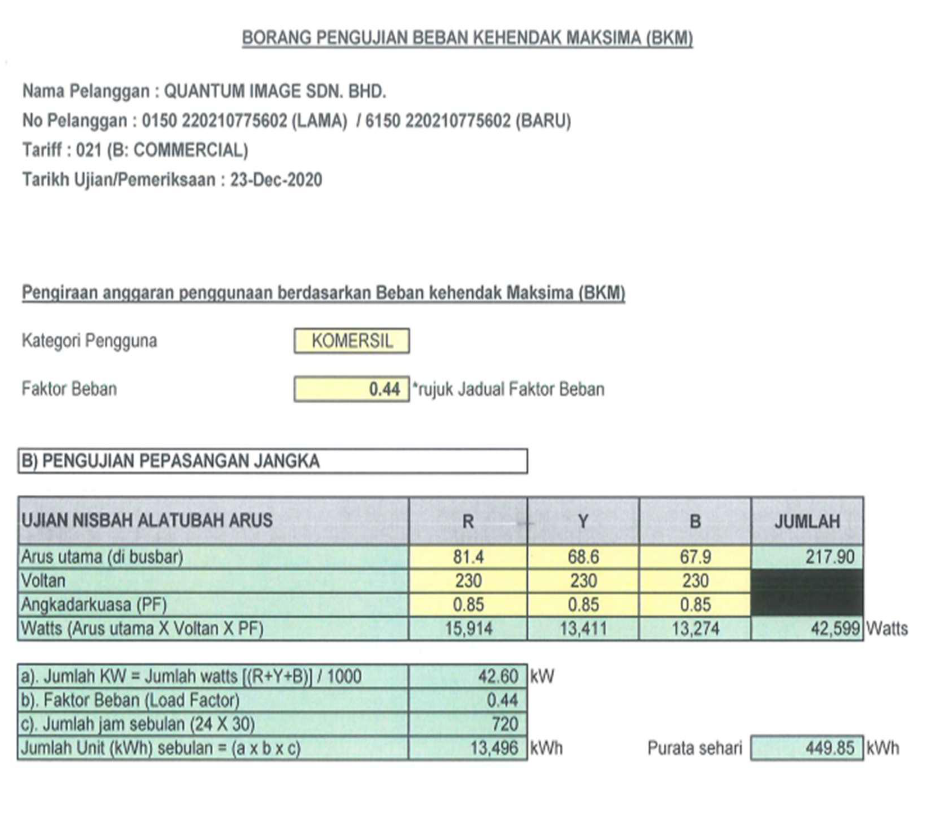
GUAMAN NO.: BD-B52NCvC-20-10/2024
Important Points
Registered electricity consumers are liable for revenue losses caused by meter tampering regardless of who performed the act or if the premises were tenanted. The cause of action for such statutory claims accrues upon the discovery of the tampering.
Subject
Civil Law - Utilities and Contractual Liability
Act Referred
Akta Syarikat 1965
Akta Bekalan Elektrik 1990: S.38(5), S.38(4), S.37, S.37(1), S.37(2), S.38(1), S.38(3)
Akta Keterangan 1950: S.101, S.102, S.103
Akta Had Masa 1953: S.6, S.6(1), S.6(1)(a)
Akta Kontrak 1950
Headnote
(A) Electricity Supply Act 1990 - Sections 37, 38(1), 38(4), and 38(5) - Liability of registered consumer for revenue loss due to meter tampering - Utility company not required to prove the specific identity of the person who tampered with the meter, only that tampering occurred (Paras 32, 53, 58) - Liability for revenue loss remains with the registered account holder even if the premises were tenanted to third parties, as the utility company is not a party to the tenancy agreement (Paras 52, 54, 58) - A certified written statement regarding loss details serves as prima facie evidence, shifting the burden to the consumer to produce credible evidence to contradict the quantum (Paras 41, 59, 60).
(B) Limitation Act 1953 - Section 6 - Cause of action for statutory claims under the Electricity Supply Act 1990 accrues from the date of discovery of the meter tampering during inspection, not the date the tampering commenced (Paras 64, 65).
(C) Evidence Act 1950 - Sections 101 to 103 - Burden of proof in civil cases is based on the balance of probabilities.
Facts of the case:
An inspection of a premises revealed meter tampering through direct wiring bypassing the meter. The utility company calculated the revenue loss using the Maximum Demand Load method for the period the bypass existed. The registered consumer denied liability on the grounds that the premises had been rented to third parties during the period of tampering and that they were not the ones who committed the act. The registered consumer subsequently sought indemnity from the third-party tenants for any liability imposed by the utility company.
Findings of Court:
The court found that the utility company established the fact of tampering and the resulting quantum of loss. The registered consumer, as the account holder, is responsible for the integrity of the meter regardless of occupancy. The utility company is not bound by private tenancy agreements. Regarding the indemnity claim, the registered consumer failed to provide a legal or contractual basis to shift the liability to the tenants.
Issues: Whether the utility company proved the liability and quantum of loss; whether the registered consumer remains liable despite the premises being tenanted; whether the action was barred by the limitation period.
Ratio Decidendi: The registered consumer is the party in contract with the utility company and is responsible for ensuring the meter is not tampered with. Liability is established once the fact of tampering is proven, without the need to identify the perpetrator. Statutorily, the limitation period begins upon the discovery of the offence. Furthermore, calculations of loss provided by the utility company are acceptable unless challenged by specific technical evidence.
Result: Claim of utility company allowed; registered consumer ordered to pay RM391,787.25, interest at 5% per annum from the date of decision, and costs of RM8,000. Indemnity claim against third parties dismissed.
Legal Category Hierarchy
- commercial law
- law of contract
- law of evidence
- limitation
Advocates:
Peguam Plaintif :
Tetuan Azmi & Associates,
Peguam Defendan :
Tetuan Sugapathy & Partners,
Table of Contents
2. Defendant denied tampering and argued liability shifted to tenant; plaintiff asserted registered consumer's strict liability. (Para 13 , 14 , 16 )
3. Court found tampering proved by inspection evidence; quantum calculated via maximum demand method unchallenged by defendant. (Para 31 , 32 , 33 , 34 , 35 , 36 , 37 , 38 , 39 , 43 , 44 , 45 , 46 , 47 , 48 , 49 , 50 , 60 , 66 , 67 , 68 , 69 , 70 )
4. Registered account holder is liable for meter tampering; TNB need not prove identity of tamperer. (Para 51 , 52 , 53 , 54 , 55 , 56 , 57 , 58 , 59 )
5. Judgment for plaintiff against defendant; defendant's indemnity claim against third parties dismissed. (Para 2 , 3 , 71 , 72 , 73 , 74 )
6. What must TNB prove for a statutory claim under Section 38 of the Electricity Supply Act 1990?
TNB must prove that the meter was tampered with and the quantum of loss on a balance of probabilities. (Para 31 , 32 , 33 , 34 , 35 , 36 , 37 , 38 , 39 , 40 )
7. Is the identity of the person who tampered with the meter relevant for TNB's claim under Section 38?
No. TNB need not prove the identity of the person who caused the tampering; it is sufficient that the meter was tampered with. (Para 52 , 53 , 57 , 58 , 59 )
8. Is a registered account holder liable for meter tampering when the premises are tenanted?
Yes. The registered account holder remains liable to TNB for electricity charges, regardless of tenancy, as TNB is not a party to the tenancy agreement. (Para 51 , 52 , 53 , 54 , 55 , 56 , 57 )
9. When does the limitation period for a civil claim under Section 38 of the Electricity Supply Act 1990 begin?
The cause of action accrues on the date TNB discovers the meter tampering during inspection, not from the date of the actual tampering. (Para 64 , 65 )
10. What is the standard for TNB's calculation of loss of revenue under the Electricity Supply Act 1990?
The Act does not prescribe a specific method; TNB may use any method that is fair, acceptable, and reasonable, as quantum is a technical issue. (Para 67 , 68 , 69 )
ALASAN PENGHAKIMAN
PENDAHULUAN
[1] Dalam kes ini Plaintif telah memfailkan writ saman dan penyata tuntutan pada 17-10-2024 terhadap Defendan, menuntut pembayaran bagi jumlah caj terkurang pada bil bekalan elektrik bulanan ke premis Defendan. Defendan telah menafikan tuntutan Plaintif dan memfailkan Notis Pihak Ketiga pada 11-11-2024 terhadap Pihak-Pihak Ketiga. Pengurusan kes telah bermula sejak 15-11-2024 dan perbicaraan penuh telah berlangsung pada 20 hingga 22-4-2026 dengan kehadiran Plaintif dan Defendan sahaja, manakala Pihak-Pihak Ketiga Kedua yang menjadi satu-satunya pihak ketiga yang memfailkan pliding, tidak hadir.
[2] Pada 10-7-2026 setelah meneliti kesemua keterangan dan hujahan pihak-pihak, Mahkamah memutuskan atas imbangan kebarangkalian bahawa Plaintif telah membuktikan tuntutannya. Oleh itu, Defendan adalah bertanggungan untuk membayar jumlah tuntutan Plaintif sebanyak RM391,787.25; faedah pada kadar 5% setahun ke atas jumlah ini bermula dari tarikh keputusan sehingga penyelesaian penuh dan kos tindakan sebanyak RM8000 untuk dibayar Defendan kepada Plaintif.
[3] Manakala bagi tindakan Defendan terhadap Pihak-Pihak Ketiga untuk indemniti bagi liabiliti yang ditanggung Defendan ke atas Plaintif, Mahkamah dapati Defendan telah gagal membuktikan tuntutannya, oleh itu tuntutan indemniti Defendan terhadap Pihak-Pihak Ketiga ditolak tanpa perintah terhadap kos.
[4] Pada 23-7-2026 Defendan memfailkan notis rayuan ke Mahkamah Tinggi terhadap keputusan Mahkamah yang membenarkan tuntutan Plaintif terhadap Defendan. Ini adalah alasan penghakiman bagi kes ini.
Pihak-pihak
[5] Plaintif adalah sebuah syarikat berhad yang ditubuhkan di bawah Akta Syarikat 1965 dan mempunyai alamat berdaftar di Pejabat Setiausaha Syarikat, Tenaga Nasional Berhad, Tingkat 16, Tower A, TNB Platinum, No. 3, Jalan Bukit Pantai, Bangsar, 59100 Kuala Lumpur dan mempunyai cawangan di Pejabat Tenaga Nasional Berhad Rawang, No.211, Jalan Maxwell, Pusat Bandar Rawang, 48000 Rawang, Selangor serta merupakan pemegang lesen di bawah Akta Bekalan Elektrik 1990 .
[6] Defendan adalah sebuah syarikat yang ditubuhkan di bawah Akta Syarikat dan mempunyai alamat berdaftar di 6-1, Jalan Angsana 2, Taman Bukit Angsana, Cheras, 56000, Kuala Lumpur dan mempunyai alamat perniagaan di No.32-1, Jalan Nautika B U20/B, Seksyen U20, TSB Commercial Centre, Sungai Buloh, 40160, Shah Alam, Selangor dan/atau 15-2 Jalan MR 1/4, Taman M Residensi, 48000, Rawang, Selangor.
[7] Defendan adalah pelanggan Plaintif dan merupakan pengguna berdaftar melalui akaun pengguna nombor 6150 220210775602 (No. Baru) dan/atau 0150 01210233 (No. Lama) bagi premis yang beralamat di 15-2 Jalan MR ¼ Taman M Residensi, 48000, Rawang, Selangor (Premis Defendan).
[8] Pihak-Pihak Ketiga adalah pemilik tunggal perniagaan bernama KYF Technology Enterprise (No. Pendaftaran Perniagaan: 201703388553 / 002734546-U) (KYF) yang menyewa premis Defendan bermula 15-12-2017 melalui suatu Perjanjian Sewa bertarikh 15-11-2017.
Kausa tindakan Plaintif
[9] Tuntutan Plaintif terhadap Defendan dibuat berdasarkan peruntukan Seksyen 38(5) Akta Bekalan Elektrik 1990 (ABE 1990) iaitu bagi kerugian hasil Plaintif disebabkan caj terkurang bagi penggunaan elektrik oleh Defendan akibat daripada pengusikan pada pepasang meter/meter di premis Defendan. Pengusikan pada pepasang meter/meter ini menyebabkan bil bulanan dan bil semasa premis Defendan tidak dikeluarkan secara tepat berdasarkan rekod sebenar bekalan yang diberikan. Justeru pembayaran yang diterima juga adalah kurang daripada yang sepatutnya.
[10] Seksyen 38(5) ABE 1990 menyatakan bahawa jumlah yang gagal dibayar oleh pengguna akaun elektrik boleh dikutip melalui tindakan sivil, seksyen tersebut menyebut-
Pemotongan bekalan elektrik
38. (5) Amaun yang dinyatakan dalam pernyataan bertulis di bawah subseksyen (4) itu hendaklah, dalam tempoh yang dinyatakan dalam pernyataan itu, menjadi genap masa dan kena dibayar kepada pemegang lesen dan jika tidak dibayar, amaun itu hendaklah didapat