
Kerala Panchayat Raj (Conduct of Election) Rules, 1995
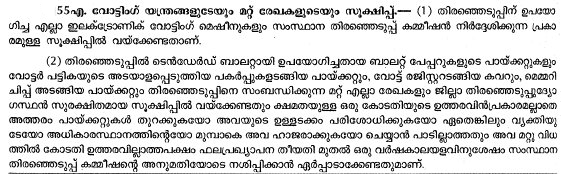
Section Rule 55A of the Kerala Panchayat Raj (Conduct of Election) Rules, 1995, pertains to the custody, inspection, and handling of election-related records, including Electronic Voting Machines (EVMs) and vote registers. It aims to regulate the safekeeping and transparency of election documents, ensuring integrity and accountability in the electoral process.
Rule 55A primarily deals with the storage, security, and inspection of election records such as ballot papers, vote registers, and electronic voting data. It stipulates that these records shall be kept in the custody of the Electoral Officer or authorized officials, and shall not be opened or produced before any person without proper orders from a competent court. It also prescribes procedures for inspection and the conditions under which records can be examined, including the production of Electronic Voting Machines and related records.
Section Rule 55A of the Kerala Panchayat Raj (Conduct of Election) Rules, 1995, plays a crucial role in maintaining the integrity, transparency, and accountability of the electoral process. It balances the rights of parties to inspect records with the need to prevent misuse and interference, ensuring that election disputes are resolved based on credible evidence and proper legal procedures.
Note: References are made to the source [Renjith VS State Election Commissioner] and related judicial pronouncements that interpret the scope and application of Rule 55A, emphasizing the importance of procedural safeguards and the limited scope of courts to direct re-inspection of EVMs during election disputes.
(i) These rules may be called the Kerala Panchayat Raj (Conduct of Election) Rules, 1995.
(ii) They shall come into force at once.
In these rules, unless the context otherwise requires,-
(a) 'Act' means the Kerala Panchayat Raj Act, 1994 (13 of 1994/7)
(b) 'Ballot Box' includes any box, bag or other receptacle used for the insertion of ballot paper by voters;
(c) 'Counterfoil' means the counterfoil appended to the ballot paper printed under the provisions of these rules;
(d) 'Form' means a form appended to these rules;
(e) 'Marked copy of the electoral roll' means the copy of the electoral roll set apart for the purpose marking the names of electors to whom ballot papers are issued at an election;
(f) 'Returning Officer' means an officer designated or nominated by the State Election Commission under Section 41 and includes the Assistant Returning Officer appointed under Section 42;
(g) 'Section' means a section of the Act;
(h) Words and expressions used, and not def
The direct election of members to the seats of a Village Panchayat, Block Panchayat and District Panchayat shall be in accordance with the provisions of the Act and these rules.
The Secretary shall report every casual vacancy arising in the office of any Member of a Panchayat to the State Election Commission through the concerned President, within one week of arising of that vacancy.
(1) Not less than 2[twenty-five] days before the date fixed for conducting election, the Returning Officer shall publish a notice in Form Number 1 in regional language or languages inviting nominations, and specifying the place at which the nomination papers are to be submitted, the hours at which the voting is held and about the commencement of the counting of votes.
(2) The notice under sub-section (1) shall be published by affixing in the office of the Returning Officer, Office of the concerned Panchayat and in such other places as may be specified by the State Election Commission.
(1) A candidate shall be nominated by means of a nomination paper in Form No. 2 and on an application in that behalf of an elector in the electoral roll of any constituency of concerned Panchayat, the Returning Officer shall provide him Form No. 2 free of cost.
(2) Every candidate shall make and subscribe an oath or affirmation before the Returning Officer or the person authorised by the State Election Commission in the Form specified in the First Schedule of the Act.
3[(2a) Every candidate shall submit before the Returning Officer, the details in Form No. 2A along with the nomination paper];
(3) The Returning Officer shall, immediately on receipt of the nomination paper, number them serially in the order of their presentation and shall note the date and time of its presentation in each nomination paper and shall issue a receipt attached to Form No. 2.
The Secretary to the State Election Commission shall sign and shall affix the office seal on the certificate issued by the State Election Commission under sub-section (3) of Section 52.
Subject to the proviso to sub-section (1) of Section 53, a candidate shall deposit or cause to be deposited one 1[two thousand rupees, four thousand rupees and five thousand rupees] for the purpose of election to a constituency of a Village Panchayat or Block Panchayat or District Panchayat respectively.
4[(1)]The Returning Officer shall, as soon as the last day and time fixed for the receipt of nomination papers is over, publish a list of nomination received, in Form No. 3 with a notice that the nomination papers will be taken up for scrutiny on the date and the place specified in the notice under Rule 5.
3[(2) Copy of the details submitted by the candidate under sub-rule (2a) of Rule 6 shall be published along with the list of nomination papers published under sub-rule (1) and the copies thereof shall be issued to other candidates and media free of cost.];
Immediately after the scrutiny of the nomination papers is over, the Returning Officer shall prepare, in Form No. 4 the list of candidates found legally nominated.
Notice for withdrawal of candidature shall be in Form No. 5 and on receipt of such notice the Returning Officer shall note the date and time of its delivery thereon and shall issue the receipt attached to the form.
(1) As soon as may be after the coming into force of these rules, the State Election Commission shall, by notification in the Gazette, publish a list of symbols and may elaborate or alter them in such manner and the Returning Officer shall then assign symbols of preference to the contesting candidates from such list:
Provided that the candidates belonging to political parties shall be assigned the same symbols assigned by the Election Commission of India:
5[Provided further that in the case of candidates belonging to political party to which Election Commission of India has not assigned symbol, such candidate shall be assigned symbols from the list of symbols published under sub-rule (1) in the order of preference noted by them.]
6[(1A) In the case where a political party recognized by or registered with the Election Commission of India is split into two or more political parties and each of such party raises claim for the same symbol ass
(1) The list under Section 57 shall be in Form No. 6 and the Symbols assigned to the candidates shall be shown against their names therein.
(2) The list under sub-rule (1) shall be published in the notice board of the office of the Returning Officer and the concerned Panchayat.
The time fixed for taking poll by the State Election Commission under Section 70 shall be published by notification in the gazette.

In order to declare a candidate as elected under sub-section (2) of Section 69, the Returning Officer shall fill up Form No.7 and signed copies of it shall be forwarded to the State Election Commission, Government, District Election Officer and the Secretary of the concerned Panchayat and an election certificate in Form No.26 shall be given to the elected candidate by obtaining an acknowledgment receipt.
The notice for appointment of an election agent under Section 58 shall be in Form No.8 and such notice with two copies shall forwarded to the Returning Officer and subject to the conditions of Section 59, the Returning Officer shall return one copy thereof to the election agent after affixing thereon his seal and signature as taken of his authority.
Any revocation under subsection (1) of Section 60 shall be in Form No. 9 and the appointment of another person under subsection (2) shall be similar to the fresh appointment of an election agent.
(1) A contesting candidate or his election agent may appoint one agent and two relief agents to act as Polling agents at each polling station.
(2) Every such appointment shall be made in Form No. 10 and the Polling agent shall deliver it to the Presiding Officer.
(3) No Polling agent shall be admitted to the Polling Station unless he has delivered to the Presiding Officer the instrument of his appointment under sub-rule (2) duly filled in and signed the declaration in the presence of the Presiding Officer.
(4) Any revocation of the appointment under sub-section (1) of Section 64 shall be delivered to the Presiding Officer in Form No. 11 and the appointment of another Polling Agent shall be similar to a fresh appointment of a Polling Agent.
(1) A contesting candidate or his election agent may appoint persons not exceeding the number equal to the number of counting tables as his counting agent or agents and notice of such appointment shall be given in Form No. 12 to the Returning Officer not later than one hour before the time fixed for the counting of votes.
(2) Any revocation under sub-section (2) of Section 64 shall be in Form No. 13 and the appointment of another counting agent shall be similar to a fresh appointment of a counting agent.
The Appointment of Presiding Officers and Polling Officers under Section 46 shall be in Form No. 14.
If an elector on election duty wishes to vote by post at an election shall send an application in Form No. 15 to the Returning Officer so as to reach him at least seven days before the date of poll or before such shorter period as the Returning Officer may allow, and if the Returning Officer is satisfied that the applicant is an elector on election duty a postal ballot paper shall be issued to him.
8[(1) The Postal ballot paper shall be in the form prescribed by the State Election Commission and it shall contain the particulars proposed by the Commission and shall be stamped with the additional words "postal ballot" on its reverse.]
(2) Postal ballot paper shall be sent by post under certificate of posting to the elector together with the following, namely:-
(a) Declaration in Form No. 16;
(b) Instructions for the electors in Form No. 17;
(c) A cover in Form No. 18;
(d) A large cover in Form No. 19;
Provided that the Returning Officer may deliver the ballot paper and forms or cause them to be delivered to such elector personally.
(3) The Returning Officer shall at the same time-
(a) Record the electoral roll number of the elector on the counterfoil of the ballot paper as entered in the marked copy of the electoral roll;
(b) make a mark 'P.B.' against the name of the elector in the marked copy of the elec
(1) An elector who has received a postal ballot paper and desires to vote on it shall record his vote in accordance with the directions contained in Part I of Form No. 17 and then enclose it in a cover in Form No.18.
(2) The elector shall sign the declaration in Form No.16 before an Officer competent to attest his signature and have the signature attested in accordance with the directions contained in Part II of Form No.17.
(3) After the elector has recorded his vote and made his declaration under sub-rules (1) and (2), he shall return the ballot paper and declaration to the Returning Officer in the cover in Form No.19 in accordance with the instructions contained in Part II of Form No. 17 so as to reach the Returning Officer before the time fixed for the commencement of counting of votes in that particular constituency.
(4) If any cover containing a ballot paper is received by the Returning Officer after the expiry of the time fixed under sub-rule (3), he shall
(1) When a postal ballot paper and other papers sent under Rule 22 are, for any reason returned undelivered, the Returning Officer may re-issue them by post under certificate of posting or deliver them or cause them to be delivered to the elector personally on a request made by the elector.
(2) If the postal ballot paper or any other paper received along with it by the elector is spoiled in such a manner that they cannot conveniently be used, he shall return it to the Returning Officer and the postal ballot paper and other papers may be re-issued to him if the Returning Officer is satisfied that it was not deliberately spoiled.
(3) The Returning Officer shall cancel the spoiled papers returned under sub-rule (2) and keep them in a separate packet after noting thereon the particulars of the election and the serial numbers of the cancelled ballot papers.


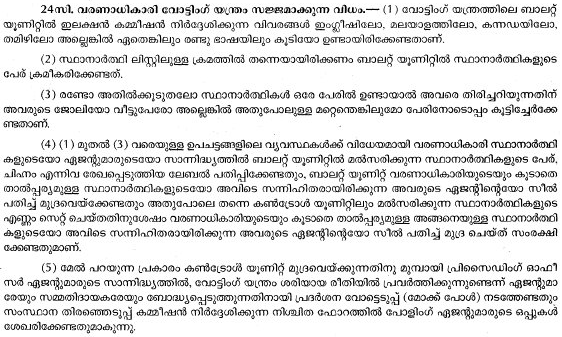
(1) Outside each Polling Station there shall be displayed prominently-
(a) a notice specifying the polling area, the electors who are entitled to vote at the polling station, and when the polling area has more than one polling station, the particulars of the electors so entitled; and
(b) a copy of the list of contesting candidates.
(2) At each polling station there shall be set up two or more voting compartments in which electors can record their votes screened from observation.
(3) The Returning Officer shall provide at each polling station a sufficient number of ballot boxes, copies of the relevant part of the electoral roll, ballot papers, instruments for stamping the distinguishing mark on ballot Papers and articles necessary for electors to mark the ballot papers.
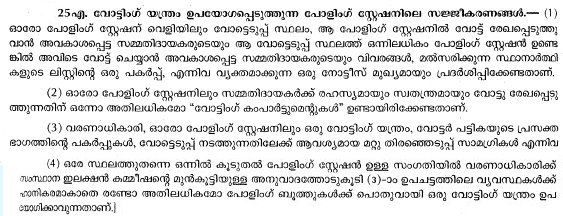
The Presiding Officer shall regulate the number of electors to be admitted at a time inside the Polling station and shall exclude therefrom all persons other than-
(a) Polling Officers;
(b) Officers on duty in connection with election;
(c) Persons authorised by the State Election Commission;
(d) Candidates, their election agents and subject to the provisions of Rule 18 one polling agent of each candidate;
(e) a child in arms accompanying an elector;
(f) a person accompanying a blind or handicapped or infirm elector who cannot move without help; and
(g) such other persons as the Returning Officer or the Presiding Officer may employ under sub-rule (2) of Rule 30 or sub-rule (1) Rule 31.
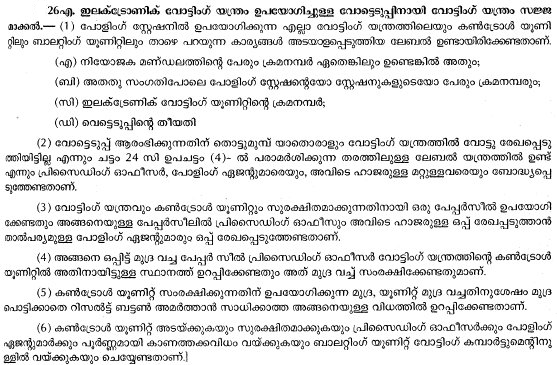
(1) The boxes shall be constructed in such a way that the ballot papers can be inserted therein but cannot be withdrawn therefrom without the box being unlocked.
(2) Where a paper seal is used for securing a ballot box, the Presiding Officer shall affix his own signature on the paper seal and obtain thereon the signatures of such of the polling agents present as are desirous of affixing the same.
(3) The Presiding Officer shall thereafter fix the paper seal so signed in the space meant therefore in the ballot box and shall then secure and seal the box in such a manner that the slip for the insertion of ballot paper therein remains open.
(4) The seals used for securing a ballot box shall be affixed in such a manner that after the box has been closed it is not possible to open it without breaking the seal.
(5) Where paper seals are not used for securing the ballot boxes, the Presiding Officer shall secure and seal the ballot box in such a manner that the sl
(1) Every ballot paper shall have a counterfoil attached thereto and the ballot paper and the counterfoil shall be in Form No.20 and the particulars therein shall be in Malayalam and in such other language as the State Election Commission may direct.
(2) The ballot papers shall be serially numbered and the number assigned to the ballot paper and counterfoil shall be the same.
(3) The names of the candidates shall be arranged on the ballot paper in the same order in which they appear in the list of contesting candidates.
(4) If two or more candidates bear the same name, they shall be distinguished by the addition of their occupation or residence or in some other manner.
Immediately before the commencement of the poll the Presiding Officer shall demonstrate to the polling agents and other persons present that the marked copy of the electoral roll to be used during the poll does not contain any entry other than those entries specified in clause (b) of sub-rule (3) of Rule 22.
(1) Where a Polling Station is for both men and women electors the Presiding Officer may direct that they shall be admitted into the Polling station alternately in separate batches.
(2) The Returning Officer or the Presiding Officer may appoint a woman to serve as an attendant at any polling station to assist woman electors and also to assist the Presiding Officer generally in taking the poll in respect of woman electors, and, in particular, to help in searching any woman elector in case it becomes necessary.
(1) The Presiding Officer may employ at the polling station such person as he thinks fit to help in the identification of the electors or to assist him otherwise in taking the poll.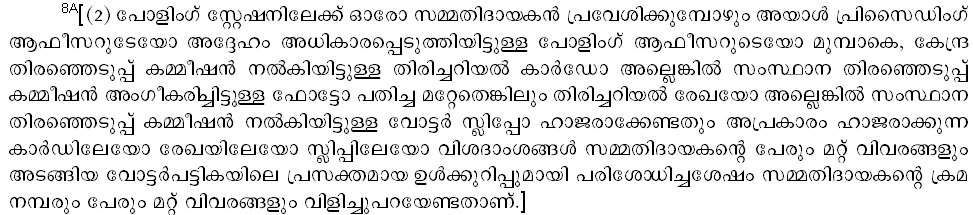
(3) In deciding the right of a person to obtain a ballot paper the Presiding Officer or the Polling Officer, as the case may be, shall overlook merely clerical or printing errors in an entry in the electoral roll, if he is satisfied that such person is identical with the elector to whom such entry relates.
8B[(x x x]
(1) Any Polling agent may challenge the identity of a person claiming to be a particular elector by first depositing a some of rupees ten in cash with the Presiding Officer for each such challenge.
(2) In the case of challenge made under sub-rule (1) the Presiding Officer shall-
(a) warn the person challenged of the penalty for personation;
(b) read the relevant entry in the electoral roll in full and ask him whether he is the person referred to in that entry;
(c) enter his name and address in the list of challenged votes in Form No.21; and
(d) require him to affix his signature in the said list.
(3) The Presiding Officer shall thereafter hold a summary inquiry into the challenge and may for that purpose,-
(a) require the challenger to adduce evidence in proof of the challenge and the person challenged to adduce evidence in proof of his identity;
(b) put to the person challenged any questions necessary for the purpose of establ
(1) Every elector about whose identity the Presiding Officer or the Polling Officer, as the case may be, is satisfied, shall allow his left forefinger to be inspected by the Presiding Officer or Polling Officer and an indelible ink mark to be put on it.
(2) If any elector refuses to allow his left forefinger to be inspected or marked in accordance with sub-rule (1) or has already such a mark on his left forefinger or does any act with a view to removing the ink mark, he shall not be supplied with any ballot paper or allowed to vote.
(3) Any reference in this rules to the left forefinger of an elector shall, in the case where the elector has his left forefinger missing, be construed as a reference to any other finger of his left hand, and shall, in the case where all the fingers of his left hand are missing, be construed as a reference to, the forefinger or any other finger of his right hand, and shall in the case where all his fingers of both the hands are missing be c
(1) Every ballot paper intended for election to a Panchayat, before it is issued to an elector and the counterfoil attached thereto shall be stamped on back with distinguished mark and every ballot paper, before it is issued, shall be signed in full on its back by the Presiding Officer.
(2) At the time of issuing a ballot paper to an elector, the Polling Officer shall,-
(a) record on its counterfoil the electoral roll number of the elector as entered in the marked copy of the electoral roll;
(b) obtain the signature or thumb impression of that elector on the said counterfoil, and if the elector is not willing to do so no ballot paper shall be issued to him;
(c) underline the entry relating to the elector in the marked copy of the electoral roll to indicate that a ballot paper has been issued to him, without however recording therein the serial number of the ballot paper issued to that elector; and
(d) in the case of woman electors, put a tick mark
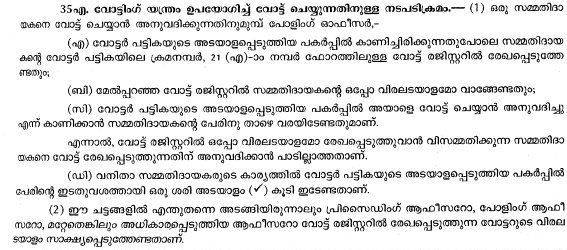
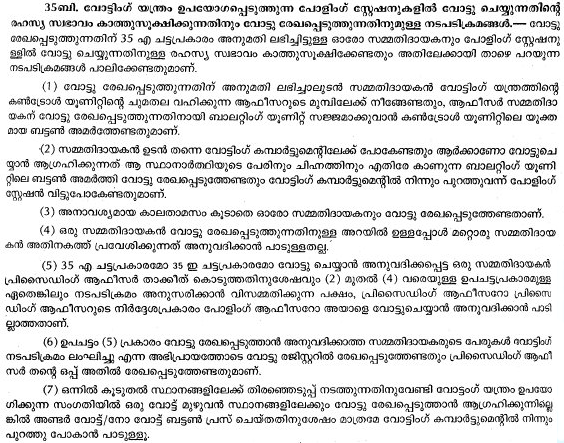
(1) Every elector to whom a ballot paper has been issued shall maintain secrecy of voting within the Polling Station.
(2) The elector on receiving the ballot paper shall forthwith,-
(a) proceed to one of the voting compartments;
(b) then make a mark on the ballot paper on the side where the names and symbols of the candidates are imprinted, with the instrument supplied for the purpose on or near the symbol of the candidate for whom he intends to vote;
(c) fold the ballot paper so as to conceal his vote;
(d) if required, show to the Presiding Officer the distinguishing mark on the ballot paper;
(e) insert the folded ballot paper into the ballot box; and
(f) quit the Polling Station.
(3) Every elector shall vote without undue delay.
(4) No elector shall be allowed to enter a voting compartment when another elector is inside it.
(5) If an elector to whom a ballot paper has been issued, refuses, after warning given by
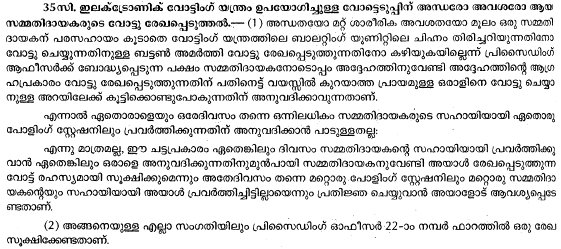

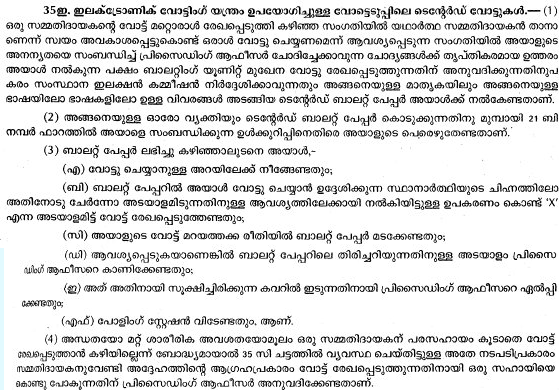
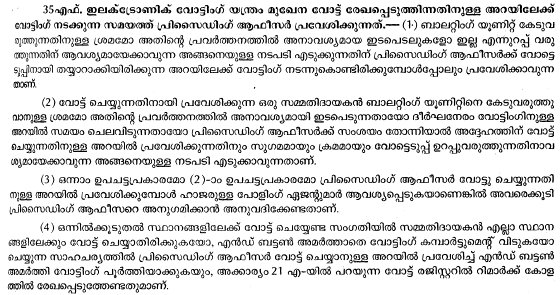

(1) If the Presiding Officer is satisfied that owing to blindness or other physical infirmity an elector is unable to recognise the symbols on the ballot paper or to make a mark thereon without assistance, the Presiding Officer shall permit the elector to take with him a companion of not less than eighteen years of age to the voting compartment for recording the vote on the ballot paper on his behalf and in accordance with his wishes, and if necessary, for folding the ballot paper so as to conceal the vote and inserting it into the ballot box:
Provided that no person shall be permitted to act as the companion of more than one elector at any Polling Station on the same day:
Provided further that before any person is permitted to act as the companion of an elector on any day under sub- rule (1), the person shall be required to declare that he will keep secret the vote recorded by him on behalf of the elector and that he has not already acted as the companion of any
(1) An elector who has inadvertently dealt with his ballot paper in such a manner that it cannot be conveniently used as a ballot paper may, on returning it to the Presiding Officer and on satisfying him of the inadvertence, be given another ballot paper, and the ballot paper so returned and the counterfoil of such ballot paper shall be marked "Spoilt cancelled" and signed by the Presiding Officer.
(2) All ballot papers cancelled under sub-rule (1) shall be kept in a separate cover.
(1) If a person representing himself to be a particular elector applies for a ballot paper after another person has already voted as such elector, he shall, on satisfactorily answering such questions relating to his identity as the Presiding Officer may ask, be entitled, subject to the other provisions of this rule, to mark a ballot paper (hereinafter referred to in these rules as a "tendered ballot paper") in the same manner as any other elector.
(2) Every such person shall, before being supplied with a tendered ballot paper, sign his name against the entry relating to him in a list in form No.23.
(3) A tendered ballot paper shall be the same as the other ballot papers used at the Polling Station except that,-
(a) such tendered ballot paper shall be serially the last in the total of ballot papers issued for use at the Polling Station; and
(b) such tendered ballot paper and its counterfoil shall be endorsed on the back with the words "tendered ballot pape
The Presiding Officer shall close a Polling Station at the hour fixed in that behalf in the notice under Rule 5 and shall not thereafter admit any elector into the Polling Station:
Provided that all electors present at the Polling Station before it is closed shall be given necessary identity slips by the Presiding Officer and they shall be allowed to cast their votes.
(2) If any question arises whether an elector was present at the Polling Station before it was closed, the decision of the Presiding Officer for that purpose shall be final.
(1) As soon as practicable after closing of the Poll, the Presiding Officer shall close the slit of the ballot box, and where the box does not contain any mechanical device for closing the slit, he shall seal up the slit and also allow any polling agent present to affix his seal.
(2) The ballot box shall thereafter be sealed and secured.
(3) Where it becomes necessary to use a second ballot box by reason of the first ballot box getting full, the first box shall be closed, sealed and secured as provided in sub-rules (1) and (2) before another ballot box is put into use.
(1) The Presiding Officer shall, after sealing the ballot box, prepare a ballot paper account in para I of Form No.24 and enclose it in a separate cover with the words "ballot paper account" superscribed thereon.
(2) The Presiding Officer shall furnish to every Polling agent present at the close of the poll a true copy of the entries made in the ballot paper account after obtaining a receipt from the said polling agent therefor and shall also attest it at a true copy.
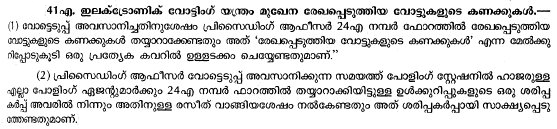
(1) The Presiding Officer shall then make into separate packets and seal,-
(a) the marked copy of the electoral roll under sub-rule (2) of Rule 34;
(b) the counterfoils of the used ballot papers;
(c) the ballot papers signed in full by the Presiding Officer under sub-rule (1) of Rule 34 but not issued to the electors;
(d) any other ballot papers not issued to the electors;
(e) ballot papers cancelled under Rule 35;
(f) any other cancelled ballot papers;
(g) the cover containing tendered ballot papers and the cover containing the list in Form No.23;
(h) the list of challenged votes in Form No.21; and
(i) any other papers directed by the State Election Commission or the Returning Officer to be kept in separate sealed packet.
(2) Each such packet shall be sealed with the seals of the Presiding Officer and with the seals either of the candidates or of his election agent or of his polling agent who may be present at th
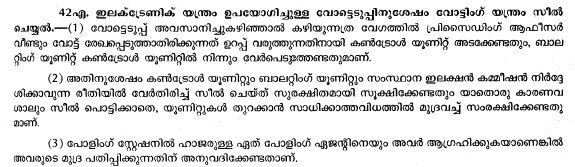
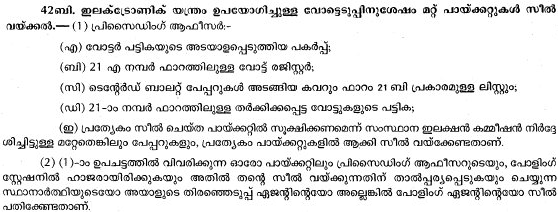
(1) The Presiding Officer shall then deliver or cause to be delivered to the Returning Officer at such place as the Returning Officer may direct,-
(a) the ballot boxes;
(b) the ballot paper account;
(c) the sealed packets under Rule 42;
(d) all other papers and articles used at the poll.
(2) The Returning Officer shall make adequate arrangements for the safe transport of all ballot boxes, packets, other papers and articles and for their safe custody until the commencement of the counting of votes.
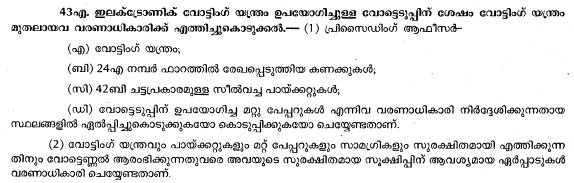
Any person who at the place and time of the counting of votes misconducts himself or fails to obey the lawful directions of the Returning Officer may be removed from the place where the votes are being counted, by the Returning Officer or by any Police Officer on duty or any person authorised in this behalf by the Returning Officer.
The Returning Officer shall, before the commencement of the counting of votes, read out the provisions of Section 125 for information of the person present there.
(1) The Returning Officer may open the ballot boxes used at more than one Polling Station and count simultaneously the votes therein.
(2) Before any ballot box is opened at a counting table, the counting agents present at that table shall be allowed to inspect the paper seal or such other seal affixed thereon and to satisfy themselves that it is intact.
(3) The Returning Officer shall satisfy himself that none of the ballot boxes has in fact been tampered with.
(4) If the Returning Officer is satisfied that any ballot box has in fact been tampered with, he shall follow the procedure laid down in Section 78.
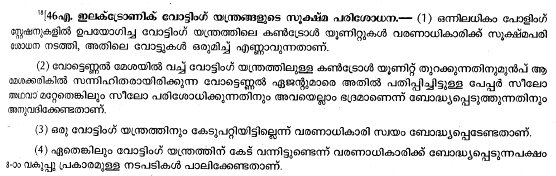
(1) The ballot papers taken out of each ballot box shall be arranged in convenient bundles and scrutinised by the Returning Officer.
(2) The Returning Officer shall reject a ballot paper,-
(a) If it bears any mark or writing by which the elector can be identified; or
(b) if no vote is recorded thereon; or
(c) if votes are given on it in favour of more than one candidate; or
(d) if the mark indicating the vote thereon is placed in such a manner as to make it doubtful to which candidate the vote has been given; or
(e) if it is a spurious ballot paper; or
(f) if it is so damaged or mutilated that its identity as a genuine ballot paper cannot be established; or
(g) if it bears a serial number, or is of a design different from the serial number, or, as the case may be, design of the ballot papers authorised for the use at the particular polling station; or
(h) if it does not bear the mark and the signature which it should hav
(1) Every ballot paper which is not rejected under Rule 47 shall be counted as one valid vote:
Provided that no cover containing tendered ballot papers shall be opened and no such ballot paper shall be counted.
(2) After the counting of all ballot papers contained in all the ballot boxes used at a Polling Station has been completed, the Returning Officer shall record the details regarding hereof in Part II of Form No.24 and in the result sheet in Form No.25 and announce the particulars.
(3) The valid ballot papers of each candidate shall thereafter be bundled separately and be kept along with the bundle of rejected ballot papers in a separate packet and shall be sealed and such of the candidates, election agents or counting agents, as the case may be, who are present there shall be allowed to affix seals thereon and the following particulars shall be recorded thereon by the Returning Officer, namely:-
(a) name of the Panchayat;
(b) name of the cons
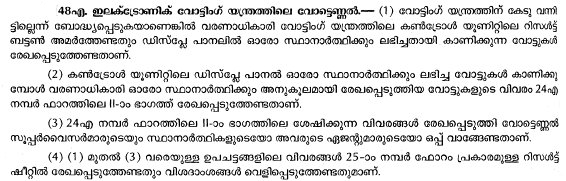
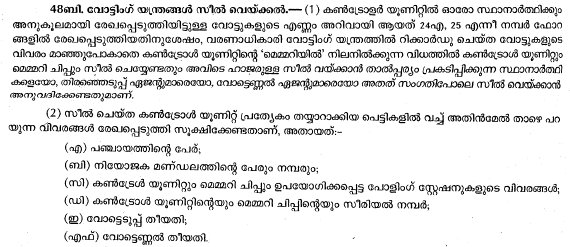
The Returning Officer shall as far as practicable, proceed continuously with the counting and shall, during any interval when the counting has to be suspended, keep the ballot papers, packets and all other papers relating to the election sealed with his own seal and the seals of such candidates or election agents who may desire to affix their seals and take sufficient precaution for their safe custody during such intervals.
(1) The Returning Officer shall, before the commences the counting of ballot papers in the ballot box, deal with the postal ballot papers in the manner hereunder provided; namely:-
(a) No cover secured in packets under sub-rule (4) of Rule 23 shall be opened and no vote contained in any such cover shall be counted;
(b) The other covers in Form No. 19 shall be opened one after another and when each cover is opened, the declaration in Form No.16 contained therein shall be scrutinised first;
(c) If the above said declaration is not found therein or has not been duly signed and attested, or is otherwise substantially defective, or if the serial number entered in Form No.16 differs from the serial number endorsed on the face of the cover in Form No. 18, that cover shall not be opened, and after making an appropriate endorsement thereon, the ballot paper contained therein shall be rejected;
(d) Each such cover so endorsed and the declaration received together w
(1) After the completion of the counting of votes under Rule 48 and Rule 50, the Returning Officer shall record in the result sheet in Form No.25 the total number of votes recorded in favour of each candidate and announce the particulars.
(2) After the announcement of particulars so made, a candidate or, in his absence his election agent may apply in writing to the Returning Officer to recount the ballot papers either wholly or in part stating the grounds on which he demands such re-count.
(3) On such an application being made the Returning Officer shall decide the matter and may allow the application in whole or in part or may reject it, in toto if it appears to him to be frivolous or unreasonable.
(4) Every decision of the Returning Officer under sub-rule (3) shall be in writing and shall contain the reasons therefor.
(5) If the Returning Officer decides under sub-rule (3) to allow an application either wholly or in part, he shall,-
(a) re-count
(1) On completion of procedures under Rule 51 the Returning Officer shall forthwith, subject to the provisions of Rule 53 declare 9[(in Form No.25A)] the candidate to whom the largest number of valid votes have been given, to be elected under the provisions of Section 80 and shall issue him a certificate of election in Form No. 26 on obtaining an acknowledgment of its receipt.
(2) The Returning Officer shall complete and certify the return of election in Form No. 27 and send signed copies thereof to the State Election Commission, Government, District Election Officer and Secretary of the concerned Panchayat.
If ballot papers are counted at more places than one, the provisions of Rules 44, 45, 46, 47, 48 and 49 shall apply to the counting at each such place, but the provisions of Rules 50, 51 and 52 shall apply only to the counting at the last of such places.
The Returning Officer shall permit, on an application of any candidate or his election agent to take copy of the result sheet in Form No.25.
(1) All ballot boxes used at an election shall be kept in such custody as the State Election Commission may direct.
(2) The District Election Officer shall keep in safe custody, the packets of used ballot papers whether valid, rejected, cancelled or tendered, packets of unused ballot papers, packets of marked copy of the electoral roll under clauses (c) and (d) of sub-rule (2) of Rule 34 and all other records relating to election, and such packets shall not be opened and their contents shall not be inspected or produced before any person or authority except under the order of a competent court and shall arrange to destroy them after one year from the date of declaration of result, with the approval of State Election Commission, unless there is court order to the contrary.
(1) The account of election expenses under sub-section (1) of Section 85 shall contain the following particulars in respect of each item of day-to-day expenditure, namely:-
(a) the date on which the expenditure was incurred or authorised;
(b) the nature of expenditure (as for example, travelling, postage or printing or for other matters of like nature);
(c) the amount of expenditure-(i) the amount paid;
(ii) the amount outstanding;
(d) the date of payment;
(e) the name and address of the payee;
(f) the serial number of vouchers, in the case of amount paid;
(g) the serial number of bills if any, in the case of amount outstanding;
(h) the name and address of the person to whom the amount outstanding is payable.
(2) A voucher shall be obtained for every item of expenditure unless from the nature of the case, such as postage, travel by rail and the like, it is not practicable to obtain a voucher.
(3) All vouche
The 10[officer authorised by the State Election Commission] shall, within two days from the date on which the account of election expenses has been lodged under Section 86, cause a notice to be affixed in his notice board, specifying-
(a) name of the candidate;
(b) the date on which the account has been lodged; and
(c) the time and place at which such account can be inspected.
Any person shall on payment of a fee of five Rupees, be entitled to inspect any such account under Section 86 and any person on payment of such fee as may be fixed by the State Election Commission in this behalf be entitled to obtain attested copies of such account or of any part thereof.
The election expenses under Section 85 of a candidate to any constituency of a Village Panchayat, Block Panchayat or District Panchayat shall not exceed 12[ten thousand rupees, thirty thousand rupees or sixty thousand rupees] respectively.
The State Election Commission may give necessary directions and take steps, to implement the provisions of these rules effectively in accordance with the provisions of the Act and these rules.
The affidavit referred to under the proviso to sub-section (1) of Section 91 shall be in Form No. 28 and it shall be sworn before a Magistrate of the fist class or a Notary.
Funds given by the Government under Section 148 shall be adjusted, within one year from the date of election, from the grant-in-aid given to the concerned Panchayat from the Consolidated Fund of the State.
| FORM 1 |
| (See Rule 5) |
| NOTICE OF ELECTION |
| Election to the..............................................*Village Panchayat/Block Panchayat/District Panchayat from constituency (No. and name).............................. |
| Notice is hereby given for the following matters |
| 1. An election is to be held to elect a member |
(This does not form part of the Notification, but is intended to indicate its general purport.) Subsection (1) of Section 254 of the Kerala Panchayat Raj Act, 1994 (13 of 1994) empowers the Government to make rules, to carry out all or any of the provisions of the Act. The direct election of the members to the seats of a Panchayat shall be in accordance with the provisions of the Act and the rules made thereunder. Moreover, the Government have to prescribe the manner of issuing the public notice and form for the election under Section 50, the form of nomination paper under Section 52, the deposit amount under Section 53, the particulars to be included in the notice of withdrawal of candidature under Section 56, the manner of publication of list of contesting candidates and the form under Section 57, the manner of appointment of election agent under Section 58, the manner of appointment of another election agent under Section 60 when the revocation of the appointment or death of an e
(1) As soon as may be after the expiration of the time specified in Section 86 for the lodging of the account of election expenses at any election, the District Election Officer shall report to the State Election Commission,-
(a) name of each contested candidate;
(b) whether such candidate has lodged his account of election expenses and if so, the date on which such account has been lodged; and
(c) whether such account has been lodged within the time limit and as required by the Act and these rules.
(2) Whether the 11[officer authorised by the State Election Commission] is of the opinion that the account of election expenses of any candidate has not been lodged as required by the Act and these rules, he shall with the report under sub-rule (1) forward to the State Election Commission the account of election expenses of such candidate and the vouchers lodged along with it.
(3) A copy of the report forwarded by the District Election Office
Legal Comments
"Introduction" - Kerala Panchayat Raj (Conduct of Election) Rules, 1995 (Rules) operate under Kerala Panchayat Raj Act, 1994; key focus is fair conduct of local body elections and identification of electors, safeguarding against malpractices; Rule framework integrates with Section 48A, Rules 31-33, and Form 2A requirements. [Satheesan S/o. Gopalan VS State Election Commission]
"What Section Says" - Section 52(1A) and Rule 6(2a) of Kerala Panchayat Raj Act/Rules establish mandatory disclosure of criminal antecedents in nomination Form 2A; Section 102(1)(d)(iv) and related provisions empower setting aside elections for non-compliance; State Election Commission (SEC) has overarching supervisory role per Article 243K. [George Joseph VS P. K. Ramachandran] [Lucy Joseph VS Elikutty James]
"Essential ingredients" - A valid election petition must allege specific grounds (corrupt practices, improper reception/rejection of votes, non-compliance with Act/Rules); pleadings must follow CPC requirements (Order 6) and Rule 62/Form 28 affidavit when corrupt practices are alleged; proper notice and opportunity to respond are essential. [Peddireddy Venkata Satyanarayana Murthy @ Chittibabu VS Election Tribunal-cum-Principal Junior Civil Judge, Yelamanchili, Visakhapatnam District] [Swayamprabha VS Chandramathy]
"Scope of Section" - Article 243K vests superintendence, direction and control of elections in the State Election Commission; Rules 59-61 in Rajasthan case struck down as ultra vires to Article 243K, illustrating that state rules cannot override SEC’s purview; Kerala framework aligns with constitutional structure by channeling conduct of elections to SEC via Rule 12/Rules 31-33, Form 2A, etc. [017000?/Renjith VS State Election Commissioner] [Sunita VS Saroj]
"Punishment for Section" - Elections can be declared void for non-compliance with Act/Rules; penalties include disqualification under Section 35(1)(f) and Rule 3(iii) of Kerala Panchayat Raj (Removal of Disqualification...) Rules, 1995; disqualification extends for specified periods (e.g., 5 years under Sec 33/153(16)) and can be subject to writ/appeal challenges. [Lucy Joseph VS Elikutty James] [T. M. Mujeeb S/o. Muhammed VS Kerala State Election Commission] [Geetha Sukumaran VS State Election Commission, Kerala State, Thiruvananthapuram]
"Legal standing on videography and police protection" - Court directives in Kerala Local Bodies elections have authorized police protection for candidates and voters; videography at sensitive/vulnerable polling stations is guided by Rule 31-33 and the court’s ratio emphasizing free and fair elections with security measures. [Satheesan S/o. Gopalan VS State Election Commission]
"Rule 59/60/61 mechanics (Rajasthan reference)" - When applicable, Rule 59 (Pradhan election by elected members of Panchayat Samiti), Rule 60 (counting procedure), Rule 61 (Pramukh election by Chief Executive Officer) were held ultra vires in Rajasthan, illustrating constitutional constraint on transferring SEC powers; Kerala rules preserve SEC primacy for conduct of elections. [017000?] [Shripal Jain VS State of Rajasthan]
"Position on nomination/recount rulings" - Several decisions emphasize proper pleading for corrupt practices (Rule 3(ii), Rule 12(d)(iv)); recounts or invalid ballots require strict compliance with Rule 58-60 in AP/ Kerala contexts; improper acceptance/rejection of nominations can be grounds for setting aside elections. [Peddireddy Venkata Satyanarayana Murthy @ Chittibabu VS Election Tribunal-cum-Principal Junior Civil Judge, Yelamanchili, Visakhapatnam District] [Kulluri Yadagiri VS Sagaria Saidulu] [Bukke Lakshma Nail VS State Election Commission, Secunderabad]
"Electronic voting and EVM inspection" - Courts acknowledge EVM-related petitions; Section 88/Rule 55A(2) allow inspection but final determination rests with Election Court; courts cannot direct re-checking of EVMs at will; expert evidence and production of machines may be deemed necessary to prove EVM functioning. [Renjith VS State Election Commissioner]
"Standing Committee elections – Kerala nuance" - Kerala Standing Committee elections (Rules 2000) involve proportional representation; judgements require alignment of Rules with the Act; amendments may be necessary to ensure simultaneous PR-Vote for multiple vacancies; governance structure shows no formal ruling vs opposition dichotomy at local level. [K. K. Viswanathan Master VS Lalitha Rajagopal] [Beena Kaniyankunnel, Arunagapally VS Kerala State Election Commission, Thiruvananthapuram]
"Disqualification and post-election petitions" - Section 35(1)(f) and Rule 3(iii) carve out exceptions for contracts undertaken for community benefit; however, if a member has personal interest in a subsisting contract outside permitted exceptions, disqualification applies; courts emphasize strict reading of disqualification provisions. [T. M. Mujeeb S/o. Muhammed VS Kerala State Election Commission] [T. M. Mujeeb S/o. Muhammed VS Kerala State Election Commission]
"Visibility of symbol allocation and parties" - Kerala Rules allocate symbols to party-endorsed candidates; Court has addressed concerns about symbols being assigned by SEC/State rules; Judgment supports that symbols should reflect party sponsorship only to the extent permitted by statute and Rule 12; however, constitutional amendments support non-party candidacy with party support. [John Joseph VS State of Kerala Rep. by Secretary, Department of Local Self Government] [Shyni Santhosh W/o. Santhosh VS Cyriac George @ Benny Kachiramattam S/o. George]
"Rule 12/Rule 63 interplay in AP context" - AP Rules 2006 (Rule 63) specify election petitions for Sarpanch/Ward roles; AP cases emphasize that after declaration of results, Election Tribunal handles disputes; transfer of petitions between tribunals has been addressed with jurisdictional clarity. [Bukke Lakshma Nail VS State Election Commission, Secunderabad] [Nimmaka Jaya Raj VS Government of Andhra Pradesh, Represented by its Principal Secretary, General Administration Department]
"Notable constitutional anchors" - Article 243K anchors SEC’s authority; Article 243D/243E/243B frameworks influence delimitation, term duration and reservation; Kerala case law reinforces SEC supremacy in conduct and supervision of elections, with state acts conforming to constitutional architecture. [John Joseph VS State of Kerala Rep. by Secretary, Department of Local Self Government] [017000.../Renjith VS State Election Commissioner]
"Reliance on Form No.2A and fake details" - Non-disclosure or false details in Form No.2A can render election void under S.52(1A) and S.102(1)(ca); however, mere imperfect pleadings without falsity may not suffice; appellate courts require precise pleading to trigger invalidation. [Gopalakrishnan N. , S/o. Narayanan VS A. Sarasi, D/O. Appi Amma] [Lucy Joseph VS Elikutty James]
"Post-2020 disqualifications and defection rules" - Kerala’s 1999 Defection Act interplay with Panchayat/ Municipality rules (Section 3(1)(c), 4(3)); recent jurisprudence treats defections and party alignment through statutory schemes, affecting standing committee composition and disqualification consequences. [Sheeba George W/o George VS State Election Commission of Kerala]
"General limitation about remedies" - Article 243-O bar is recognized, but election petitions under Section 233 of various Acts provide the remedy; High Courts emphasize that extraordinary remedies under Article 226 should not normally override statutory election petitions unless there is a compelling due process issue. [Lucy Joseph VS Elikutty James] [Jadhav Mohan Singh VS Election Tribunal-cum-Agency Divisional Officer/Revenue Divisional Officer, Utnoor, Adilabad District]
"Judicial approach to videography at polling" - Courts have allowed limited videography at sensitive polling locations and directed expenses to petitioners; this aligns with ensuring transparency but not to defeat statutory immunity for officers in charge of elections. [Satheesan S/o. Gopalan VS State Election Commission]
"Impact of Rule invalidation on ongoing processes" - When SEC rules (like Rules 59/61 in Rajasthan) are struck down as ultra vires, SEC retains control under constitutional framework; Kerala’s approach maintains SEC primacy and ensures conformity with Part IX constitutional amendments. [Mahipal Singh VS State of Rajasthan] [George Joseph VS P. K. Ramachandran]
"Conclusion" - The Kerala framework, as reflected in the cited sources, upholds State Election Commission’s central role under Article 243K, ensures fair electoral process through Rule 31-33, Form 2A disclosures, and stringent grounds for voiding elections, while balancing with procedural safeguards and remedies via Election Petitions; divergence from other states’ rules (e.g., Rajasthan) underscores constitutional alignment. [Satheesan S/o. Gopalan VS State Election Commission] [Shripal Jain VS State of Rajasthan]

Elevate your legal practice with advanced AI-driven research and drafting solutions. Experience unmatched efficiency, precision, and security, tailored exclusively for legal professionals.


An indispensable Tool for Legal Professionals, Endorsed by Various High Court and Judicial Officers
Please visit our Training & Support
Center or Contact Us for assistance

Scan Me!
India’s Legal research and Law Firm App, Download now!


For Daily Legal Updates, Join us on :



 Back to top


 AI Assistant





