


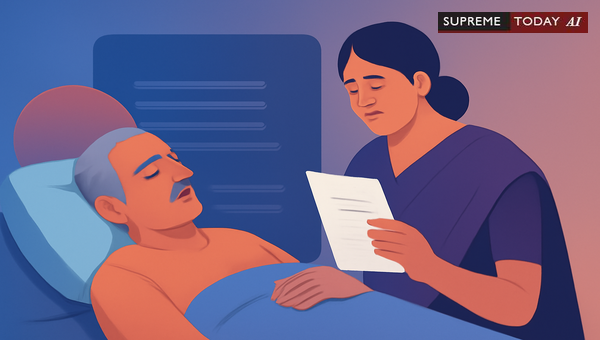
Money Demands in Dying Declaration: Does Apply?
In the realm of criminal law, hold significant weight, often serving as pivotal evidence in cases involving unnatural deaths. But what happens when a deceased person attributes their suicide to relentless demands for repayment of borrowed money? Does this automatically invoke , which punishes ? This question arises frequently in disputes involving financial pressures and self-inflicted harm.
We'll explore this issue step-by-step, drawing from established legal principles and judicial precedents. Note: This article provides general information based on legal analyses and is not a substitute for professional legal advice. Consult a qualified lawyer for case-specific guidance.
The Legal Question at Hand
Consider this scenario: If the deceased writes a dying declaration stating that he dies due to demand of borrowed money, does attract? This query probes the intersection of evidentiary rules under the and substantive criminal liability under the IPC.
are powerful but scrutinized pieces of evidence. They must not only be admissible but also reliable to sustain convictions, especially in sensitive abetment cases.
What is a Dying Declaration?
A dying declaration is a statement made by a person who is on the verge of death, explaining the cause of their impending death or the circumstances leading to it. Under , such declarations are admissible as an exception to the , provided they relate directly to the cause of death or associated circumstances. As noted in legal precedents, A dying declaration is admissible as evidence under Section 32 of the , provided it relates to the cause of death or the circumstances leading to it. The declaration must be closely connected to the actual transaction resulting in death 2000 5 Supreme 205.
However, reliability is paramount. Courts demand that the declaration be free from suspicion, voluntary, and preferably corroborated by independent evidence, particularly if discrepancies exist. The reliability of a dying declaration is crucial; it must be free from suspicion and corroborated by other evidence when discrepancies arise 1997 0 Supreme(MP) 371.
In cases of multiple , inconsistencies can undermine the prosecution's case. For instance, in one matter, contradictory statements led to acquittal, with the court emphasizing, Inconsistencies in and weak evidence of abetment led to the acquittal of the accused 2024 0 Supreme(Bom) 214. Similarly, another judgment highlighted that the court found no evidence of abetment under ... based on the contradictory 2024 0 Supreme(Cal) 719.
Understanding :
states: If any person commits suicide, whoever abets the commission of such suicide, shall be punished with imprisonment...
To invoke this section, the prosecution must prove two key elements:1. The deceased indeed committed suicide.2. The accused intentionally instigated, aided, or encouraged the act.
Mere harassment or financial pressure does not suffice. To establish abetment, the prosecution must prove: The deceased committed suicide. The accused had the intention to instigate or aid the deceased in committing suicide 2016 0 Supreme(HP) 614 2008 0 Supreme(MP) 572. Importantly, Mere demands for money or threats regarding repayment do not automatically constitute abetment unless they are accompanied by instigative actions or words that directly lead to the suicide 1997 0 Supreme(MP) 371 2018 0 Supreme(Mad) 3334.
Judicial interpretation reinforces this. In a case involving money lending, the court observed: applicants cannot be said to be wrong in demanding their money back -- it cannot be said that applicants No. 1 and 3 had lent money to deceased -- neither offence under section 306, IPC is made out 2018 0 Supreme(MP) 773. The definition of instigation is strict: a person can be said to have instigated another person, when he actively suggests or stimulates him by means of language, direct or indirect -- instigate -- means, to goad or urge forward or to provoke, incite, urge or encourage to do an act 2018 0 Supreme(MP) 773.
Applying the Law: Demands for Borrowed Money in
If the dying declaration claims death resulted from demands for borrowed money, it may raise suspicions under . However, courts typically require more than a mere allegation of pressure.
Evidentiary Threshold: The declaration must explicitly link the demands to direct instigation. For example, stating I am dying due to constant demands for money might suggest harassment but falls short without proof of intent to provoke suicide. Courts have ruled that if the dying declaration merely states financial demands without indicating direct instigation or threats leading to suicide, it may not suffice to establish guilt under 2022 0 Supreme(MP) 375 1997 0 Supreme(MP) 371.
Corroboration Essential: Standalone declarations, especially if inconsistent, rarely convict. In a burns case, even if accepted in toto, it does not establish the charge under Section 306 of IPC because it lacked abetment proof 2019 0 Supreme(Mad) 3338. Another ruling clarified: Missing of the vital aspect in the dying declaration... will miss an offence under 2016 0 Supreme(Mad) 576.
Context Matters: Financial disputes alone do not equate to abetment. In a money-lending scenario tied to unfulfilled promises, mere threats (even referencing affiliations like ) did not constitute abetment 2018 0 Supreme(MP) 773.
Cases also distinguish ' use across sections. They cannot prove cruelty under if death is not under inquiry: a dying declaration cannot be used for convicting an accused under 2016 0 Supreme(Chh) 254 2014 0 Supreme(Mad) 1198.
Insights from Landmark Cases
Judicial scrutiny is evident across precedents:
Inconsistencies Lead to Acquittal: In a dowry-related suicide by immolation, the court found inconsistencies in the and weak evidence of abetment, leading to the acquittal 2024 0 Supreme(Bom) 214.
No Direct Link, No Conviction: Where a wife alleged beating but self-immolated, the declaration did not support Section 306, resulting in conviction only under 2019 0 Supreme(Mad) 3338.
Demanding Repayment Not Abetment: Even with recorded threats, courts quashed charges: merely because they belong to an association, would not by itself mean that applicants abetted deceased to commit suicide 2018 0 Supreme(MP) 773.
Multiple Declarations Analyzed: Courts evaluate each intrinsically, granting bail where arguable points exist 2016 0 Supreme(Mad) 576.
These cases underscore that while a dying declaration blaming money demands may initiate investigation, conviction demands robust proof of (guilty intent).
Practical Recommendations
For those facing such charges or investigating:- Corroborate Thoroughly: Collect witness statements, financial records, and prior complaints to support or refute the declaration 1997 0 Supreme(MP) 371.- Scrutinize Context: Assess if demands crossed into instigation—e.g., explicit suicide suggestions.- Challenge Weak Evidence: Highlight inconsistencies or lack of intent, as in acquittals under Sections 498A/306 2024 0 Supreme(Cal) 719.
Key Takeaways
- A dying declaration attributing suicide to borrowed money demands may support proceedings but rarely leads to conviction without clear instigation proof and corroboration.
- Reliability under Section 32, Evidence Act, is non-negotiable; inconsistencies often doom cases 2024 0 Supreme(Bom) 214.
- Financial pressure alone isn't abetment—intent to provoke suicide must be evident 2018 0 Supreme(MP) 773.
In summary, while such declarations trigger scrutiny, Indian courts prioritize evidence over emotion. Always seek expert legal counsel to navigate these complexities.
References: 2000 5 Supreme 205 2016 0 Supreme(HP) 614 1997 0 Supreme(MP) 371 2022 0 Supreme(MP) 375 2021 0 Supreme(Mad) 1744 2024 0 Supreme(Bom) 214 2024 0 Supreme(Cal) 719 2019 0 Supreme(Mad) 3338 2018 0 Supreme(MP) 773 2016 0 Supreme(Chh) 254 2016 0 Supreme(Mad) 576 2014 0 Supreme(Mad) 1198
#IPC306 #DyingDeclaration #AbetmentSuicide












