


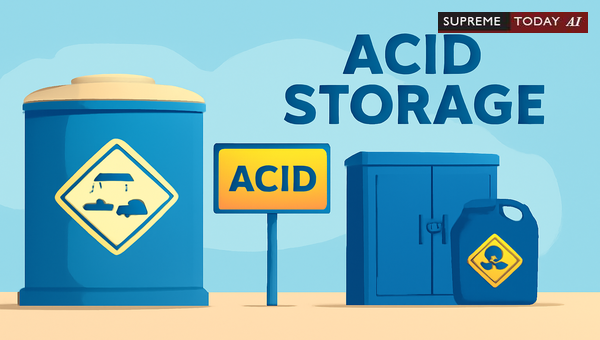
Acid Storage Rules in India: Complete Legal Guide
Introduction
In industries ranging from manufacturing to laboratories, the proper storage of acids like hydrochloric, nitric, and sulphuric acid is critical not just for operational efficiency but for legal compliance and public safety. Mishandling corrosive substances can lead to severe accidents, environmental damage, or legal penalties. If you're asking, Acid Storage Rules?, you're likely navigating the complex regulatory landscape in India.
This guide breaks down the key laws, licensing requirements, safety protocols, and best practices for acid storage. Drawing from central acts, state rules, and expert clarifications, we'll help businesses and practitioners understand their obligations. Note: This is general information and not specific legal advice. Consult a qualified lawyer for your situation.
Overview of the Legal Framework
Acid storage and handling in India fall under multiple regulations, primarily the , , and the (). These laws aim to prevent misuse, ensure safety, and protect the environment. State-specific rules, like those from the , add layers of compliance. 2020 2 Supreme 326
For instance, sites storing hydrochloric acid, nitric acid, and sulphuric acid often use rubber-lined tankers, empty cans, and barrels. 2024 Supreme(Online)(NGT) 370 2024 Supreme(Online)(NGT) 2166 2024 Supreme(Online)(NGT) 4174
Key Acts and Their Scope
- : Covers storage of petroleum Class A, which may extend to certain acids based on classification.
- : Regulates sales to curb misuse, with model rules prohibiting over-the-counter sales without ID and justification. 2016 1 Supreme 210 2013 0 Supreme(SC) 1175
- : Defines critical terms like , meaning storage of a hazardous chemical, other .... separate from installation sites in . 2024 Supreme(Online)(NGT) 370 2024 Supreme(Online)(NGT) 2166
The TNPCB clarifies that 'Red' category classification applies only to of hazardous chemicals in , regulated by the under the .
Licensing Requirements for Acid Storage
Licensing is threshold-dependent and hinges on quantity and storage type.
Provisions
- No license needed for small quantities of petroleum Class A (up to 30 liters). 2020 2 Supreme 326
- For 30-300 liters, a license under is required.
- Over 300 liters, especially in tanks exceeding 1,000 liters (bulk storage), requires a license under . 2020 2 Supreme 326
Acids in bulk tanks trigger these rules, emphasizing the distinction between bulk and non-bulk storage.
Hazardous Chemicals Rules
of acids like those mentioned requires specific oversight. Multiple facilities store these acids in dedicated equipment, falling under for hazardous activities including storage and transport. 2024 Supreme(Online)(NGT) 4622 2023 Supreme(Online)(NGT) 4894
Regulation of Acid Sales and Possession
To prevent attacks and misuse, sales are tightly controlled:- Mandatory buyer identification and purchase justification.- Registration of acid stocks with local authorities. 2016 1 Supreme 210 2013 0 Supreme(SC) 1175- In labs or premises, a designated person oversees possession: A person shall be made accountable for possession and safe keeping of acid in the premises. 2017 0 Supreme(UK) 180
Storage must use a for security: (c) The storage of acid/corrosive shall be under to ensure more security. 2017 0 Supreme(UK) 180
Compulsory checks on personnel leaving storage areas: There shall be of the students/personnel leaving the laboratories/place of storage where acid is used. 2019 0 Supreme(P&H) 1330 2017 0 Supreme(UK) 180
The is responsible for enforcement: The concerned shall be vested with the responsibility of taking appropriate action for the breach/default/violation. 2019 0 Supreme(P&H) 1330 2016 0 Supreme(Del) 2122
Safety and Environmental Considerations
Safety protocols are non-negotiable to avert leaks and contamination.
Storage Best Practices
- Use proper containment like rubber-lined tankers for corrosive acids. 2024 Supreme(Online)(NGT) 3039 2024 Supreme(Online)(NGT) 3627
- Regular inspections and maintenance. 2000 8 Supreme 31802
- Supervision by a responsible person: The acid shall be stored under the supervision of this person. 2019 0 Supreme(P&H) 1330 2016 0 Supreme(Del) 2122
Environmental risks, such as pitting from oxidation due to acidic traces in storage atmospheres, highlight the need for dry, controlled conditions: This is possible only during storage because traces of acid will always be present in the atmosphere surrounding the Refinery.
National Insurance Co. Ltd. VS Bharat Heavy Electricals Ltd. -
In tapping processes, acids like dilute sulphuric (20%) require specific glassware for mixture preparation and storage. 2019 0 Supreme(UK) 316
Specifics
For 'Red' category sites, compliance with ensures separation from other operations, minimizing risks. 2024 Supreme(Online)(NGT) 1894 2024 Supreme(Online)(NGT) 4559
Key Findings and Compliance Essentials
- Licensing Thresholds: Exceeding limits mandates licenses; bulk vs. definitions are pivotal. 2020 2 Supreme 326
- Sales Controls: Documentation and registration prevent diversion.
- Safety Emphasis: Double locks, supervision, and checks are standard. 2017 0 Supreme(UK) 180
- Regulatory Oversight: Central rules plus state bodies like TNPCB govern classifications.
Non-compliance risks fines, shutdowns, or liability under environmental laws.
Recommendations for Businesses and Practitioners
For Businesses
- Conduct audits to verify licensing based on quantities and tank sizes.
- Implement double-lock systems and personnel checks.
- Register stocks and train staff on . 1964 0 Supreme(SC) 98
For Legal Practitioners
- Monitor updates to model rules and state notifications.
- Advise on documentation to defend against inspections.
- Highlight TNPCB's clarification for consents.
Regular compliance checks mitigate risks.
Conclusion and Key Takeaways
Acid storage rules in India weave a tight net of licensing, sales controls, and safety measures under the , , and . From small labs to industrial sites handling hydrochloric, nitric, or sulphuric acid, adherence prevents legal pitfalls and hazards.
Key Takeaways:- Licenses required for quantities over 30 liters; bulk over 1,000 liters. 2020 2 Supreme 326- Use supervised, secure storage with double locks. 2017 0 Supreme(UK) 180- Register sales and stocks; check '' status.- Prioritize containment and inspections. 2000 8 Supreme 31802
Stay proactive—compliance safeguards your operations. For tailored advice, engage legal experts.
#AcidStorageRules #IndiaLaw #HazardousChemicals















