Searching Case Laws & Precedent on Legal Query.....!
Scanned Judgements…!



Searching Case Laws & Precedent on Legal Query.....!
Scanned Judgements…!
AMARIS APPU v. PALIS APPU
"], ["2026 Supreme(Online)(MP) 1940"].AMARIS APPU v. PALIS APPU
"], ["2026 Supreme(Online)(Del) 2689"], ["2023 0 Supreme(Cal) 629"].AMARIS APPU v. PALIS APPU
"].Statements made during police custody, or confessions not made in accordance with legal provisions, are generally inadmissible, and such confessions cannot be used to establish guilt or connect co-accused unless specifically permitted by law ["
JUSTIN FERNANDO v. INSPECTOR OF POLICE
"], ["2024 0 Supreme(Gau) 1055"], ["THE QUEEN v. BUDDHARAKKITA AND 2 OTHERS
"].Use of Confessions and Statements
AMARIS APPU v. PALIS APPU
"], ["2026 Supreme(Online)(Del) 2689"], ["2023 0 Supreme(Cal) 629"].AMARIS APPU v. PALIS APPU
"], ["KING v. APPU SINNO
"], ["2024 0 Supreme(Gau) 1055"].Statements or confessions that are exculpatory or made outside the proper legal framework are not admissible as evidence against the accused or co-accused ["
KING v. ATTYGALLE ET AL
"], ["SEYADU v. THE KING
"].Identification and Other Evidence
KELUM AND OTHERS VS. ATTORNEY GENERAL
"].The identity of an accused can be established through witness testimony and admissible forensic evidence, but reliance solely on confessional statements, especially if inadmissible, is insufficient ["
KELUM AND OTHERS VS. ATTORNEY GENERAL
"].General Principles and Limitations
AMARIS APPU v. PALIS APPU
"], ["2026 Supreme(Online)(Del) 1350"].KING v. APPU SINNO
"], ["2024 Supreme(US)(ca8) 61"].Analysis and Conclusion:The legal framework restricts the use of statements and confessions of co-accused to safeguard against wrongful convictions. Such evidence is generally inadmissible as substantive proof unless made during a joint trial and under specific statutory conditions (Section 30 of the Evidence Act). Cross-examination of co-accused is permitted but can be limited to prevent prejudice, and confessions obtained unlawfully or outside the scope of statutory provisions are inadmissible. Overall, the admissibility of co-accused's statements hinges on strict procedural compliance and their role as supporting rather than primary evidence.
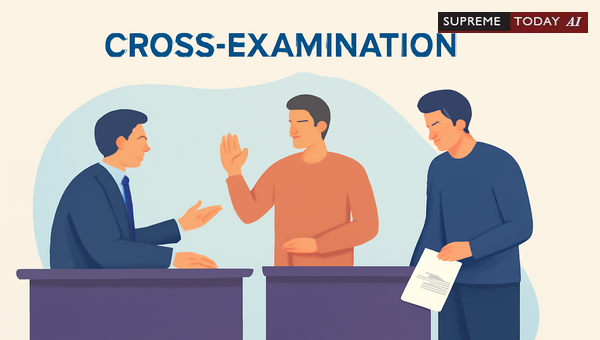
In criminal trials, the right to witnesses is a cornerstone of fair justice. But what happens when evidence is presented without giving the accused—or their co-accused—the chance to test it? Is such evidence , especially against a co-accused? This question often arises in inquiries under or when relying on confessions from one accused against another.
The core issue: cross no used against his co-accused. In simple terms, can evidence from a witness, where no cross-examination occurred, be used against a co-accused? Let's break it down based on Indian provisions and key judicial precedents. Note: This is general information and not specific legal advice—consult a lawyer for your case.
Under , evidence given by a witness without the accused having the right or opportunity to is not against that accused and cannot form the basis of . This extends to co-accused unless strict conditions are met, such as a under Section 30, where a confession by one may be considered against others—but only as weak evidence requiring . 2004 2 Supreme 140
Key principles:- In inquiries, the accused has no right to prosecution witnesses, making such statements . 2004 2 Supreme 140- Co-accused confessions under Section 30 are only in joint trials, carry weak evidentiary value, cannot sole-basis convictions, and need independent . 2009 0 Supreme(SC) 1408 1952 0 Supreme(SC) 17- Without or cross-exam rights, such evidence is against the other accused. 2021 8 Supreme 583
Section 33 permits in subsequent proceedings only if the adverse party (the accused) had the right and opportunity to in the earlier stage. In , the held: the accused has no right at all to cross examine any witness examined on behalf of the prosecution. Thus, statements from inquiries cannot form the basis of . 2004 2 Supreme 140
Even if recorded before without the specific accused's cross-exam, evidence may be , but its weight is for the court to decide. Lack of cross-exam doesn't automatically expunge it—courts defer admissibility to judgment. 1980 0 Supreme(Bom) 149
From other cases, this reinforces: A co-accused's confession cannot solely support a without corroborating evidence. In an NDPS case, an FIR was quashed as it relied solely on a co-accused's memorandum under , lacking independent links. 2024 0 Supreme(MP) 340
Confessions by a co-accused cannot implicate another without cross-exam opportunity. Section 30 applies strictly to joint trials for the same offense: Section 30 applies to a case in which the confession is made by accused tried at the same time with the accused person against whom it is proposed to be proved. If trials are separate, it's . 2021 8 Supreme 583 2020 8 Supreme 454
Such confessions are evidence of a very weak type... cannot be made the foundation of a . 2009 0 Supreme(SC) 1408 statements (police-recorded) are similarly limited—usable only if other evidence is insufficient and in joint trials. 2019 4 Supreme 618
In a case appeal, the court acquitted, noting: If for any reason, a is not held, the confession of a co-accused cannot be held to be in evidence against another accused who would face trial at a later point of time. 2020 8 Supreme 454
Another ruling emphasized: A confession of the accused may be and used not only against him but also against a co-accused person tried jointly with him for the same offence. Separate trials render it . 2023 0 Supreme(P&H) 3276 2020 8 Supreme 454
Untested statements can't corroborate others or sustain convictions alone. Even evidence without full cross-exam under gets low weight if untested. Retracted co-accused confessions need independent . 2004 2 Supreme 140 1967 0 Supreme(SC) 371
Courts follow a golden rule: no evidence shall be received against any codefendant or co-accused who had no opportunity of testing it by cross examination; as it would be unjust and unsafe. don't explicitly allow co-defendant cross-exam unless their evidence adversely affects the other—then it's permissible via inherent powers.
Vinod VS Muljibhai s/o Maujibhai Patel
2013 0 Supreme(Bom) 1133In a forgery case, a co-accused's statement (unsworn, no cross-exam chance) was unusable: a co-accused has no chance to another co-accused making the statement. 2007 0 Supreme(J&K) 23
While general rules are strict, exceptions exist:- /-like statutes: makes confessions substantive against co-accused in the same trial, overriding Section 30—but still needs veracity testing and . Doesn't apply to routine cases. 2009 0 Supreme(SC) 1408 2011 1 Supreme 449 2020 8 Supreme 454- Conduct/Discovery: Under , accused conduct (e.g., recovery based on statements) is against multiple accused, but not sole basis. 2024 4 Supreme 650- Joint Trials Only: Separate proceedings bar use against later-tried co-accused. 2019 4 Supreme 618 2021 8 Supreme 583- Weight Assessment: Untested evidence isn't expunged but given nil/low weight. 1980 0 Supreme(Bom) 149
In appeals, reliance on co-accused disclosures led to acquittals, as proof must be beyond . 2023 0 Supreme(P&H) 3276
Understanding these rules protects fair trials. For case-specific guidance, seek professional legal counsel. Stay informed on evolving jurisprudence!
References (select citations):1. 2004 2 Supreme 140 - Section 33 & 202 inadmissibility.2. 1980 0 Supreme(Bom) 149 - Weight without cross-exam.3. 2021 8 Supreme 583 - Separate trials bar confessions.4. 2009 0 Supreme(SC) 1408 - Weak Section 30 evidence.5. 2024 0 Supreme(MP) 340 - No sole without .
#EvidenceAct #CoAccused #CrossExamination



admissible as against his co-accused (see section 30 of the Evidence Ordinance), a witness in every sense of the term. ... Where one of several accused persons comes into the witness box on his own behalf, he becomes, save as to the proviso for the limitation of cross-examination to credit, and the probability that evidence given by him may not be admissible as against his co- accused, a witness in every ... Evidence-An accused may cross-exami....

Gurubachan’s confession has played an important part in implicating the appellant, and the question at once arises, how far and in what way the confession of an accused person can be used against a co-accused? ... The question is, in what way can it be used in support of other evidence? Can it be used to fill in missing gaps? ... “It does not indeed come within the definition of “evidence” contained in section 3 of the Evidence Act., It is not required to be given on oath, nor in the presence of the #HL....
He argued that section 27 of the Evidence Ordinance did not make that evidence admissible as- (a) the statement was not made by the accused when he was and accused in this case and in the custody of a Police Officer. ... Evidence-Statement made by accused while in police custody-Statement leading to discovery of a fact-Must relate distinctly to the fact discovered- Confession-Elicited in cross-examination by accused-Admissibility- Evidence Ordinance, ss. 25 and 27. ... In #HL_....

It was further held that a confession can only be used to “lend assurance to other evidence against a co-accused”. ... Such a statement made by one accused can certainly be used to connect the co-accused if the statement of the former clearly inculpates not only himself but also the latter. It can, therefore, be used as substantive evidence for proving the offence. 10. ... If an accused makes a confession in terms of the provisions of Cr.P.C. or otherwise, his confes....
R. case:-"The statement (which was held to be admissible by the Privy Council) though it was in conflict with the defence set up and was used for the purpose of discrediting that defence, was held to be in no sense a confession and admissible against the accused who made it to the police. ... Held, further, that the statement was admissible to test the credibility of the accused under section 145 of the Evidence Ordinance. ... I allowed the Deputy Solicitor-General to #HL_START....
Accused were pitted against a single individual. Several objects were used to inflict injuries on the deceased. The attack had been unmerciful. ... Hands, feet, chairs, broken bottles and a T56 were also used in the attacks on Rayan Akalanka and Khuram. None of the convicted accused persons, including the 2nd accused-appellant had left the unlawful assembly. ... Joseph Aloysius and others2 it was held that; The identity of the accused, as a person who committed the offence, is a....

A confession of the accused may be admissible and used not only against him but also against a co-accused person tried jointly with him for the same offence. ... The question for consideration was whether a confession of one of the accused persons who was tried earlier, is admissible in evidence against the appellant. The Court held that the confession of the co-accused was not admissible in evidence against the present appellant. ... As noted above,....
The consequence was that he was not recalled with the other witnesses for cross-examination by the accused. ... The deposition of this witness was, therefore, inadmissible under section 33 of the Evidence Ordinance, which only makes the deposition of a witness admissible if he cannot be found in cases where the accused had the right and opportunity to cross-examine the witness on his deposition. ... The Magistrate issued a warrant, but the accused was not arrested for some months....

A confession of the accused may be admissible and used not only against him but also against a co-accused person tried jointly with him for the same offence. ... taken the victim along with him but during cross-examination, he tried to make out a case that the other accused were also accompanying accused Priyavart at that time. ... The disclosure statement suffered by the accused himself was also relevant and admissible piece of evi....
that they are otherwise relevant and admissible, Rex v. ... It was elicited in cross-examination and in the evidence in rebuttal, without objection from the defence, that the accused made a statement to the Police in which he had stated that the knife which was used was not that of the deceased but his own. it was submitted in the Court of Criminal Appeal ... The accused, who was charged with murder, gave evidence that the knife with which he stabbed the deceased was that of the latter and tha....

As recorded by the learned trial Judge, the accused Narendra Bahera, whose confessional statement had been relied upon, had been tried earlier and not jointly with the appellant and the co-accused person Baina Das. A confession of the accused may be admissible and used not only against him but also against a co-accused person tried jointly with him for the same offence. The confession of an accused tried previously would be rendered inadmissible. Section 30 applies to a case in which the confession is made by accused tried at the same time with the accused person against wh....

He along with his 3 (three) sons including the deceased, stated to have gone to the pond to stop the accused-appellant and his companion from catching fish in their pond. In the cross-examination, he stated that there was a cross-case, instituted by the accused-appellant, against his sons. He was confronted with his previous statement which was, later on, confirmed through the I.O. (P.W.12) that he in his previous statement, did not state that on the date of occurrence, he with his sons went to the pond near the paddy field and found the accused-appellant catching fish at t....
If there is no dash of interest or if nothing has been said against the other party, there can not be any right of cross-examination. Section 137 and 138 of the Evidence Act do not specifically refer to cross-examination of codefendant’s witnesses. A short but, interesting discussion is found in Sarkar’s Evidence at Page 1342, 13th Edition. But, the courts have to adopt a golden rule that no evidence shall be received against any codefendant or co-accused who had no opportunity of testing it by cross examination; as it would be unjust and unsafe not to allow a co-accused or codefen....

Section 137 and 138 of the Evidence Act do not specifically refer to cross examination of codefendant's witnesses. If there is no dash of interest or if nothing has been said against the other party, there can not be any right of cross examination. A short but, interesting discussion is found in Sarkar's Evidence at Page 1342 13th Edition. But, the courts have to adopt a golden rule that no evidence shall be received against any codefendant or co-accused who had no opportunity of testing it by cross examination; as it would be unjust and unsafe not to allow a co-accused or codefend....

As stated above that a co-accused has no chance to cross-examine another co-accused making the statement under aforesaid section, therefore, the aforesaid statement made by Anil Bhat a co- accused since acquitted cannot be used against the appellant. Further more, the statement made under Sec. 343 Cr. P.C. is recorded without oath.


An indispensable Tool for Legal Professionals, Endorsed by Various High Court and Judicial Officers
Please visit our Training & Support
Center or Contact Us for assistance

Scan Me!
India’s Legal research and Law Firm App, Download now!


For Daily Legal Updates, Join us on :



 Back to top


