


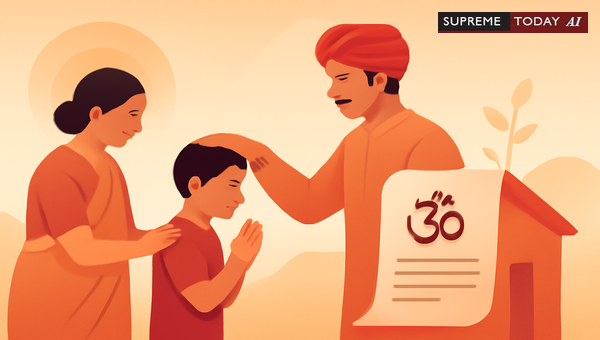
Can Adopted Son Claim Biological Father's Property?
In the complex world of family law, particularly under Hindu traditions, can profoundly alter inheritance rights. Imagine this scenario: a plaintiff is adopted into a new family, receives properties from the adoptive father, and years later attempts to claim assets from the biological father. Does the law allow such dual claims? This question often arises in property disputes, raising issues of , doctrines like ',' and rare exceptions such as .
This blog post delves into key rulings and principles under Hindu law, providing clarity on whether an adopted individual can pursue properties from their biological family after fully integrating into the adoptive one. We'll examine court findings, exceptions, and practical insights—remember, this is general information and not specific legal advice. Consult a qualified lawyer for your situation.
The Core Principle: Severance of Ties Upon Valid
Under Hindu law, a valid typically severs all legal ties with the biological or natural family. The adopted son becomes a full member of the adoptive family, treated as if 'born' there from the date of the adoptive father's death under the doctrine of . This means no rights persist in the natural properties.
Courts have consistently ruled that long residence in the adoptive family, enjoyment of its properties, and non-participation in biological family affairs bar later claims. For instance, in a pivotal case, the court observed: I am inclined to come to the conclusion that the plaintiff was adopted as per law to A China Appireddy and he continued to live in Ambapuram as the adoptive son of A China Appireddy. He thereby ceased to be the member of the of the defendants... he never participated in the enjoyment of the plaint schedule properties in the of the defendants... He ceased to be a member of the of the defendant and, therefore, he cannot claim any in the plaint-schedule properties. 1984 0 Supreme(AP) 258
Supporting evidence included a will (Ex. A-7) confirming intent, post-majority residence in the adoptive home, and no shared enjoyment of biological properties: the plaintiff never participated in the enjoyment of the plaint schedule properties along with his brother... probably because he had got his own properties there given to him by A. China appireddy under a Will Ex. A-7. 1984 0 Supreme(AP) 258
This severance is absolute in ordinary adoptions, divesting the adoptee of inheritance rights in the biological line while granting full continuity in the adoptive one.
The Rare Exception:
Not all adoptions are straightforward. , or 'illusory ,' allows a son to belong to both families, enabling inheritance from natural and adoptive fathers. However, this demands clear proof of an explicit agreement: There must be an agreement to the effect that the person given in shall be the son of both, natural fathers as well as adoptive father—Such an agreement must be proved like any other fact by the party alleging the same. 2003 6 Supreme 712
Without such evidence, courts default to ordinary . In one ruling, the court rejected dual rights: Finding recorded by first appellate court that plaintiffs failed to prove that there was such an agreement between parties— of G held to be in ordinary form... was not justified in allowing appeals. 2003 6 Supreme 712 This form is divided into absolute (explicit 'son of us two') or incomplete variants, but unproven claims invariably fail due to the heavy burden on the claimant.
Insights from Related Cases on and Property
Numerous judgments reinforce that valid ends biological claims, emphasizing proof of ceremonies, residence, and conduct. For example, after , the plaintiff severed his relation with his natural parents and was enjoying the properties of his adoptive parents and living in the family of adoptive parents. 2023 0 Supreme(Kar) 342 Courts clarified that no registered deed is mandatory if customs and ceremonies are proved, but lack of evidence—like consent from natural/adoptive mothers—dooms claims. 2023 0 Supreme(Kar) 342
In another dispute, the adopted plaintiff managed adoptive properties and cared for adoptive parents, solidifying severance, though shares were limited post-. 2018 0 Supreme(Kar) 997 Defendants' defenses failed without proof, upholding the plaintiff's biological ownership. 2014 0 Supreme(Bom) 2205 Courts held plaintiff proved lawful possession and ownership, and defendants failed to establish . 2014 0 Supreme(Bom) 2205
Suspicious documents, like a '' lacking the natural father's signature, are rejected: A '' not bearing the endorsement/signature/L.T.I. of the natural father is suspicious and cannot be relied upon to prove . 2010 0 Supreme(Cal) 1125 Admittedly, once there is a valid the son becomes the son of adoptive father and loses all his rights in respect of the properties of his natural father. 2010 0 Supreme(Cal) 1125
Ante- agreements among adults may not violate , if no trafficking is involved: Section 17 of the Act has been enacted with a view to prevent trafficking of children... Such an agreement is not prohibited by Section 17. 2003 6 Supreme 1011
These cases highlight that enjoyment of adoptive properties and separation preclude biological claims, aligning with the main rulings.
Key Limitations and Exceptions
While the general rule holds firm, consider these nuances:
- : Viable only with proven agreement; appellate courts' fact-finding is rarely disturbed. 2003 6 Supreme 712
- Pre- Events: Valid partitions or alienations in the biological family bind the adoptee if they affect the adoptive father's interests. 1972 0 Supreme(SC) 60
- Proof Burden: Long lapses may presume ceremonies, but not dual rights. No revival post- enjoyment. 1984 0 Supreme(AP) 258
- Adoptive Family Claims: Limited to the adoptive father's share post-; no broader divestiture. 1972 0 Supreme(SC) 60
(son-in-law) require relinquishment, but the principle of full transfer persists. 2014 0 Supreme(AP) 537
Practical Recommendations
If facing such a dispute:- Gather deeds, wills, residence proofs, and family conduct evidence.- Prove only with documents or witnesses showing dual agreement.- Seek solely in the adoptive family, mindful of prior divisions.- Act promptly to avoid limitation bars.
Typically, claims in the biological family post- are untenable without exceptional proof.
Key Takeaways
- Valid Hindu severs biological family ties, barring property claims there. 1984 0 Supreme(AP) 258
- Ordinary fully transfers rights; needs explicit agreement proof. 2003 6 Supreme 712
- Residence and enjoyment in adoptive family reinforce severance.
- Courts prioritize evidence of ceremonies and intent over mere documents.
Understanding these principles can prevent costly litigation. For personalized guidance, consult a legal expert familiar with Hindu law.
References:1. 1984 0 Supreme(AP) 258: Explicit severance ruling.2. 2003 6 Supreme 712: requirements.This post is for informational purposes only and does not constitute legal advice.
#HinduAdoptionLaw, #PropertyInheritance, #AdoptionRights












