


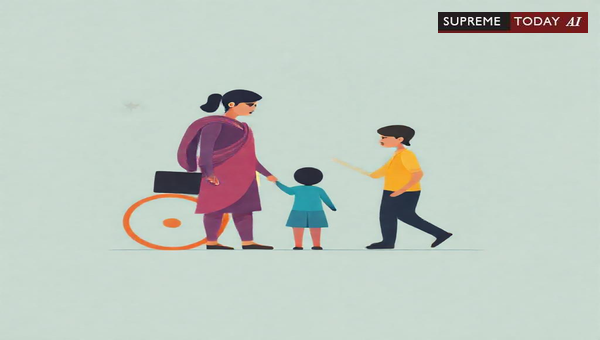
Adopting a Child With Physical or Mental Disabilities Under Hindu Adoption Law in India
Parents and guardians often ask a deeply personal question: can a physically or mentally challenged child be adopted under the , 1956? Whether the concern arises from a desire to adopt a child living with a disability, or from uncertainty about whether such an adoption will be legally recognised, the answer matters enormously for the child's future, inheritance rights, and family status.
The short answer is yes. The , 1956 contains no exclusion based on a child's physical or mental condition. An adoption of a child with disabilities is valid, provided the general statutory requirements are satisfied.
What the Act Actually Says About Valid Adoptions
The Four Requisites Under
of the Act lays down the foundational conditions for every adoption:
No adoption shall be valid unless- (i) the person adopting has the capacity, and also the right, to take in adoption; (ii) the person giving in adoption has the capacity to do so; (iii) the person adopted is capable of being taken in adoption; and (iv) the adoption is made in compliance with the other conditions mentioned in this Chapter. 1969 0 Supreme(SC) 306
Notice what is absent from this list. There is no condition relating to the child's health, physical ability, or mental capacity as a ground of disqualification. Courts interpreting the Act have emphasised that its focus is on the , not on categorical restrictions tied to the child's condition 1969 0 Supreme(SC) 306 and 2023 1 Supreme 239.
Capacity of the Adopter
Sections 7 and 8 govern who may take a child in adoption. , for instance, provides that any female Hindu of sound mind who is not a minor may take a son or daughter in adoption, subject to the husband's consent where he is living, unless he has renounced the world, ceased to be a Hindu, or been declared of unsound mind by a competent court 2023 1 Supreme 239. These provisions regulate the adopter — they say nothing about the child's disability status.
Key Conditions That Still Must Be Met
While disability is no bar, the adoption must comply with all ordinary requirements:
- Capacity of both parties — the adopter and the person giving the child must have statutory capacity under Sections 6, 7, 8, and 9.
- Actual giving and taking — (vi) requires that the child be actually given and taken in adoption by the parents or guardian, with intent to transfer the child from the family of birth. Courts have repeatedly stressed this requirement; where it is ignored, the adoption fails 2026 Supreme(Online)(P&H) 553 and 2026 0 Supreme(Bom) 543.
- Ceremony and evidence — in practice, courts look for proof of the giving and taking, sometimes accompanied by customary ceremonies such as the Datta Homam, and a registered adoption deed strengthens the claim 2021 0 Supreme(Telangana) 5.
- No contravention of Section 5 — an adoption made in contravention of the Act's prohibitions is void 2024 0 Supreme(AP) 1322.
A registered adoption deed also attracts a valuable presumption. Under , when a registered document purporting to record an adoption is produced before a court and signed by the person giving and the person taking the child, the court shall presume the adoption was made in compliance with the Act unless disproved 2011 1 Supreme 297. This presumption operates regardless of the child's physical or mental condition, and the burden lies on the party challenging the adoption 2011 1 Supreme 297.
Legal Effects of a Valid Adoption
Once valid, declares that the adopted child shall be for all purposes, and all ties with the family of birth are severed and replaced by ties in the adoptive family 1969 0 Supreme(SC) 306. Three statutory safeguards apply:
- The child cannot marry any person he or she could not have married in the birth family.
- Property vested in the child before adoption continues to vest, subject to existing obligations, including the duty to maintain birth-family relatives.
- The adopted child cannot divest any person of an estate that vested before the adoption 1969 0 Supreme(SC) 306.
These protections apply uniformly to all validly adopted children — including children with disabilities. Judicial decisions confirm that the rights available to a naturally born child are equally available to an adopted child, and provisions that would defeat such rights are unsustainable 2025 0 Supreme(P&H) 451.
How the Disability Question Appears in Practice
Courts routinely encounter children with disabilities in HAMA-related litigation, and the disability itself is never treated as an obstacle to legal recognition. For example, in a maintenance matter under , courts took judicial notice that a daughter was physically and mentally challenged and factored this into the mother's caregiving responsibilities — the child's condition was relevant to maintenance, not to any question of the family relationship's validity
Paresh Kumar Parichha VS Anita Kumari Parichha
.It is also worth noting that under the , a child who is mentally ill or physically or mentally challenged and has no one to support or look after them may fall within the category of , opening the JJ Act adoption route as well 2026 0 Supreme(Bom) 543 and 2023 0 Supreme(P&H) 2826. Importantly, the JJ Act expressly excludes adoptions made under the , 1956 from its scope, and courts have held that CARA Guidelines do not apply to HAMA adoptions 2021 0 Supreme(Telangana) 5 and 2021 0 Supreme(Telangana) 14.
Practical Points for Prospective Adoptive Parents
- Verify capacity and consent under Sections 6 through 9, including any spousal consent requirements.
- Ensure the child is with clear intent to transfer the child from the birth family — this is the most litigated requirement 2026 Supreme(Online)(P&H) 553.
- Execute and register an adoption deed to benefit from the 2011 1 Supreme 297.
- Where a child has significant challenges, seek legal counsel to document the giving and taking carefully, since courts scrutinise the factum of adoption closely when disputes arise 2022 0 Supreme(Jhk) 1374.
Key Takeaways
- The , 1956 contains no statutory bar on adopting a physically or mentally challenged child 1969 0 Supreme(SC) 306.
- Validity turns on the adopter's capacity, the giver's capacity, the child's capacity to be taken in adoption, and strict compliance with — not on the child's disability.
- A validly adopted child, including one with disabilities, becomes the adoptive parents' child for all purposes and enjoys full rights in the adoptive family 1969 0 Supreme(SC) 306.
- Registration of the adoption deed is strongly advisable because of the under 2011 1 Supreme 297.
This article reflects general legal information based on statutory provisions and judicial decisions; individual circumstances can vary, so specific guidance may be needed for a particular adoption.
#HinduAdoptionAct #AdoptionLawIndia #ChildAdoption #DisabilityRights #FamilyLaw












