


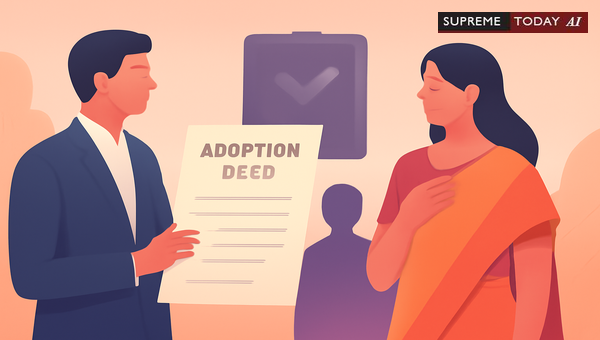
Adoption Not Proved When None is Examined and Documents are Not Reliable
In family law disputes, few issues carry as much emotional and legal weight as proving adoption. Imagine a court case where a claimed adopted child seeks inheritance rights, only for the claim to crumble because no key witnesses were examined and documents proved unreliable. This scenario, encapsulated in the legal question Adoption Not Proved when None is Examined and Documents are Not Reliable, highlights a critical hurdle in adoption litigation. Courts demand rigorous evidence, and failure here can lead to dismissal.
This blog post delves into the key principles, case findings, and practical recommendations to help you understand why adoption claims often fail and how to bolster your case. Note: This is general information based on legal precedents and not specific legal advice. Consult a qualified attorney for your situation.
Understanding the in Adoption Cases
Under laws like the (HAMA), proving adoption requires . The plaintiff bears the , which typically includes:
- Evidence of the physical act of giving and taking the child.
- Consent of natural parents.
- Corroboration through witnesses and reliable documents.
The absence of crucial witnesses, especially the natural mother, undermines the entire claim. As one court emphasized, The plaintiff must provide of the adoption, including the and the consent of the natural parents. The absence of key witnesses, particularly the natural mother, significantly undermines the case 1993 0 Supreme(Ori) 247.
Documents alone, such as an , fall short without supporting testimony. Courts have ruled that documents alone, such as an , are insufficient without corroborating evidence of the actual giving and taking ceremony
1982 0 Supreme(MP) 166.
Validity Requirements for Adoption Deeds
An must be meticulously drafted and executed. Key elements include:- Signatures of both natural parents and the adoptive father.- Clear details of the ceremony and date.
If these are missing, the deed may be invalidated. For instance, An must meet specific legal requirements, including the signatures of both natural parents and the adoptive father. If these conditions are not met, the deed may be deemed invalid 1993 0 Supreme(Ori) 247 2014 0 Supreme(Raj) 589.
In cases under , similar standards apply. Adoption under requires formal proof of the physical act of giving and taking, which was not established, leading to the dismissal of the appeal 2025 0 Supreme(Ker) 416. Mere baptism certificates or long association do not suffice without formal proof.
Key Case Findings: Why Adoption Claims Fail
Courts consistently dismiss adoption claims due to evidentiary gaps. Here's a breakdown of common pitfalls drawn from precedents:
1. Lack of Witness Testimony
- No examination of natural parents or independents: In multiple cases, the failure to call the natural mother or ceremony witnesses proved fatal. In the reviewed cases, the absence of the natural mother and other relevant witnesses led to a finding that the adoption was not proven 1993 0 Supreme(Ori) 247 2013 0 Supreme(Guj) 181.
- Interested witnesses only: Testimony from family members alone is often deemed unreliable. There was no independent witness was examined to prove the . Both of them are not competent to speak about the adoption 2016 0 Supreme(Mad) 3593.
- Adverse inferences: Courts draw negative conclusions from unexamined witnesses. Though it has been stated by P.W.1 that the child was given in adoption no witnesses have been examined to prove the same... creating against P.W.1 2021 0 Supreme(Mad) 1015.
2. Insufficient or Unreliable Documentary Evidence
- Documents without ceremony proof: The courts have ruled that documents acknowledging adoption do not suffice to establish legal adoption without evidence of the actual ceremony. The plaintiff's failure to provide such evidence, along with inconsistent claims regarding the adoption date, further weakened the case
2011 0 Supreme(P&H) 1221.
- Unproven authenticity: In order to prove the entry in Ext.X1 and its authenticity, nobody examined... No oral evidence tendered and no documents produced to show the... 2025 0 Supreme(Ker) 416.
- Presumption challenges: While registered deeds carry a under , this can be rebutted with strong evidence of fraud—but the challenger must prove it. Registered adoption documents presume compliance with the law; the burden rests on the claimant to disprove, which may not simply rely on allegations of fraud 2024 Supreme(Online)(JK) 1940.
3. Court Decisions and Broader Implications
Appeals are routinely dismissed for these reasons. In multiple instances, courts have dismissed appeals where the plaintiff failed to provide adequate proof of adoption, highlighting the necessity of credible oral and documentary evidence 1993 0 Supreme(Ori) 247 1982 0 Supreme(MP) 166.
In a partition suit, the court noted, None of the family members have been examined to prove that the adoption ceremony took place ever 2017 0 Supreme(Raj) 427. Similarly, Equally, no other independent witness was examined as to the treatment of the seventh defendant by the general public as the adopted son... except the interested testimony of DW1 2016 0 Supreme(Mad) 474.
Criminal cases also underscore this: False adoption claims for jobs led to convictions where proof was lacking, as in impersonation under 2020 0 Supreme(Jhk) 718.
Practical Recommendations to Strengthen Your Adoption Claim
To avoid these pitfalls:
- Gather witness testimony early: Examine natural parents, ceremony attendees, and independents. Their affidavits and cross-examination are vital.
- Ensure document compliance: Verify signatures, dates, and registration. Supplement with photos, videos, or contemporaneous records of the ceremony.
- Address inconsistencies: Align dates, stories, and evidence to prevent credibility issues.
- Anticipate challenges: Prepare for cross-examination on gaps. To successfully prove adoption, it is crucial to gather and present credible witness testimony, particularly from the natural parents and any independent witnesses to the adoption ceremony.
Review Documentation: Ensure that all documentation related to the is complete and meets legal standards, including necessary signatures and dates.
Conclusion: Prioritize Robust Evidence for Adoption Success
Proving adoption demands more than assertions—courts require the full evidentiary package. Cases like those cited show that skipping witnesses or relying on shaky documents leads to failure 1993 0 Supreme(Ori) 247
. By heeding these lessons, parties can significantly improve their chances.
Key Takeaways:- Burden lies on the claimant for clear proof of giving/taking and consent.- Witnesses trump documents; examine them diligently.- Valid deeds need proper execution and corroboration.
This analysis draws from established precedents to inform, but laws vary by jurisdiction and facts. Always seek professional legal counsel to navigate your adoption matter effectively.
#AdoptionLaw, #ProveAdoption, #FamilyLaw















