


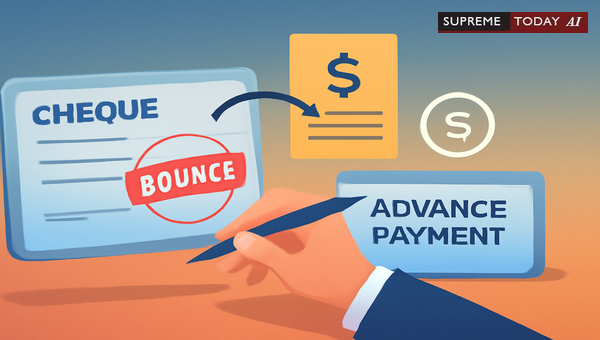
: Does It Attract ?
In the world of business transactions, and are commonplace. But what happens when a cheque issued for an advance bounces? A common question arises: will Not Attract 138 NI Act—is this true? Many individuals and businesses face notices under , leading to stressful . However, courts have consistently ruled that not every bounced cheque triggers this provision.
This article explores the legal nuances, drawing from landmark judgments and principles. We'll clarify when a refund of an advance amount escapes Section 138 liability, helping you navigate these issues effectively. Note: This is general information based on judicial precedents and not specific legal advice. Consult a qualified lawyer for your situation.
Main Legal Finding
Refund of an advance amount, when issued as a security or as a mere advance without an existing legal debt or liability at the time of issuance, does not attract the provisions of , 1881.2014 3 Supreme 8
Under Section 138, a cheque must be issued in discharge of a to constitute an offence. The explanation to Section 138 explicitly defines debt or other liability as a . Cheques given solely as security or advances—without a at issuance—fall outside this scope, distinguishing civil from criminal matters. 2014 3 Supreme 8
Key Points to Understand
- Cheques for legally enforceable debts only trigger Section 138 upon dishonour.
- Security or advance cheques without prior liability do not qualify. 2024 0 Supreme(Raj) 668
- Courts emphasize that liability must be subsisting at issuance; otherwise, no criminal offence arises. 2014 3 Supreme 8
Detailed Analysis from Judicial Precedents
Indian courts, including the and High Courts, have clarified this through key rulings.
Insights: Indus Airways Case
In Indus Airways2024 0 Supreme(Raj) 668, the held that cheques issued as for purchase orders later canceled cannot be deemed for an existing debt. The Court stated: the cheque cannot be said to have been drawn for an existing debt or liability when given as an advance. No existed at issuance, quashing Section 138 proceedings.
Without
In v.
VS - Dishonour Of Cheque ()
, the Court ruled that a cheque issued as security without a does not attract Section 138.The in the Ullas case2007 0 Supreme(Del) 2393 echoed this: a cheque issued with an order but before goods supply—and instructed not to present—was not issued in discharge of a liability, thus outside Section 138.
High Court judgments reinforce: or issued without an existing do not attract Section 138. If interpreted otherwise, the purpose of Section 138 is defeated. 2014 3 Supreme 8
Refund of Advance Amounts: Specific Context
Refunds of advances paid as security or preliminary payments—without at cheque issuance—do not meet Section 138 criteria. The liability must be subsisting when the cheque is drawn. 2014 3 Supreme 8
Supporting cases from other sources affirm this:- In one ruling, the trial court granted a decree for of Rs.24,00,000/- by the defendant, noting no denial of the claim and no stipulation barring refund. 2023 0 Supreme(AP) 1181- Another held: Hence, the same does not attract . This applied to self-cheques without endorsement, but the principle extends to advances lacking debt. 2021 0 Supreme(Kar) 37- Courts deny Section 138 where cheques are security not meant to be presented, returned due to stopped payment: This will not attract the strict provisions of Sec.138. 1997 0 Supreme(P&H) 155- Generally, refunds of are not barred by Section 138 if no legally enforceable debt exists 2023 0 Supreme(Cal) 1372 2023 Supreme(Online)(MAD) 22193.
Civil disputes over such refunds remain in civil courts, not criminal forums. 2024 4 Supreme 114
Exceptions and Limitations
While the rule protects advance/, exceptions apply:- If liability arises post-issuance (e.g., goods supplied, services rendered) and the cheque bounces, Section 138 can apply.- that mature upon default depend on at presentation. 2024 0 Supreme(Raj) 668- Cheques post-account closure may attract liability: the cheque was issued only after the closure of the account, which will amount to attract the Section 138. [](https://supremetoday.ai/doc/judgement/02100096913)- Time-barred presentations (e.g., after six months) exempt: the cheque itself was presented after expiry of six months... Section 138... will not attract. 2011 0 Supreme(Pat) 208
Practical Recommendations for Businesses and Individuals
To avoid pitfalls:- Ensure legally enforceable debt exists before issuing cheques for Section 138 risks.- For refunds or cancellations pre-liability, proceedings are likely quashed.- Examine if liability was subsisting at issuance before filing complaints. 2014 3 Supreme 8- Opt for civil suits for pure advance refunds, as in cases seeking refund of Rs. 10,000/- due to non-use.
Legal practitioners should scrutinize transaction timelines and agreements.
Conclusion and Key Takeaways
In conclusion, the refund of an advance amount or security deposit does not attract if no enforceable debt or liability existed at cheque issuance.2014 3 Supreme 8 2024 0 Supreme(Raj) 668
Key Takeaways:- Focus on timing of liability—pre-existing debt is crucial.- Security/advance cheques often lead to only. 2023 Supreme(Online)(MAD) 22193 2025 Supreme(Online)(Del) 7761- Courts prioritize genuine debts for criminal action 2024 0 Supreme(Bom) 422.
Stay informed to protect your interests. For tailored advice, reach out to a legal expert. References include 2014 3 Supreme 8, 2024 0 Supreme(Raj) 668,
VS - Dishonour Of Cheque ()
, 2007 0 Supreme(Del) 2393, 2023 0 Supreme(Cal) 1372, 2023 Supreme(Online)(MAD) 22193, and others cited. #Section138, #NIACT, #ChequeBounce





![C. Murugesan ] VS Vijayalakshmi - 2007 Supreme(Mad) 668](https://supremetoday-s3.b-cdn.net/Madras_small_2.png)












