


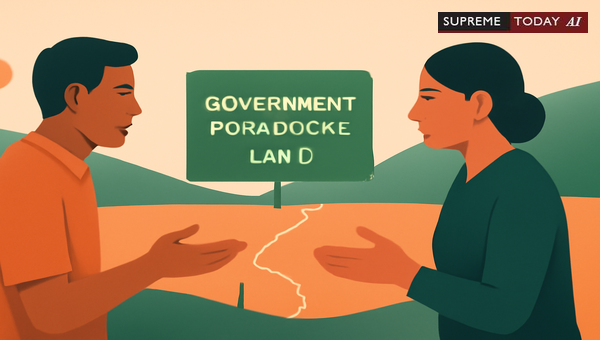
Ramakrishna Reddy vs Mallappa: Landmark Case on and Government Land
Land disputes in India often hinge on possession, title, and long-standing claims, especially when government property is involved. The case of Ramakrishna Reddy vs Mallappa illuminates critical legal principles around , the nature of government land classified as , and the maintainability of suits for declaration or injunction. This blog delves into the facts, arguments, and broader implications, drawing from court observations and related precedents. Whether you're a landowner facing similar issues or simply interested in property law, understanding this ruling can provide valuable insights.
Case Background: The Dispute Over Sy. No. 8
In Ramakrishna Reddy vs Mallappa, the plaintiffs—descendants of one Mallappa—sought a and protection of possession over Survey No. 8 (Acs. 15-12 gts) in Himayathsagar Village. They claimed their grandfather acquired the land over 70 years ago, cultivated it, and paid land revenue uninterrupted until his death in . As legal heirs, they continued possession and argued for title registration in their names. Threats of dispossession by government officials prompted legal notices under , leading to the suit. 2023 0 Supreme(Telangana) 458
The defendant, represented by the District Collector, countered that the land is government-owned , with plaintiffs as mere trespassers lacking legal rights. This set the stage for a classic battle between claims and over public lands. 2023 0 Supreme(Telangana) 458
Plaintiffs' Key Arguments: Building a Case for
The plaintiffs' case rested on several pillars:1. Long-term Acquisition and Cultivation: Mallappa allegedly acquired and cultivated the land, paying revenue, establishing ownership via possession over decades. 2023 0 Supreme(Telangana) 4582. Claim: Continuous possession exceeded 30 years, the statutory period for private claims, though stricter for government land (typically 60 years). 2023 0 Supreme(Telangana) 4583. Government Acknowledgment: Compensation paid for a portion acquired for the Outer Ring Road signaled recognition of their rights. 2023 0 Supreme(Telangana) 4584. Protective Legal Action: Notices under preceded the suit for declaration and injunction against dispossession. 2023 0 Supreme(Telangana) 458
These points aimed to prove not just possession but open, hostile, and continuous use known to the true owner—the government.
Defendants' Counter: Defending Government Title
The government's stance was firm:1. Government Property Status: Classified as , negating private ownership claims. 2023 0 Supreme(Telangana) 4582. Trespasser Allegation: Mallappa's entry was unauthorized; cultivation doesn't confer title. 2023 0 Supreme(Telangana) 4583. No Continuous Possession: Plaintiffs failed to prove statutory uninterrupted possession, especially since the land lay uncultivated for years and remained government-classified. 2023 0 Supreme(Telangana) 4584. Precedent: Cited , emphasizing government rights and strict conditions against state lands. 2022 0 Supreme(AP) 1249
This defense underscored that mere possession doesn't override official records on public lands. 2023 0 Supreme(Telangana) 458
Core Legal Principles: and Government Land
requires proving continuous, uninterrupted, hostile possession for the statutory period (30 years generally, 60 for government), with the owner's knowledge. However, claims over government land face rigorous scrutiny—mere possession rarely suffices if classified as state property. 2023 0 Supreme(Telangana) 458
The case highlights: To claim ownership through , the claimant must demonstrate continuous, uninterrupted possession for a statutory period (typically 30 years) and must possess the land to the knowledge of the true owner. 2023 0 Supreme(Telangana) 458
Plaintiffs' challenges include proving government awareness and overcoming Poramboke classification. Recommendations include gathering revenue payment records, possession proofs, and acknowledgment documents. The outcome may turn on interpreting possession recognition. 2023 0 Supreme(Telangana) 458
Insights from Related Judgments: Suits for Injunction vs Declaration
Ramakrishna Reddy vs Mallappa (often cited as T.V. Ramakrishna Reddy vs M. Mallappa, (2021) 13 SCC 135) extends to suits for permanent injunction. Multiple rulings affirm: A is maintainable when title is not disputed. Courts shouldn't dismiss such suits or delve into title absent pleadings. 2025 Supreme(Online)(MP) 6193 2025 0 Supreme(AP) 134
For instance: A without a declaration of title is maintainable when the title is not disputed. 2025 Supreme(Online)(MP) 6193
In Anathula Sudhakar vs P. Buchi Reddy ((2008) 4 SCC 594), reiterated in this context: Normally, title follows possession unless contradicted, but revenue records alone don't confer title post-donation or transfer. Burden lies on challengers under . 2024 6 Supreme 110
Another view: In a , possession is the issue. Normally, the issue of title will not be directly and substantially in issue. Courts can't adjudicate title without pleadings. Second appeals have set aside overreaching decisions. 2025 0 Supreme(AP) 134
Related cases like stress needs hostile title and exclusive possession. 2021 0 Supreme(Telangana) 257 Revenue records' lethargy doesn't erase state rights. 2024 6 Supreme 110
These reinforce that in undisputed title scenarios, injunction suits proceed on possession; disputes necessitate declaration prayers.
2024 Supreme(Online)(Telangana) 47917
Practical Implications for Landowners
For those claiming :- Document Everything: Revenue payments, cultivation proofs, government interactions.- Choose the Right Suit: Injunction if title undisputed; declaration if contested. 2025 Supreme(Online)(MP) 6193- Government Land Caution: Higher bar—60-year possession, public knowledge.- Evidence Burden: Possession presumed with title unless rebutted, but state classifications prevail without strong counter-evidence. 2024 6 Supreme 110
Delays or unclean hands can weaken claims, as seen in partition suits involving suppressed heirs. 2021 0 Supreme(Telangana) 257
Key Takeaways and Disclaimer
Ramakrishna Reddy vs Mallappa exemplifies the tension between long possession and state title, stressing evidentiary rigor for adverse claims. It guides when injunctions suffice without title suits, promoting procedural clarity.
- Possession alone rarely beats government records.
- Tailor reliefs to title dispute status.
- Gather historical proofs proactively.
This analysis is for informational purposes, based on general principles. Laws vary; consult a qualified lawyer for advice specific to your situation. Cases like these evolve, so check latest judgments.
References:- 2023 0 Supreme(Telangana) 458 (Primary case details)- 2022 0 Supreme(AP) 1249 (Precedent on govt lands)- 2025 Supreme(Online)(MP) 6193, 2025 0 Supreme(AP) 134, 2024 6 Supreme 110 (Injunction & possession principles)
Stay informed on property rights to safeguard your interests.
#AdversePossession #LandLawIndia #SupremeCourtRulings















