


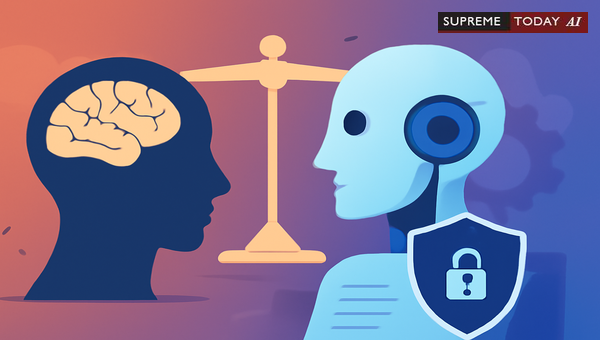
Can AI Face in India?
In an era where artificial intelligence (AI) powers everything from self-driving cars to medical diagnostics, a pressing question arises: of AI. Can machines be prosecuted for crimes they commit? Under Indian law, the answer is nuanced, hinging on foundational principles like (the guilty act) and (guilty mind). This blog delves into whether AI can be directly held criminally liable or if responsibility falls on human actors.
Note: This article provides general information based on legal principles and is not specific legal advice. Consult a qualified lawyer for your situation.
Understanding Fundamentals
in India requires both and 2023 1 Supreme 405. As one document states, the law recognizes nothing but incapacity to realise the nature of the act and presumes that where a man's mind or his faculties of ratiocination are sufficiently dim to apprehend what he is doing, he must always be presumed to intend the consequence of the action he takes 2023 1 Supreme 405.
AI, lacking sentience or consciousness, cannot form intent. It performs programmed actions without moral agency, making direct impossible 2022 0 Supreme(Telangana) 394. Courts distinguish legal from medical insanity, emphasizing mental capacity at the time of the act 2023 1 Supreme 405. By extension, AI's absence of any mental capacity precludes responsibility.
Key Elements of
- : The physical act or omission. AI executes code, but this is not autonomous action.
- : Guilty intent or knowledge. AI has neither, as confirmed in legal analyses 2023 1 Supreme 405.
- Human Agency: Liability attaches to humans with knowledge or involvement 2022 0 Supreme(Telangana) 394.
AI as a Tool, Not a Legal Person
Legal documents affirm AI cannot be an autonomous legal subject 2022 0 Supreme(Telangana) 394. It functions as a tool, akin to a hammer in a crime—liability lies with the wielder. rests on principle of or intention. It is well settled law that a person intends what he does 2010 0 Supreme(J&K) 427.
This aligns with broader principles: The is personal strict in nature 2019 0 Supreme(MP) 382, requiring personal culpability.
: Shifting Blame to Humans
While direct liability evades AI, may apply to humans like developers, operators, or company officials 2022 0 Supreme(Telangana) 394. For instance, when the allegation is that any of the Directors, Partners, Managers, etc. of a Company or a Firm, are involved in committing an offence along with the Company or a Firm, there is every requirement to plead, aver and establish that the said individuals have the required knowledge/information or to commit such acts 2022 0 Supreme(Telangana) 394.
Corporate Liability Analogies
Corporate , extended to offenses over time, relies on responsible persons 2009 0 Supreme(Gau) 632. The knowledge relevant for attributing must be contemporaneous knowledge. A Director cannot be implicated by the mere fact that he obtained knowledge much later of the alleged offence having been committed 2008 0 Supreme(Bom) 1728.
exemplifies this for cheque dishonor, deeming liability for company officers but strictly construed—role over status matters 2023 0 Supreme(Jhk) 180 2023 0 Supreme(Jhk) 495 2022 8 Supreme 618. Courts demand literal compliance: mere designation doesn't suffice 2022 8 Supreme 618 2024 0 Supreme(Guj) 571.
is exceptional in criminal law, absent general application without statutes 2024 0 Supreme(Jhk) 284. For AI, humans must have active roles, knowledge, or intent.
Joint and Constructive Liability
enable via 2024 0 Supreme(Chh) 478 2023 0 Supreme(All) 1217. If multiple humans collaborate on faulty AI deployment, shared intent could implicate them.
Limitations and Exceptions
- AI is not a legal person; no autonomy for crimes 2022 0 Supreme(Telangana) 394.
- Liability demands human intent; AI's role is instrumental.
- Strict statutory interpretation for penal provisions 2024 0 Supreme(Guj) 769.
- No automatic without explicit law 2023 0 Supreme(Jhk) 180.
Other contexts reinforce: in criminal proceedings emphasizes determined liability 2018 0 Supreme(Ker) 604. Breaches without fraud don't criminalize 2024 0 Supreme(Jhk) 284.
Real-World Implications for AI Deployment
Imagine an AI trading bot causing market manipulation or a drone striking a pedestrian. Liability probes developers' training data, operators' oversight, or firms' policies. Current frameworks focus on humans, but evolving AI autonomy challenges this.
In course of time, however, criminal corporate liability started being extended to even those offences, which require presence of or criminal intent 2009 0 Supreme(Gau) 632. Future laws may adapt, but today, humans bear the burden.
Recommendations for Stakeholders
To mitigate risks:- Clear Frameworks: Advocate regulations specifying AI liability chains.- Accountability Mechanisms: Developers and operators should document intent and safeguards.- Guidelines: Follow ethical AI deployment to preempt misuse 2025 0 Supreme(SC) 1533.- Insurance and Compliance: Businesses deploying AI need robust policies.
Conclusion: Humans Behind the Machine
Under Indian law, AI cannot be criminally liable due to lacking and 2023 1 Supreme 405 2022 0 Supreme(Telangana) 394. Responsibility vicariously shifts to humans with requisite involvement, per strict principles 2023 0 Supreme(Jhk) 180 2022 8 Supreme 618. As AI advances, expect legislative evolution, but for now, human agency reigns.
Key Takeaways:- AI: No direct liability.- Humans: Liable via knowledge/intent.- Need: Updated laws for AI era.
References:1. 2023 1 Supreme 405: / principles.2. 2022 0 Supreme(Telangana) 394: Vicarious/corporate liability.3. Others as cited.
#AICriminalLiability, #IndianLawAI, #MensRea












