


Under the
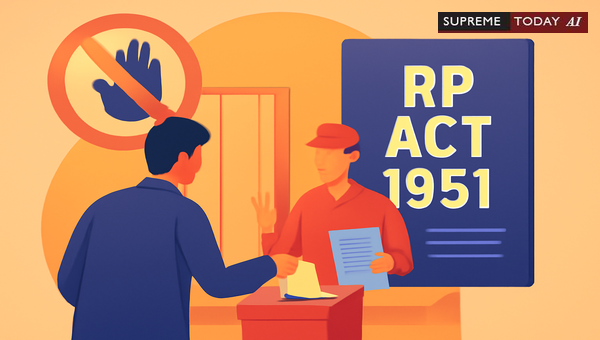
Elections form the cornerstone of democracy, but practices like threaten their sanctity. involves unlawfully seizing control of a polling station to rig votes, often through force, intimidation, or fraud. Under the , this is deemed a serious . If you're wondering about Under RP Act 1951: Key Insights, this post breaks down the legal framework, key provisions, case laws, and evidentiary hurdles.
Note: This article provides general information on election law and is not legal advice. Consult a qualified attorney for specific cases.
What is ? Definition and Context
refers to the illegal practice of taking control of a polling booth during an election to manipulate the voting process. This can involve coercing voters, impersonating them, or using fraudulent means to cast votes in favor of a particular candidate or party. 2018 0 Supreme(All) 2272 It undermines the free and fair exercise of electoral rights, making it a under the RP Act, 1951.
Courts have clarified that typically involves force or intimidation, distinguishing it from other malpractices like , which relies on deception. 2013 0 Supreme(SC) 483 For instance, involves use of force, whereas or double voting is on the basis of deception. 2013 0 Supreme(SC) 483
Key Legal Provisions Governing
The RP Act, 1951, provides specific safeguards against such electoral malfeasance:
: Defines as a . It states that any act of capturing a polling booth by force or intimidation, or by any means that disrupts the free exercise of the electoral process, constitutes a . 2017 0 Supreme(Gau) 1370 mentions that by a candidate or his agent or other person shall be deemed to be a . 2017 0 Supreme(Gau) 1370
: Elaborates on , including:
- Preventing voters from entering the polling booth.
- Using violence or intimidation to influence voters.
- Impersonating voters to cast votes fraudulently.
Committing is a ground to declare an election void under . 2012 0 Supreme(Guj) 54 is also made an offence under of the Act, and the term ‘’ is spelt out in the explanation to that section. 2012 0 Supreme(Guj) 54
These provisions ensure that elections remain transparent and voter-centric.
Landmark Case Law on
Indian courts, particularly the and , have shaped the jurisprudence around , stressing the need for concrete evidence.
Markio Tado V. Takam Sorang and Others (2012): The ruled that without substantial evidence of or , allegations cannot be upheld. It rejected post-election fishing inquiries, requiring proof at the outset. 2020 0 Supreme(Mad) 3
Election Petition Findings: Courts dismiss claims lacking credible evidence. In one instance, allegations failed due to insufficient substantiation, leading to petition dismissal. 2010 0 Supreme(Pat) 2219 2000 0 Supreme(SC) 1459
Preservation of Evidence: Courts may direct evidence preservation for post-election legal action. 2021 0 Supreme(P&H) 799
Additional precedents reinforce these principles:
In a case, an election petition alleging under (1), Explanation (a), (b), (c), and (e) was scrutinized, highlighting specific acts inside polling stations.
Another ruling emphasized that mere assembly does not constitute a under , which relates to bribery groups, not directly. 2021 Supreme(Online)(MAD) 45805
The burden of proof is stringent: Petitioners must plead with full particulars under . Vague pleadings are struck out, as seen where paragraphs lacked details on incidents. 2011 0 Supreme(All) 2277 It alleges that there was a as defined in of 1951 Act without disclosing details of such polling booth etc. 2011 0 Supreme(All) 2277
Courts prohibit roving inquiries. In Markio Tado related matters, allowing production of voter records (Form 17A) for 38 stations was overturned due to absent specific allegations and evidence. 2012 0 Supreme(Guj) 54 The respondent therefore can not be allowed to improve his case... 2012 0 Supreme(Guj) 54
These cases underscore that is required, and the returned candidate's election is not voided without showing material impact. 2017 0 Supreme(Gau) 1370
Allegations of : Evidence and Challenges
Allegations often include transporting individuals with fake voter IDs to cast fraudulent votes. 2021 0 Supreme(AP) 162 However, the petitioner bears a heavy burden:
Credible Evidence Required: Claims must be backed by specifics like names, locations, and witnesses. General assertions fail. 2000 0 Supreme(SC) 1459
Distinction from Other Practices: requires force; needs deception proof. Without naming perpetrators or victims, petitions falter. 2013 0 Supreme(SC) 483
Pleading Standards: Election petitions must contain a concise statement of . Failure leads to rejection under or striking pleadings. 2018 0 Supreme(All) 2272 In one remand challenge, the court upheld proceedings, noting proof issues are for trial, not preliminary dismissal. 2018 0 Supreme(All) 2272
Recent petitions highlight thousands allegedly involved, but courts demand documentation. Mere gathering at polling sites does not suffice. 2021 Supreme(Online)(MAD) 45805
Practical Implications and Courtroom Strategy
For candidates facing or alleging :
Document Thoroughly: Collect witness statements, videos, and official reports immediately.
Avoid Vague Pleadings: Specify booths, actors, and impacts to survive scrutiny.
Material Effect: Prove how the malpractice affected the result, e.g., margin of victory. In one case, even 1304 alleged double votes didn't overturn a 2713-vote margin without specifics. 2012 0 Supreme(Guj) 54
Courts promote judicial discipline, adhering to precedents under . Ignoring settled law invites reversal. 2013 0 Supreme(SC) 483
Conclusion and Key Takeaways
erodes democratic trust, but the RP Act, 1951, offers robust remedies via Sections 123(8) and 135A. Case law like Markio Tado demands substantial evidence, preventing frivolous challenges. 2020 0 Supreme(Mad) 3
Key Takeaways:- is a involving force or disruption.- Petitioners must provide detailed, credible proof; no fishing expeditions allowed.- Consult legal experts for election disputes to navigate pleading and evidentiary rules.
Stay vigilant to uphold election integrity. References: 2021 0 Supreme(AP) 162 2020 0 Supreme(Mad) 3 2021 0 Supreme(P&H) 799 2000 0 Supreme(SC) 1459 2010 0 Supreme(Pat) 2219 2018 0 Supreme(All) 2272 2017 0 Supreme(Gau) 1370 2013 0 Supreme(SC) 483 2012 0 Supreme(Guj) 54 2011 0 Supreme(All) 2277
This is general guidance; seek professional advice for your situation.
#BoothCapturing, #RPAct1951, #ElectionLaw












