


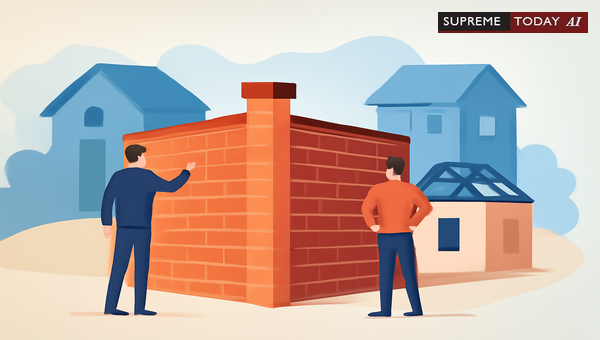
Does Mere Construction of a Boundary Wall Prove Possession?
In property disputes, boundary walls often become flashpoints. Homeowners and landowners frequently argue that erecting a boundary wall signifies control over the land. But is that true? The legal question at the heart of many cases is: Mere Construction of Boundary Wall by Defendant can Not be Construed as Possession. Courts across jurisdictions have consistently ruled that no, simply building a boundary wall does not equate to possession. This blog post dives deep into the judicial reasoning, key precedents, and practical insights to help you understand this crucial distinction.
Note: This article provides general information based on legal precedents and is not specific legal advice. Consult a qualified attorney for your situation.
Understanding Possession in Property Law
Possession is a foundational concept in property law, typically requiring , use, or occupation of the land. It's not just about symbolic acts like fencing or wall-building. Courts emphasize that possession must be factual and demonstrable, often through evidence of continuous use, cultivation, or residency.
Key Legal Finding
Mere construction of a boundary wall by a defendant does not, by itself, constitute or prove possession. As highlighted in several judgments, possession demands more than structural assertions. For instance, in 2006 0 Supreme(SC) 1225, the noted that while boundary wall construction by respondents was a factor, it was insufficient without proof of actual control over the appellants' . The court held that mere construction was insufficient to establish possession 2006 0 Supreme(SC) 1225.
Similarly, 2022 6 Supreme 751 clarifies: the right to put up a boundary wall is confined only to the extent of land over which the plaintiff has title, and the act of building alone does not prove possession. Possession involves actual user and control, not isolated construction 2022 6 Supreme 751.
Judicial Distinction: Construction vs. Actual Possession
Courts have drawn a sharp line between erecting structures and true possession. In 2003 0 Supreme(SC) 147, the existence of old walls and structures, backed by witness testimony, supported longstanding possession—contrasting with mere recent construction lacking proof of use. The ruling underscores that without actual occupation, walls alone fall short 2003 0 Supreme(SC) 147.
This principle extends to claims. In 2003 6 Supreme 391, long possession coupled with actual user is essential, not just building structures. Mere erection doesn't suffice for adverse claims 2003 6 Supreme 391.
Insights from Additional Cases
Other precedents reinforce this. In 2024 Supreme(Online)(Del) 33472, plaintiffs were dispossessed after trespassers demolished a boundary wall and started construction, but the court focused on prior physical possession and continuous control until dispossession—not the new construction as proof of possession 2024 Supreme(Online)(Del) 33472. The snippet notes: They were put into physical possession and the Plaintiff had raised the boundary Wall and erected the gate. Their possession continued to be continuous till when they were dispossessed.
Likewise, 2023 0 Supreme(MP) 451 describes a plaintiff purchasing land, constructing a boundary wall, and claiming possession from the sale deed date—yet defendants damaged it, highlighting that construction follows title and possession, rather than creating it 2023 0 Supreme(MP) 451.
In 2025 0 Supreme(AP) 98, discrepancies in wall construction matching plans undermined claims, with no evidence supporting encroachment via boundary walls. Courts rejected possession based on mismatched or unauthorized builds 2025 0 Supreme(AP) 98.
When Construction Might Support a Possession Claim
While mere construction isn't enough, it can contribute under certain conditions:- Accompanied by actual use: If wall-building pairs with occupation, cultivation, or exclusive control, it strengthens the case 2006 0 Supreme(SC) 1225.- Long-standing and open: Continuous, visible use over time may aid , but walls alone don't start the clock 2003 6 Supreme 391.- On titled land: Construction rights are limited to owned property, as in 2022 6 Supreme 751 and 2025 0 Supreme(P&H) 195, where a respondent's factory and boundary wall on adjacent possessed land were upheld—but only because possession predated construction 2025 0 Supreme(P&H) 195.
Exceptions are narrow. For example, 2012 0 Supreme(P&H) 489 allowed defendants to raise a boundary wall on exclusively possessed land derived from the plaintiff, stating: Defendant No.1 has specifically pleaded that they are raising boundary wall only to protect their possession 2012 0 Supreme(P&H) 489. Here, prior possession justified the act.
Conversely, unauthorized or forcible construction post-dispossession fails. In 2024 0 Supreme(Cal) 256, prayers restrained defendants from building on plaintiffs' boundary wall, rejecting construction as possession assertion 2024 0 Supreme(Cal) 256.
Common Pitfalls in Property Disputes
Defendants often plead boundary walls as possession proof, but courts scrutinize:- Lack of title or prior control: As in
-
, claims of possession via walls built at someone's instance were mere statements without factual backing-
.- Demolition or disputes: Cases like 2025 Supreme(Online)(HP) 7283 note completed wall construction dates but tie possession to broader evidence, not the wall alone 2025 Supreme(Online)(HP) 7283.- Encroachment claims: 2013 0 Supreme(Raj) 1241 defends land surrounded by a boundary wall as possessed for years, but plaintiffs' maps wrongly included it—courts demand proof beyond walls 2013 0 Supreme(Raj) 1241.Bullet-point takeaways from precedents:- Construction without permission or after forcible entry doesn't confer rights 2024 Supreme(Online)(Del) 33472 2025 0 Supreme(AP) 98.- Mere errors or delays don't equate to unauthorized walls 2025 Supreme(Online)(Mad) 56891.- Rights to build are incidental to fixed boundaries, not standalone possession 2024 0 Supreme(Ker) 92.
Practical Recommendations for Landowners
To assert or defend possession effectively:1. Gather evidence of actual use: Photos, utility bills, witness statements showing occupation—not just walls.2. Document title and history: Sale deeds, revenue records proving control predates construction 2023 0 Supreme(MP) 451.3. Avoid self-help measures: Unauthorized builds invite , as in
- Current Civil Cases
, where defendants claimed owner rights to construct but faced easement challenges- Current Civil Cases
.4. Seek court clarification: For boundaries, decrees may include fencing rights without separate proof 2024 0 Supreme(Ker) 92.Courts urge scrutiny: scrutinize the nature of construction and actual user before equating it with possession 2006 0 Supreme(SC) 1225.
Conclusion: Possession Demands More Than Walls
In summary, mere construction of a boundary wall by a defendant cannot be construed as possession. Judicial consensus, from 2006 0 Supreme(SC) 1225 to 2024 Supreme(Online)(Del) 33472, demands and use. While walls protect or assert claims on possessed land, they don't create possession in isolation. For property owners facing disputes, focus on robust evidence of occupation to prevail.
Key takeaways:- Possession = control + use, not structures alone.- Use precedents wisely in claims.- Always pair construction with proof of prior rights.
Stay informed on land laws to safeguard your property. Share your thoughts below—have you faced a boundary wall dispute?
References
- 2006 0 Supreme(SC) 1225: Mere construction insufficient for possession.
- 2022 6 Supreme 751: Walls limited to titled land.
- 2003 0 Supreme(SC) 147: Old structures + testimony = possession.
- 2003 6 Supreme 391: Actual user for .
- 2024 Supreme(Online)(Del) 33472, 2023 0 Supreme(MP) 451, 2025 0 Supreme(AP) 98, and others as cited.















