


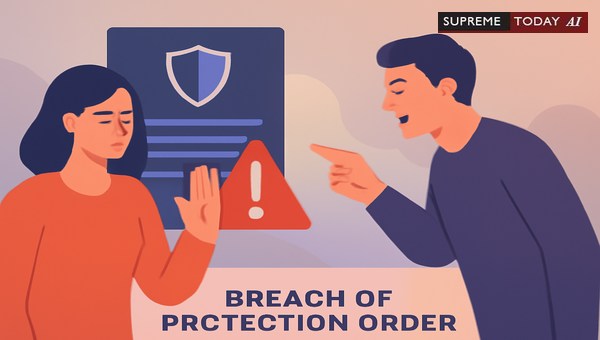
: Remedies Under Section 31
In cases of domestic violence, protection orders serve as a critical shield for the aggrieved party. But what happens when these orders are violated? The question arises: The Protection Order has been Breached and under which Provision Aggrieved Party Sought for the Remedy before the Court? This blog post delves into the legal framework, focusing on India's (), to provide clarity on breaches, penalties, and remedies. Note that this is general information and not specific legal advice—consult a qualified lawyer for your situation.
Understanding Protection Orders and Their Breach
Protection orders under Section 18 of the are designed to prevent the respondent from committing acts of domestic violence, such as physical harm, threats, or economic abuse. These orders are issued by a Magistrate after hearing both parties and finding of violence. An can also be granted urgently.
A breach occurs when the respondent violates these terms, turning a civil safeguard into a criminal matter. As per Section 31(1), A , or of an , by the respondent shall be an offence under this Act and shall be punishable with imprisonment of either description for a term which may extend to one year, or with fine which may extend to twenty thousand rupees, or with both. 2022 0 Supreme(Ker) 916
This provision makes violation a , emphasizing swift enforcement 2022 0 Supreme(Ker) 916.
Key Legal Provision:
The cornerstone remedy lies in Section 31(1). When a protection order is breached, the aggrieved party can approach the court to initiate criminal proceedings. The process typically involves:- Filing a complaint or police report detailing the breach.- The Magistrate taking cognizance and issuing summons or warrant.- Trial leading to potential imprisonment, fine, or both.
Judicial precedent in clarifies that only orders under Section 18 qualify as protection orders under Section 31. A , or of an , by the respondent shall be an offence under this Act... 2022 0 Supreme(Ker) 916. Orders for residence (Section 19) or monetary relief (Section 20) do not attract Section 31 penalties 2022 0 Supreme(Ker) 916, 2023 0 Supreme(Mad) 2965.
Section 31 of the is a key provision and heartbeat of the to regulate the violator of protection order passed under . 2023 0 Supreme(Mad) 2965
Remedies Sought by the Aggrieved Party
The primary remedy is under Section 31(1). The aggrieved party files a complaint directly with the Magistrate or police, who investigate and forward the case. Courts stress prompt action to uphold order sanctity 2022 0 Supreme(Ker) 916.
Additional enforcement options from judicial sources include:- under CPC: For disobedience, apply under Order XXXIX Rule 2A for or . True it is that a successful litigant... has an appropriate remedy under the provision of Order 39 Rule 2A of the Code... 2023 0 Supreme(Bom) 124.- : Under for like protection orders 2023 0 Supreme(Telangana) 736.- : Not direct protection, but auxiliary for enforcement. In cases of breach, the aggrieved party can lodge a complaint directly with the police or approach the Magistrate, who can then order police intervention... 2024 0 Supreme(All) 618. Police may refuse standalone requests without proven breach 2024 0 Supreme(Telangana) 36.
This being position, no action for can be initiated for by the respondent. In eventuality of breach... applicant can file complaint u/s.31 of the Act... 2018 0 Supreme(Bom) 1306
Judicial Interpretations and Enforcement
Courts have consistently affirmed Section 31's scope. In Velayudhan Nair, only Section 18 orders trigger penalties, excluding monetary relief: Therefore, the Court cannot overturn the legislature wisdom to hold that a 'monetary relief' such as payment of maintenance... would attract significant penalty under Sec.31... 2023 0 Supreme(Mad) 2965.
Enforcement is criminal, not contempt: Breach isn't but a statutory offence 2018 0 Supreme(Bom) 1306. Aggrieved parties must prove the order was under Section 18 and deliberately violated 2023 0 Supreme(Del) 4281.
In exceptional cases, civil suits offer supplementary relief if provisions fall short: In an exceptional case, where provisions are rendered incapable of giving relief to an aggrieved party... the answer is a regular suit in the civil court. 2024 0 Supreme(Telangana) 36
Exceptions and Limitations
- Limited to Section 18: Residence or compensation orders aren't protection orders under Section 31 2022 0 Supreme(Ker) 916, 2023 0 Supreme(Del) 4281.
- No direct police protection: Aid is for execution, not standalone 2023 0 Supreme(Telangana) 736, 2024 0 Supreme(All) 618.
- Alternative remedies barred if ineffective: Writ jurisdiction isn't for execution; exhaust statutory remedies first 2019 0 Supreme(All) 2010, 2019 0 Supreme(Telangana) 17.
- Criminal nature: Focuses on punishment, not civil damages (pursue separately).
Practical Recommendations
If facing a breach:1. Document evidence (photos, witnesses, order copy).2. File under Section 31(1) promptly—approach police or Magistrate.3. Consider CPC applications for interim enforcement (Order 39 Rule 2A).4. Seek urgent via court order if immediate threat exists.5. Verify order type (must be Section 18).
The aggrieved party should file a formal complaint or initiate proceedings under Section 31(1) for the breach. 2022 0 Supreme(Ker) 916
Conclusion and Key Takeaways
Breaches of protection orders under the demand decisive action via Section 31(1), blending criminal deterrence with civil enforcement. Aggrieved parties typically seek remedies through prosecution, ensuring violators face up to one year's imprisonment or fines. While supports execution, primary recourse is court-initiated.
Key Takeaways:- Breach = Criminal offence under Section 31(1) for Section 18 orders.- File complaint for prosecution; use CPC for attachment/.- Judicially limited to true protection orders—no monetary relief inclusion.- Act swiftly to protect rights and deter future violations.
This framework empowers victims, but outcomes depend on facts. Always consult a legal professional.
References:- 2022 0 Supreme(Ker) 916: on Section 31 scope.- 2023 0 Supreme(Bom) 124, 2018 0 Supreme(Bom) 1306, 2023 0 Supreme(Mad) 2965, 2024 0 Supreme(All) 618, 2023 0 Supreme(Telangana) 736, 2023 0 Supreme(Del) 4281
#DVActRemedies, #ProtectionOrderBreach, #DomesticViolenceLaw












