Searching Case Laws & Precedent on Legal Query..!
Scanned Judgements…!



Searching Case Laws & Precedent on Legal Query..!
Scanned Judgements…!
Several judgments have altered convictions from Section 326 to Section 325 IPC when injuries are grievous but the weapon or circumstances do not meet the criteria for dangerous weapons under Section 326 ["SARASAMMA WO SUKUMARAN vs THE STATE OF KERALA - Kerala"], ["2025 0 Supreme(Ker) 1897"].
Analysis and Conclusion:
References:- ["2024 0 Supreme(All) 56"]- ["2026 0 Supreme(Kar) 19"]- ["2025 0 Supreme(Ker) 1897"]- ["2006 0 Supreme(Jhk) 1324"]- ["SARASAMMA WO SUKUMARAN vs THE STATE OF KERALA - Kerala"]- ["SARASAMMA WO SUKUMARAN vs THE STATE OF KERALA - Kerala"]- ["SARASAMMA WO SUKUMARAN vs THE STATE OF KERALA - Kerala"]- ["2024 0 Supreme(Kar) 95"]- ["2023 0 Supreme(Kar) 1128"]- ["1996 0 Supreme(P&H) 216"]- ["SARASAMMA WO SUKUMARAN vs THE STATE OF KERALA - Kerala"]- ["2017 6 Supreme 244"]- ["
Tanaji Shivaji Solankar VS State of Maharashtra through the Officer In-charge - Crimes
"]- ["2026 Supreme(Online)(MP) 2085"]- ["2021 0 Supreme(Gau) 399"]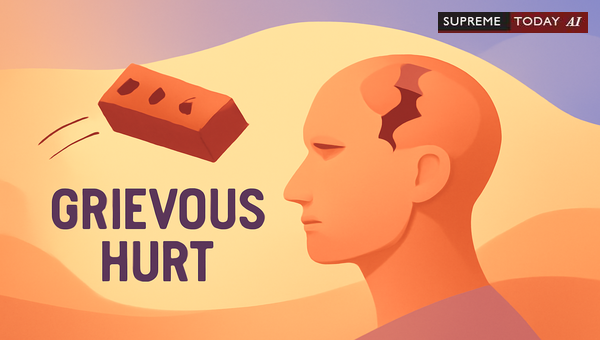
In heated altercations, everyday objects like bricks can become weapons with serious legal consequences. A common question arises: causing injury by brick will constitute 326 IPC or not? This query delves into the (IPC), specifically Section 326, which punishes causing by or means. The answer hinges on whether the injury qualifies as under and the circumstances of use. This post breaks down the legal framework, key judicial interpretations, and practical implications—remember, this is general information, not specific legal advice. Consult a qualified lawyer for your situation.
defines with eight specific categories, including:- - - - Any hurt causing - Injury endangering life or causing severe pain for 20 days
The definition of '' under includes fractures and injuries causing or substantial impairment
. Courts emphasize medical evidence to classify injuries. For instance, skull fractures or damage to vital parts like teeth consistently qualify as grievous
2005 1 Supreme 215 2014 0 Supreme(All) 216.
applies when someone causes using instruments like firearms, stabbing tools, or any instrument which, used as a weapon of offence, is likely to cause death 2019 6 Supreme 525. Punishment can extend to life imprisonment.
In order to convict a person u/s 326 IPC, for causing , the hurt or injury must come within the definition of and such hurt or injury must be caused by the type of weapon mentioned in 2020 Supreme(Online)(GAU) 453. The focus is dual: grievous injury and dangerous means.
A brick isn't inherently a firearm or blade, but context matters. The use of a brick as a weapon does not automatically constitute a dangerous weapon in every case; the severity of injury determines whether the hurt is grievous 2005 1 Supreme 215. Courts assess:- Force and location of blow: A brick to the skull causing fracture is dangerous
.- Injury outcome: Fractures, spinal damage, or disfigurement elevate it 2002 0 Supreme(Mad) 654.
In one case, A1 hit the deceased with a brick on the neck... vertebrae was injured at the cervical spine at C6 level and fracture of thoracic vertebra at T8 level... stone (brick) is a dangerous weapon, the could at least converted the offence under 2002 0 Supreme(Mad) 654. Conversely, minor blows may downgrade to (simple hurt) or 324 (hurt by without grievous result) 2006 0 Supreme(Raj) 1007.
PW2 further stated that after he was hit with brick by the second accused, the first accused again hit... with a stone causing a serious injury. This will definitely constitute the offence punishable under IPC 2018 Supreme(Online)(KER) 24573, showing alteration based on weapon and injury.
Section 326 requires —intent to cause or knowledge it's likely to cause death. The (intent or knowledge) of the accused, along with the nature of the injury, influences whether the offense is under .
Courts examine circumstances: sudden fights vs. premeditated attacks. In assault cases, The court found that while the assault occurred, the prosecution failed to establish the necessary intent to kill required for a conviction under . The injuries were serious but not sufficient to prove an , leading to a conviction under Section 326 (from case summary on Sections 307/326). Lack of lethal intent often shifts from 307 () to 326 2024 0 Supreme(Cal) 1275.
Judicial precedents clarify application:- Skull Fracture Case: In a case where the injury caused by a brick resulted in multiple fractures of the skull, the court held that the injury was grievous, and the offense was under 1995 0 Supreme(Raj) 520
.- Reduction of Charges: When the injury was not grievous, or the weapon used was not deemed dangerous, the offense was altered from Section 326 to or 323 IPC 2006 0 Supreme(Raj) 1007.- Stone as Blunt Weapon: Sections 325 and 326, IPC deal with the causing of grievous injury. However, the difference between the two Sections is that while , IPC deals with causing of grievous injury by a blunt weapon, Section 326, IPC deals with causing of injury by a sharp edged weapon or a lethal weapon 2006 0 Supreme(Raj) 173. Bricks, as blunt objects, may invoke 325 unless deemed 'likely to cause death' 2020 Supreme(Online)(GAU) 453.- Acid Analogy: Though not brick, Offence of causing by use of acid is gruesome and horrendous and falls u/s 320 punishable u/s 326 IPC 2019 6 Supreme 525, underscoring severity over object type.
The use of a brick causing a fracture of the skull or other serious injuries clearly falls within the scope of
.
Not every brick injury triggers Section 326:- Minor Injuries: Simple bruises fall under 2005 1 Supreme 215.- Accidental or Self-Defense: Lack of voluntariness excludes it.- Weapon Classification: The classification as depends on the injury’s nature, not merely the object used. A brick used in a minor injury may not constitute 2005 1 Supreme 215.- Charge Alterations: Courts often reduce from 326/307 to 325/324 if evidence lacks grievousness or danger 2018 Supreme(Online)(KER) 24573 2024 0 Supreme(Cal) 1275.
The court reduced a conviction from Section 326 to based on the injury’s nature, illustrating the importance of injury severity in legal classification 2006 0 Supreme(Raj) 1007.
.
Prosecutors should gather medical evidence to establish whether the injury qualifies as grievous under .
Causing injury with a brick may constitute if it results in under Section 320 (e.g., fractures, disfigurement) and the brick is used as a dangerous weapon likely to cause death. Severity of injury and are pivotal
2005 1 Supreme 215. Courts flexibly interpret based on facts, often altering charges downward if thresholds unmet.
Key Takeaways:- Prioritize medical evidence.- Assess weapon in context.- Intent distinguishes sections.
This analysis draws from established precedents—stay informed, but seek professional counsel for case-specific guidance. Share your thoughts below!
#IPC326, #GrievousHurt, #IPCIndia


A single blow may in some cases entail conviction under section 302 I.P.C., in some cases under section 304 I.P.C. and in some other cases under section 326 I.P.C. ... In our view a single injury caused by throwing a piece of brick, which is not a hand held weapon, cannot be categorised as an injury likely to cause death. ... Interestingly, the term ‘intention’ and term ‘knowledge’ form essential ingredient of section 321 I.P.C. whi....

It is not that in every case a stone would constitute a dangerous weapon. It would depend upon the facts of the case. At this juncture, it would be relevant to note that in some provisions e.g. Sections 324 and 326 the expression “dangerous weapon” is used. ... Lacerated wound over the left posterior parietal, lays down the ingredients to constitute an offence under Section 326 of the IPC. The judgment reads as follows: “…. …. …. 8. ... Section 325 deals with punishment for voluntaril....

In order to convict a person u/s 326 IPC, for voluntarily causing grievous hurt, the hurt or injury must come within the definition of Section 320 IPC and such hurt or injury must be caused by the type of weapon mentioned in Section 326 IPC. ... In course of trial, learned trial court framed charges u/s 341/324/326/307/34 IPC, to which the appellants pleaded not guilty. ... One has to bear in mind....

, on alteration of conviction from Section 326 I.P.C to 325 I.P.C. ... PW2 further stated that after he was hit with brick by the second accused, the first accused again hit on the side of his head with a stone causing a serious injury. ... Anyway, PW2 is definite that this grievous injury was inflicted by the first accused with a stone. This will definitely constitute the offence punishable under Section 325 IPC. 8. ....

To justify a conviction under Section 307 IPC, it is not essential that fatal injury capable of causing death should have been caused. ... Section 326 of the Indian Penal Code states as follows:- “Section 326. Voluntarily causing grievous hurt by dangerous weapons or means. ... The benefit of doubt must, therefore, be given to Suraj with regard to the injury intended to be caused and, in our opinion, the offence is not#HL_....
Though Section 326 of IPC addresses the offence of voluntarily causing hurt by dangerous weapons or means, the term “dangerous weapon” is not expressly defined in IPC. ... In every case, stone need not constitute a dangerous weapon. It would depend on the facts of each case. A stone can be an instrument for cutting, depending on its nature, size, sharpness, etc. ... It is apposite to reproduce Section 326 of IPC. It reads thus: ....

The appellant has been convicted by the trial Court under Section 326 of the Indian Penal Code though charge was framed under Section 307 IPC. Section 326 of the Indian Penal Code speaks: ... Voluntarily causing grievous hurt by dangerous weapons or means. ... Upon conscious consideration 1 find substance in the observation of the Sessions Judge and that the appellant was rightly held guilty under Section 326 of the Indian Penal code as its required....

allegation of brick batting causing injury on Ram sustainable and order of conviction recorded under Sections 307 and 326 I.P.C. ... However, injury mentioned injury no. 1 by the doctor does not p style="position:absolute;white-space:pre;margin:0;padding:0;top:566pt
allegation of brick batting causing injury on Ram sustainable and order of conviction recorded under Sections 307 and 326 I.P.C. ... However, injury mentioned injury no. 1 by the doctor does not p style="position:absolute;white-space:pre;margin:0;padding:0;top:566pt
The trial Court convicted appellant - accused No.1 for causing grievous injury with deadly weapon for offence under Section 326 of IPC. 13. There was no charge for offence under Section 326 of IPC. Charge was for offence under Section 307 of IPC. ... He contends that punishment provided for offence under Section 307 and Section 326 of IPC is same and therefore, offence under Section 326 of IPC is ....

Section 326 IPC, providing punishment for causing grievous hurt by dangerous weapons or means, reads as under: "Section 326 - Voluntarily causing grievous hurt by dangerous weapons or means.- Whoever, except in the case provided for by section 335, voluntarily causes grievous hurt by means of any instrument for shooting, stabbing or cutting, or any instrument which, used as a weapon of offence, is likely to cause death, or by means of fire or any heated substance, or by means of any poison or any corrosive substance, or by means of any explosive substance, or by means of an....

According to her, she was hit with a "Lathi", which is a blunt weapon. 9. Sections 325 and 326, IPC deal with the causing of grievous injury. However, the difference between the two Sections is that while Section 325, IPC deals with causing of grievous injury by a blunt weapon, Section 326, IPC deals with causing of injury by a sharp edged weapon or a lethal weapon. 10. Section 326, IPC clearly states that "whoever, except in the case provided for by Section 335, voluntarily causes grievous hurt by means of any instrument for shooting, stabbing or cutting,....

When the matter was brought to this Court, it was found that the injury inflicted by the appellant before this Court could not be said to be fatal as such his conviction under Section 302 IPC simpliciter was unwarranted and the same was set aside specially in view of the fact that he could not have been convicted under Section 302 read with Section 34 IPC as other two accused persons had been already acquitted by the trial court itself and their acquittal attained finality. This Court, however, convicted the accused under Section 326 IPC for causing grievous injury by him to the de....
Likewise, in Roopa Ram v. State of Rajasthan6 three accused persons were charged under Section 302 and out of them two were acquitted by the trial court and one person was convicted under Section 302 IPC and his conviction was upheld by the High Court. When the matter was brought to this Court, it was found that the injury inflicted by the appellant before this Court could not be said to be fatal as such his conviction under Section 302 IPC simpliciter was unwarranted and the same was set aside specially in view of the fact that he could not have been convicted under Section 302 read with Se....

The fact remains that vertebrae was injured at the cervical spine at C6 level and fracture of thoracic vertebra at T8 level and spinal column is damaged at C6 and T8 level. Since A1 hit the deceased with a brick on the neck, and inasmuch as stone (brick) is a dangerous weapon, the trial Court could at least converted the offence under Section 326 IPC. This conviction under Section 325 IPC, in my opinion, is very lenient. This is very serious injury; he never moved both his limbs.


An indispensable Tool for Legal Professionals, Endorsed by Various High Court and Judicial Officers
Please visit our Training & Support
Center or Contact Us for assistance

Scan Me!
India’s Legal research and Law Firm App, Download now!


For Daily Legal Updates, Join us on :



 Back to top


