


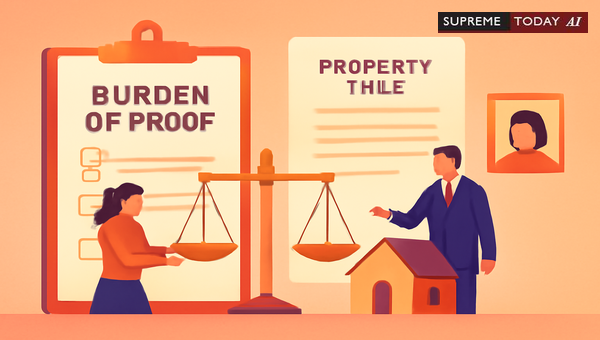
in Title Disputes Without All
Introduction
Property disputes often arise when claiming title to land or assets, especially after someone's passing. A common question emerges: Who has the burden in a title without showing all the ? This issue is particularly tricky in inheritance cases where not every heir is accounted for or represented. Understanding the is crucial for claimants, as courts strictly apply legal principles to ensure fairness.
In this post, we'll explore the general rules, how the burden operates when heirs are missing, potential shifts during trials, and insights from key cases. Note that this is general information based on legal precedents, primarily under Indian law like the . It is not specific legal advice—consult a qualified attorney for your situation.
Overview of in Title Disputes
In title disputes, the party asserting ownership or rights typically carries the initial burden. states that the party desiring a court judgment based on certain facts must prove those facts exist. 1976 0 Supreme(SC) 377 This means if you're claiming title, you must provide evidence of your entitlement, such as deeds, wills, or succession documents.
When not all are shown, this doesn't automatically relieve the claimant. Courts emphasize that the absence of other heirs doesn't shift the responsibility. The plaintiff must establish a clear case, and the defendant's weaknesses alone won't suffice. 2014 1 Supreme 1
Key Legal Principles
1. General Burden Lies with the Claimant
The foundational rule is straightforward: whoever asserts a fact bears the burden of proving it. In property title cases, the plaintiff must demonstrate superior title or rightful possession. Mere possession or tax receipts isn't enough if contradicted by records. 2021 Supreme(Online)(MAD) 19779 2025 Supreme(Online)(Mad) 37693
For example, in disputes involving deceased owners, claimants can't rely on informal assertions like FIRs; revenue authorities determine heir rights through formal proceedings.
BAIJNATH Vs STATE OF U P AND 2 OTHERS -
2. Impact of Missing
Failing to show all doesn't transfer the burden to opponents. The claimant must prove their exclusive or shared entitlement. Consider a scenario with a will: a legatee can't recover property without probating the will first. The court in held that such a legatee could not maintain recovery proceedings without probating the will, placing the burden squarely on them.
00100037049
One case highlighted an unmarried daughter among other daughters and a widowed mother as , underscoring that all must be considered in claims. Incomplete representation risks dismissal. 2016 0 Supreme(Cal) 667
3. Shifting of the Burden
While the initial burden is on the plaintiff, it can shift with evidence. If the claimant presents a case, the moves to the defendant to rebut. Once such convincing rebuttal evidence is adduced and accepted by the court... the shifts back to the plaintiff who has also the legal burden. 2022 0 Supreme(Mad) 1542 2014 0 Supreme(Ker) 167
Defendants can use direct, circumstantial evidence, or presumptions. In fraud allegations, like with bank guarantees, the burden of showing there was fraud is heavy, and the claimant must discharge it. 2019 0 Supreme(Bom) 1200
add nuance: if is alleged, the burden shifts to the dominant party to prove transaction fairness. 2003 7 Supreme 105
4. Insights from Related Contexts
Burden principles extend beyond pure title cases:
Employment and Heir Claims: In class actions or employment disputes, plaintiffs must prove membership or hires. Failure shifts the burden; employers then show legitimate reasons. 2021 Supreme(US)(ca7) 67 2021 Supreme(US)(ca7) 68
Vehicle and Service Disputes: Claimants prove ownership or precautions on balance of probabilities; service providers may need to show commercial use. 2022 Supreme(SRI)(CA) 634 2024 4 Supreme 693
These reinforce that courts demand concrete proof, not assumptions.
Specific Case References
Case: Emphasized necessity for legatees, burden on claimant to establish rights.
00100037049
General Title Declarations: Plaintiff must prove clear title; defendant's case flaws don't help. 2014 1 Supreme 1
Presumption Shifts: Post-rebuttal, burden returns under presumptions. 2022 0 Supreme(Mad) 1542
Courts defer to legislative wisdom but scrutinize claims rigorously, as in challenges to statutes. 2015 8 Supreme 257
Practical Recommendations
Navigating these disputes requires preparation:
Gather Comprehensive Evidence: Collect deeds, wills, heir lists, and documents.
Address Missing Heirs Proactively: Identify all potential heirs via records; seek legal declarations if needed.
Anticipate Shifts: Build a case strong enough to force rebuttals.
Counter Fiduciary Issues: If influence is alleged, prepare fairness proofs.
Failure here can doom claims, as courts prioritize .
Conclusion and Key Takeaways
In title disputes without all shown, the remains with the asserting party—typically the plaintiff. They must prove entitlement under principles like Section 101 of the Evidence Act, regardless of gaps in heir representation. 1976 0 Supreme(SC) 377 Burdens may shift with evidence, but initial responsibility is firm. 1971 0 Supreme(SC) 616
Key Takeaways:- Claimant proves title; missing heirs don't auto-shift burden.
00100037049
- Use for wills; formal proceedings for heirs.- Rebuttals can pivot evidential burdens via evidence or presumptions. 2022 0 Supreme(Mad) 1542- Heavy loads in fraud or fiduciary cases. 2019 0 Supreme(Bom) 1200Property claims demand diligence. For tailored advice, engage a lawyer familiar with local laws. References: 2014 1 Supreme 1
00100037049
1971 0 Supreme(SC) 616 2003 7 Supreme 105 1976 0 Supreme(SC) 377 2022 0 Supreme(Mad) 1542 2019 0 Supreme(Bom) 1200 2016 0 Supreme(Cal) 667 #BurdenOfProof, #TitleDisputes, #LegalHeirs















