



Navigating Legal Recourse When a Neighbor Encroaches on a Government Drain Near Your Land
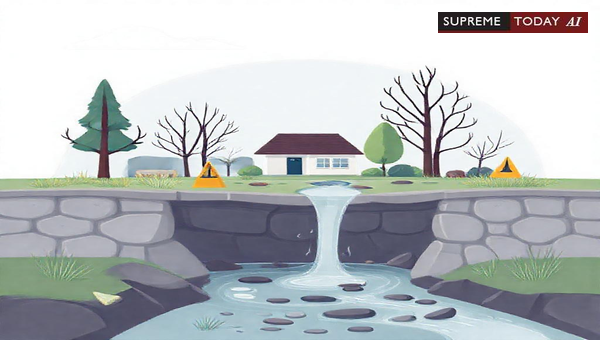
Property boundaries can often become the source of significant friction between neighbors. One particularly complex scenario arises when an individual observes a neighbor encroaching upon a government drain or public channel located near their private plot. A common question arises in such situations: A government drain near a plaintiff's plot encroached by defendant whether plaintiff's can bring suit against such ? The reality of the law is nuanced—while a private citizen cannot always dictate how public land is managed, there are specific legal pathways to protect one's own property interests when an spills over or causes harm.
Understanding the Right to Sue
A plaintiff may generally bring a suit against an on a government drain near their plot, but the ability to succeed depends heavily on the specific statutory framework of the area, the nature of the , and whether the plaintiff has suffered distinct, actionable damage. While a private landowner cannot always act as a proxy for the government in removing public encroachments, they are not without remedies if their own title or property enjoyment is compromised.
The legal landscape hinges on a vital distinction: is the merely an unauthorized occupation of public land, or does it directly interfere with your private rights? Courts have clarified that a suit for or an is maintainable where the plaintiff's title is admitted or established, even if the involves a government drain, provided the is distinct and independent 1994 0 Supreme(SC) 1140.
When the Government Owns the Drain
It is critical to identify the ownership of the drain in question. In many jurisdictions, a drain belonging to the State Government does not automatically vest in the municipal corporation simply because the municipality is tasked with its maintenance. The has noted that usually requires specific statutory procedures, such as those found in of certain municipal acts 2001 6 Supreme 785.
If the drain remains clearly under government ownership, it is considered public land. The law generally views encroachers on such property as . Importantly, the principle of does not typically apply to encroachments on government water bodies or public land. As one legal principle emphasizes, if such acts of trespass are permitted, it would lead to an absolute degradation and collapse of the public trust vested with the State to protect the lands and water bodies 2015 0 Supreme(Mad) 3276. Consequently, the government—not necessarily the adjacent private landowner—is usually the primary authority empowered to initiate removal proceedings.
Municipal Authority and Statutory Powers
The primary responsibility for clearing obstructions from public streets and drains usually lies with the municipal corporation or local authority. Statutes, such as the Bombay Municipal Corporation Act, grant the Commissioner or council the authority to remove structures that obstruct or encroach upon open channels, drains, or public wells. In these instances, the municipality can often act without notice to remove the offending structure 1985 0 Supreme(SC) 226.
If a neighbor constructs a platform or pial over a municipal drain, it is considered an and an obstruction in the street. In such cases, the municipality holds the right to remove it, and a private party generally cannot succeed in a suit for to stop the municipality from performing its statutory duty 1912 0 Supreme(Mad) 470.
Key Considerations for Your Lawsuit
If you are considering legal action, you must be prepared to establish that the has specifically infringed upon your rights. Consider the following:
- Establish Your Title: A court is much more likely to entertain a suit for possession or if the defendant admits your ownership or if you can clearly establish your title to the adjacent plot 1994 0 Supreme(SC) 1140.
- Identify the Damage: You must demonstrate how the causes you harm. Are you losing access to your property? Is there a risk of water damage due to obstructed drainage? General complaints about public land usage are often dismissed, but specific complaints about personal damage hold more weight.
- The Distinct Rule: If you have filed previous suits, ensure your current claim is based on a distinct and independent . The bar under may prevent you from suing if the current issue is merely an extension of a prior dispute that should have been addressed earlier 1994 0 Supreme(SC) 1140.
- The Nature of the Remedy: Remember that proceedings for public land are often treated as summary remedies. However, if there is a bona fide dispute of title—meaning there is a genuine disagreement about who owns the land—the is inappropriate, and a regular civil suit becomes the proper course of action 2023 0 Supreme(Jhk) 88.
Distinguishing Between Public and Private Rights
Conflicts often arise when a property owner believes their privacy or enjoyment of their home is threatened by activity on an adjacent strip of land. However, courts distinguish between rights of way, public drains, and private boundaries. For example, if there was already a registered partition deed confirming boundary lines, claims regarding privacy or unauthorized usage of land by a neighbor may be difficult to sustain if the neighbor is operating within their own demarcated territory 2002 0 Supreme(Pat) 640.
Furthermore, you cannot force a neighbor to construct a drain, nor can you always dictate how they manage their land unless there is a clear or a violation of established property rights 2015 0 Supreme(All) 1698 and 2017 0 Supreme(Mad) 201.
Conclusion
Initiating a lawsuit regarding an on a government drain is a complex endeavor that requires careful navigation of both public and private law. Before rushing to court, it is essential to determine:1. Ownership: Does the drain belong to the state or the municipality?2. Harm: Is the directly causing damage to your personal property, or is it purely a public nuisance?3. Evidence: Can you prove your own title and the specific nature of the defendant's ?
While general on public land is a matter for state or municipal authorities, an individual can seek legal protection if their own beneficial interest is jeopardized. It is always advisable to consult with a legal professional to review your specific site plans, municipal records, and local statutes before proceeding. This information is intended for educational purposes and should not be considered specific legal advice.
#PropertyLaw #LegalAdvice #LandDisputes #RealEstateLaw







