


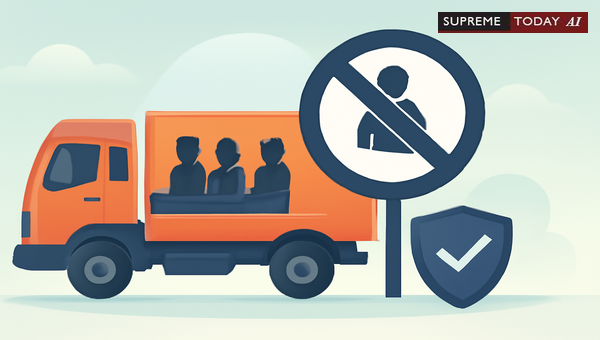
Passengers in Goods Vehicles: Legal Rules in India
In India, the transportation sector is tightly regulated to ensure public safety, especially when it comes to mixing passengers with goods. A common question arises: Goods Transportation for Passengers – can goods vehicles legally carry passengers? This practice, often seen in rural areas or due to economic pressures, raises significant legal, safety, and insurance concerns. Under the (MV Act), such transportation is generally prohibited, with limited exceptions. This blog post explores the legal framework, key court rulings, risks involved, and practical recommendations. Note: This is general information and not specific legal advice; consult a qualified lawyer for your situation.
Legal Framework Under the
The MV Act explicitly prohibits the transportation of passengers in goods vehicles without a valid . A is defined as a motor vehicle constructed solely for the carriage of goods, and the 1988 amendment removed any prior allowance for carrying passengers alongside goods 2002 0 Supreme(Raj) 1191 2005 0 Supreme(Raj) 98.
Key Prohibitions and Exceptions
- Strict Ban: Passengers cannot be transported in goods vehicles except for coolies involved in loading/unloading or the owner/authorized agent accompanying the goods 2006 0 Supreme(Mad) 2323.
- Legislative Intent: It leaves no doubt that the cannot be used for transportation of the passengers and intention of the legislation to classify the vehicle as , is one for transportation of the goods 2011 0 Supreme(Kar) 453 2011 0 Supreme(Kar) 987.
- : Even if a vehicle occasionally carries passengers, it remains a unless systematically used for passenger transport 2009 0 Supreme(Guj) 486 2000 0 Supreme(Guj) 111.
This framework aims to prevent misuse of vehicles not designed for human occupancy, reducing accident risks.
Enforcement Challenges and Judicial Emphasis
Despite clear laws, unauthorized passenger carriage in goods vehicles is prevalent due to lax enforcement 2006 0 Supreme(Mad) 2323. Courts have highlighted the dangers: in accidents, this leads to compensation disputes and underscores the need for strict safety norms 1997 0 Supreme(Kar) 296 2006 0 Supreme(Mad) 2323.
Judges have repeatedly stressed compliance: If the intention of the legislation is to prevent use of particular class of vehicle for the purpose other than purpose for which it was permitted in law it would be violation of the Motor Vehicle Act 2011 0 Supreme(Kar) 453. Additional sources reinforce that vehicles primarily for goods cannot carry passengers unless or ones traveling with their goods 2024 0 Supreme(MP) 136 2023 0 Supreme(AP) 1190.
Insurance Implications and Liability Risks
One of the biggest pitfalls is insurance coverage. Policies typically exclude passengers in goods vehicles as they are unauthorized occupants 1998 0 Supreme(Kar) 554
.
- Limited Coverage: Risk may extend if passengers travel for goods transport purposes and are not fare-paying, but unauthorized carriage remains unlawful 2025 0 Supreme(Mad) 5121.
- : Owners can transport their own goods, with under the 1994 amendment to Section 147, but not large numbers of passengers 2024 0 Supreme(Bom) 187.
In accidents, owners, drivers, and even passengers face liability issues, with no payout for unauthorized riders.
Judicial Precedents and Key Findings
Indian courts, including the , have solidified these rules:
- Definition: Strictly for goods; no passenger allowance post-1988 2002 0 Supreme(Raj) 1191 2005 0 Supreme(Raj) 98.
- : A vehicle isn't reclassified by occasional passenger trips 2009 0 Supreme(Guj) 486 2000 0 Supreme(Guj) 111.
- Licensing Violations: Exceeding permitted passengers or using vehicles beyond licensed purpose invites penalties, seizure, and fines 2006 0 Supreme(Mad) 2323 2010 0 Supreme(Kar) 226
2023 0 Supreme(Ker) 821.
- Reciprocity: Conversely, goods in stage carriages must be packed to avoid hindering comfort, with strict limits 2023 0 Supreme(Raj) 1316 2024 0 Supreme(SC) 1380
.
Transport vehicle apparently is a vehicle used for transportation of passengers or goods 2015 0 Supreme(Ker) 14, but mixing requires permits.
Regulatory Powers and Broader Context
State Governments can modify permits under Section 67(3) for goods and passenger schemes 2023 Supreme(Online)(Ker) 74156. Central policies promote national frameworks. Businesses like goods transporters must adhere: one case notes a company carries on business of transportation of goods for hire but parking/operations don't override vehicle rules 2017 0 Supreme(Ori) 1160.
Licenses cap passengers and goods; excess is a violation 2023 0 Supreme(Ker) 821. Personal luggage may be allowed, but not passengers in goods vehicles.
Practical Recommendations
For Transport Operators
- Obtain permits for any passenger transport; avoid goods vehicles.
- Train staff on MV Act obligations and safety 2006 0 Supreme(Mad) 2323.
- Comply with licensing to prevent seizure 2010 0 Supreme(Kar) 226.
For Passengers
- Avoid goods vehicles to sidestep insurance gaps and risks.
- Report violations to authorities for better enforcement.
For Businesses and Lawyers
- Advise on liabilities; monitor MV Act amendments.
- Note: Goods in passenger buses need sealing/packing for safety 2023 0 Supreme(Raj) 1316.
Conclusion and Key Takeaways
Transporting passengers in goods vehicles is largely prohibited under the MV Act, 1988, to prioritize safety. Exceptions are narrow, and violations trigger penalties, seizures, and insurance denials 2006 0 Supreme(Mad) 2323 1997 0 Supreme(Kar) 296 2005 0 Supreme(Raj) 98 1998 0 Supreme(Kar) 554
2009 0 Supreme(Guj) 486 2000 0 Supreme(Guj) 111. While economic needs drive this practice, courts demand strict adherence.
Key Takeaways:- Goods vehicles = goods only; no passengers generally.- Insurance doesn't cover unauthorized riders.- Use proper permits; report misuse.- Safety first – choose authorized transport.
Stay compliant to avoid legal pitfalls. For tailored advice, reach out to a legal expert. Share your thoughts below!
#GoodsVehicleLaw, #MVAct1988, #PassengerSafety












