Searching Case Laws & Precedent on Legal Query.....!
Analysing the retrieved Case Laws
Scanned Judgements…!



Searching Case Laws & Precedent on Legal Query.....!
Analysing the retrieved Case Laws
Scanned Judgements…!
No Work No Pay Principle - The principle states that wages are paid in consideration of work performed; if no work is rendered, wages are typically not due. Several judgments reaffirm that this principle is fundamental in employment law, but it is not absolute and can be relaxed under certain circumstances, such as when an employee is unlawfully prevented from working (e.g., SCC 2007, 7 SCC 689; Uttar Pradesh v. Madhav Prasad Sharma, 2011). 2023 0 Supreme(Chh) 465
Misuse and Exceptions - The principle can be misused, as in cases where employers invoke it without proper cause or evidence of employee misconduct. For example, HPCL's claim of 'no work no pay' was challenged, with courts noting the absence of evidence showing the employee's refusal or misconduct and emphasizing that the principle should not be applied arbitrarily. 2023 0 Supreme(Del) 5375
Court Rulings on Back Wages - Courts have held that back wages are not automatically granted when an employee is reinstated if the employee did not perform work during the period. Orders often specify that back wages are denied based on the 'no work no pay' principle, especially when employees are absent or refuse to report to duty, unless unlawful impediments are proven. For instance, orders from Labour Courts and High Courts have clarified that back wages are only payable if the employee was willing and able to work but was unlawfully prevented from doing so. 2025 0 Supreme(Kar) 474; 2024 0 Supreme(Telangana) 244; 2024 0 Supreme(Telangana) 38
Equal Pay for Equal Work - The Supreme Court has emphasized that the principle of 'equal pay for equal work' applies to all employees performing the same duties, including temporary, casual, or contractual workers, based on constitutional provisions and judicial precedents. The courts have directed that such employees are entitled to wages comparable to permanent employees holding similar posts. 2023 0 Supreme(Guj) 468; 2023 0 Supreme(All) 699; 2023 0 Supreme(Gau) 685
Legal Clarifications and Limitations - While the 'no work no pay' principle is generally upheld, courts recognize exceptions, such as illegal detention or prevention from working. Additionally, the principle cannot override statutory provisions or rules like FR 54-A, which provide for payment of allowances even in cases of absence due to lawful reasons. 2023 0 Supreme(Chh) 465; SCC 2007
Analysis and Conclusion:The 'no work no pay' principle is a well-established legal doctrine in employment law, emphasizing that wages are contingent upon work performed. However, courts have acknowledged its limitations and exceptions, especially where the employee was willing to work but unlawfully prevented or impeded from doing so. In cases of wrongful termination or illegal detention, courts may order back wages despite the principle. Moreover, the principle does not negate statutory entitlements or constitutional mandates like 'equal pay for equal work,' which extend to temporary and contractual employees. Therefore, while the principle serves as a general guideline, its application is context-dependent, and courts may grant back wages or relax its strict application based on the facts and legality of the circumstances involved.
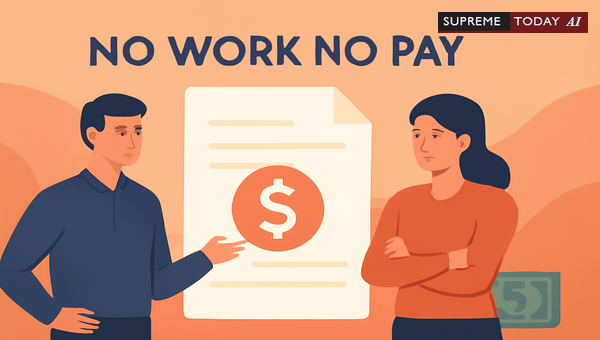
In the realm of employment law, the is a cornerstone concept. It posits that employees are entitled to wages only for work actually performed. But what happens when a court orders an employer to pay last wages or , even if the employee hasn't worked during that period? This question often arises in cases of , , or .
Despite Court Ordered to Pay Last Wages – this is a common dilemma for employees and employers alike. While the principle holds firm in many scenarios, courts have carved out significant exceptions, particularly when the employer's actions are at fault. This blog post delves into the legal nuances, key precedents, and practical recommendations, drawing from established case law.
The no work no pay doctrine is rooted in the idea that wages compensate for labor rendered. As noted in various rulings, wages are paid in consideration of work performed; if no work is rendered, wages are typically not due. 2023 0 Supreme(Chh) 465
However, this principle is not absolute. Courts consistently hold that it does not apply when an employee is willing to work but is prevented by the employer. For instance:- In the Case of Assam Forest Protection Force Constable, the court ruled that the principle of no work no pay should not apply when an employee is kept out of work by the employer and later reinstated by a court order. The employer was directed to pay for the entire period of dismissal. 2023 0 Supreme(Gau) 1440- A general principle affirms: An employee cannot be denied wages if work is not taken from him by the employer. 2015 0 Supreme(SC) 1240
This exception prevents employers from benefiting from their own wrongful actions, such as unjust dismissal or refusal to reinstate.
Indian courts exercise wide discretion when granting , evaluating the specifics of each case. Factors include the legality of the employee's appointment, the employer's conduct, and whether the employee was at fault.
Key insights from precedents:- In cases of unjust dismissal, courts order full , stating the principle of no work no pay does not apply. 1988 0 Supreme(SC) 26- The decision hinges on the nature of the employer's actions and the legality of the employee's appointment. 2008 4 Supreme 458
Moreover, calculations for must account for pay revisions. One observed: The calculation made by the respondent shows that the of the petitioner was calculated basing on the last pay drawn by the petitioner but... It is to be noted that for every four years there is Revision of Pay Scales but the same was not applied to the petitioner which is erroneous. 2024 0 Supreme(Telangana) 244 2024 0 Supreme(Telangana) 38
In another instance, petitioners were ordered wages @ Rs.225/- per day and fractions thereof for lesser period. 2024 0 Supreme(J&K) 338
Courts recognize several scenarios where the principle yields:- Employee not at fault: When keeps the employee out of work. 2023 0 Supreme(Gau) 1440- Unjustified employer refusal: The employer's refusal to allow the employee to work is deemed unjustified. 1964 0 Supreme(SC) 184- Legal appointment with illegal cancellation: are mandated if the appointment was valid. 1988 0 Supreme(SC) 26
Conversely, the principle holds when employees refuse work or are absent without cause. For example: An order was passed that he will not be paid for the intervening period on the principle of ‘no work no pay’. 2022 0 Supreme(Jhk) 531 And, Insofar as issue of is concerned, the has assigned proper reasons by applying principle of 'no work no pay' and has therefore, refused . 2022 0 Supreme(Guj) 855
Courts caution against misuse: In HPCL cases, claims of 'no work no pay' were challenged due to lack of evidence of employee misconduct, emphasizing non-arbitrary application. 2023 0 Supreme(Del) 5375
While not directly overriding no work no pay, the constitutional mandate of intersects in reinstatement scenarios. The has declared: There is no room for any doubt, that the principle of ‘’ has emerged from an interpretation of different provisions of the Constitution. 2023 0 Supreme(Guj) 468 2023 0 Supreme(Gau) 685
Temporary employees may claim wages on par with regulars: The principle of '' would be applicable to all the temporary employees concerned, so as to vest in them the right to claim wages on a par with the minimum of the pay scale of regularly engaged government employees. 2023 0 Supreme(All) 699
Consider a reinstated employee after wrongful termination. Even if no work was performed post-dismissal, courts may award from the dismissal date, rejecting no work no pay. This aligns with directives for without in some , but full payment where fault lies with the employer. 2017 0 Supreme(AP) 906
In enforcement proceedings, Labour Courts have adjusted calculations for pay scale revisions, ensuring fairness. 2025 0 Supreme(Kar) 474
High Courts have overturned denials: Before the ... it was claimed the workman was not entitled to on principle of ‘no work no pay’. However, the held the workman entitled to entire . 2017 0 Supreme(All) 2464
The remains vital but bends to justice when employers unlawfully bar employees from work. Courts prioritize in cases, backed by precedents like the Assam Forest case 2023 0 Supreme(Gau) 1440 and others 2015 0 Supreme(SC) 1240 1988 0 Supreme(SC) 26 2008 4 Supreme 458 1964 0 Supreme(SC) 184.
Key Takeaways:- Gather court orders, dismissal documents, and proof of willingness to work.- Petition for enforcement if employers delay compliance.- Note pay revisions in back wage claims 2024 0 Supreme(Telangana) 244.- Consult professionals for case-specific strategy.
This post provides general information based on legal precedents and is not a substitute for professional legal advice. Employment laws vary by jurisdiction; seek counsel tailored to your situation.


2018dated 25.01.2018 is considered and therefore, it is ordered that the petitioners shall be paid wages @ Rs.225/- per day and fractions thereof for lesser period.

The principle of "no work no pay" is being misused by the HPCL. The Appellant never displayed any refusal to work, and there was a conspicuous absence of a show cause notice or any adverse comments from his Reporting Officer on record to substantiate HPCL's stance. ... The narrative that HPCL possessed mala fide intentions in invoking the "no work no pay" principle lack....

to back wages from the date of award passed by the Labour Court till the date of order passed by this Court in the Writ Appeal on the principle of ‘no pay no work’. ... He would submit that the Labour Court erroneously interpreted the order of the Division Bench of this Court to hold that the back wages are denied applying the #HL_STA....

There is no room for any doubt, that the principle of ‘equal pay for equal work’ has emerged from an interpretation of different provisions of the Constitution. The principle has been expounded through a large number of judgments rendered by this Court, and constitutes law declared by this Court. ... There can be no doubt, that the principle of ‘equal pay#HL_E....

The principle of 'No Work No Pay' is based upon a fundamental concept in a Law of Contract of Employment namely wages and salary are paid by the employer in consideration of work / service rendered by the employee. ... Whether the principle of “no work no pay” has rightly been invoked by the learned Single Judge? 2. If no, then what back-wage....

There can be no doubt, that the principle of “equal pay for equal work” would be applicable to all the temporary employees concerned, so as to vest in them the right to claim wages on a par with the minimum of the pay scale of regularly engaged government employees holding the same post. ... The Supreme Court after considering all the earlier law settled on the issue has again reiterated....
The Bank, therefore, cannot be saddled with the liability to pay him his salary and allowances for the period. That will be against the principle of 'no work, no pay' and positively inequitable to those who have to work and earn their pay. ... The principle of “no work no pay” is a salutary principle of general appli....

(4) The Labour Court vide order dated 15.06.2016 allowed the E.P. with the following observations: "...The calculation made by the respondent shows that the back wages of the petitioner was calculated basing on the last pay drawn by the petitioner but ... It is to be noted that for every four years there is Revision of Pay Scales but the same was not applied to the petitioner which is erroneous. When the....

(4) The Labour Court vide order dated 15.06.2016 allowed the E.P. with the following observations: “.......The calculation made by the respondent shows that the back wages of the petitioner was calculated basing on the last pay drawn by the petitioner but ... It is to be noted that for every four years there is Revision of Pay Scales but the same was not applied to the petitioner which is erroneous. When....

pay parity on the principle of equal pay for equal work. ... There is no room for any doubt that the principle of ‘equal pay for equal work’ has emerged from an interpretation of different provisions of the Constitution. The principle has been expounded through a large number of judgments rendered by this Court, and constitutes law de....

An order was passed that he will not be paid back wages for the intervening period on the principle of ‘no work no pay’.
Insofar as issue of back wages is concerned, the Labour Court has assigned proper reasons by applying principle of "no work no pay" and has therefore, refused back wages. The Court does not find any reason to interfere with the finding of the Labour Court in this connection.
Before the High Court, in proceedings initiated by the management it was claimed the workman was not entitled to back wages on principle of ‘no work no pay’. However, the High Court held the workman entitled to entire back wages. In this background, the Supreme Court held as below : 18. Last, in the case of State of U.P. v. Charan Singh (supra), upon Industrial Tribunal had granted relief of reinstatement without back-wages.

The Corporation is accordingly directed to reinstate the petitioner; however, without any back wages from the date of termination till the date of reinstatement but, with continuity of service and other monetary and attendant benefits. As a sequel, the orders of the appellate authority and the disciplinary authority are set aside and the petitioner is found not guilty of the charge formulated against him and is exonerated of the said charge. However, this Court finds that this is a f....
1 is at present working without considering the fact that such person must be senior to the workman concerned and was already promoted to the next cadre in Class III. 27. The High Court has also committed an error in giving the relief of reinstatement with back wages without considering whether the concerned workman was gainfully employed from 1976 till date of judgment, there being no evidence on record. In our opinion, the High Court has completely erred in ordering an appointment to a simil....


An indispensable Tool for Legal Professionals, Endorsed by Various High Court and Judicial Officers
Please visit our Training & Support
Center or Contact Us for assistance

Scan Me!
India’s Legal research and Law Firm App, Download now!


For Daily Legal Updates, Join us on :



 Back to top


