


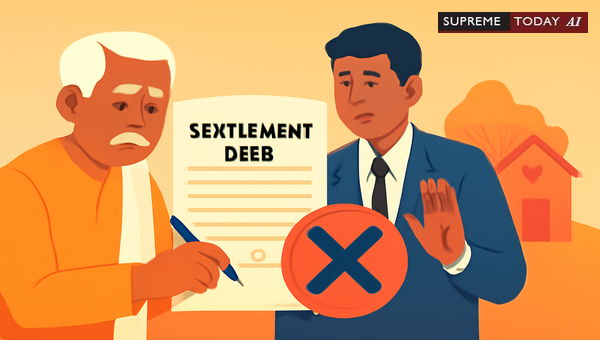
Can a Be Set Aside for ?
In property disputes, settlement deeds are common instruments used to transfer rights voluntarily, often within families. But what happens when the person who executed the deed claims they were illiterate and didn't understand what they signed? Can a suit be filed to set aside the on the ground of illiterate? This question arises frequently in Indian courts, especially in cases involving vulnerable parties like elderly or uneducated family members.
This article explores the legal framework, key doctrines, , and real court insights. Note: This is general information based on legal precedents and not specific legal advice. Consult a qualified lawyer for your situation.
What is a ?
A is a legal document where the settlor transfers property rights to the settlee, typically without exchange of money, for family arrangements or gifting. Under Indian law, these deeds must be registered and executed with full consent and understanding.
However, if the executant (settlor) was illiterate and unaware of the document's nature, it may be challenged. Courts recognize that can lead to , , or lack of consent, making the deed vulnerable.
Grounds for Challenging a : Focus on
Yes, generally, a suit can be filed to set aside a if the party proves they were illiterate and executed it without proper understanding of its nature and contents. This is supported by the doctrine of (Latin for it is not my deed), which applies when the signer is illiterate or blind and was deceived about the document's character. 2022 0 Supreme(Mad) 1147
Key points include:- The doctrine applies when the executant is unaware of the document’s true nature due to . 2022 0 Supreme(Mad) 1147- Courts have held that illiterate persons may execute under , , or , allowing challenges if proved. 2022 0 Supreme(Mad) 1147- alone isn't enough; evidence must show lack of awareness. 2022 0 Supreme(Mad) 1147
In one case, the court noted: The doctrine of will be applicable in a case where the concerned party is illiterate and was not aware of the nature of document that was executed and had never intended to convey the property as evidenced by the concerned document. 2022 0 Supreme(Mad) 1147
Doctrine of Explained
When Does It Apply?
This doctrine protects those who sign without comprehending the document, particularly illiterates. The party must first prove and lack of understanding. Once established, the burden shifts to the relying party to show no or occurred. 2022 0 Supreme(Mad) 1147
In a analyzed case, the 2nd defendant (mother) claimed and that her son tricked her into signing a under the guise of paying house tax. However, her cross-examination revealed she knew it was a : The 2nd defendant during the course of cross examination had categorically stated that the document executed by her in the year 2004 was a . 2022 0 Supreme(Mad) 1147
The court rejected , stating: From the oral and documentary evidence, it is clear that the 2nd defendant was aware of the nature of the document that was executed in her favor. 2022 0 Supreme(Mad) 1147
- Initial Burden: Claimant proves and unawareness. Evidence like witnesses, medical records, or lack of education proof is crucial. 2022 0 Supreme(Mad) 1147
- Shifted Burden: Opponent then proves valid execution without deceit. 2022 0 Supreme(Mad) 1147
Similar burden principles appear in other property suits. For instance, plaintiffs must establish title beyond mere documents like patta, as The lies with the plaintiff to establish title and possession of the property. Documentary evidence such as patta (Ex.A3) alone may not be sufficient to prove exclusive possession. 2018 0 Supreme(Mad) 3206
Case Studies and Court Rulings
Primary Case on
In the key judgment, the lower courts upheld the deed because evidence showed awareness, despite family tensions (son trying to evict mother). The doctrine failed due to the executant's admissions. 2022 0 Supreme(Mad) 1147
Related Challenges to Settlement Deeds
Courts often scrutinize deeds for or invalid execution, akin to claims:- In a case, a plaintiff alleged a was disguised as a power of attorney. The court rejected it as vexatious, noting admissions negated : The plaintiff's admission of the document’s execution and her understanding negated claims of and . 2025 0 Supreme(Mad) 5018- Limitation bars delayed challenges: Failure to contest within time extinguishes co-ownership claims, as failure to challenge the within the statutory period results in extinguishment of rights. 2024 0 Supreme(Mad) 2474- Validity requires proof of understanding: There is no proof to show that the settlor understood the contents of the and then signed it or put thumb impression upon it. If , no suit needed, but typically one is filed. 2015 0 Supreme(Mad) 3645
Another ruling emphasized: The can be cancelled by Court of law only on the ground of , threat, mis-representation and . 2016 0 Supreme(Mad) 64
Exceptions and Limitations
- Awareness Negates Claim: If evidence shows knowledge (e.g., family context, prior statements), doctrine doesn't apply. 2022 0 Supreme(Mad) 1147
- No Proof, No Relief: Mere allegation insufficient; credible evidence mandatory.
- Possible: Deeds can be corrected via if intent clear, but not for invalid ones. 2024 0 Supreme(Mad) 2223
In partition suits, unchallenged deeds bind parties: Without contesting the validity of the , plaintiffs could not claim rights over the property. 2025 0 Supreme(Mad) 2751
Practical Recommendations
If alleging :- Gather strong evidence: Literacy certificates, witness testimonies, or expert opinions.- File promptly to avoid limitation issues. 2024 0 Supreme(Mad) 2474- Plead specific facts of deception in the suit.
Courts advise: A party alleging should produce credible evidence, such as medical certificates, witnesses, or other proof of . 2022 0 Supreme(Mad) 1147
For those relying on deeds, retain records showing voluntary execution and awareness.
Key Takeaways
- Yes, Possible: Suits to set aside settlement deeds on grounds are viable via , if proved. 2022 0 Supreme(Mad) 1147 2003 7 Supreme 105
- Evidence is King: Admissions or contradictory proof often defeats claims.
- Broader Lessons: Similar scrutiny applies to , ; timely action essential.
Property transfers demand caution, especially with vulnerable executants. While courts protect the illiterate, they demand rigorous proof to prevent abuse. For personalized guidance, seek professional legal counsel.
References:- 2022 0 Supreme(Mad) 1147: Core on and .- 2003 7 Supreme 105: Supports challenges for lack of understanding.- Other cases as cited for context.
#SettlementDeed #NonEstFactum #PropertyLaw












