


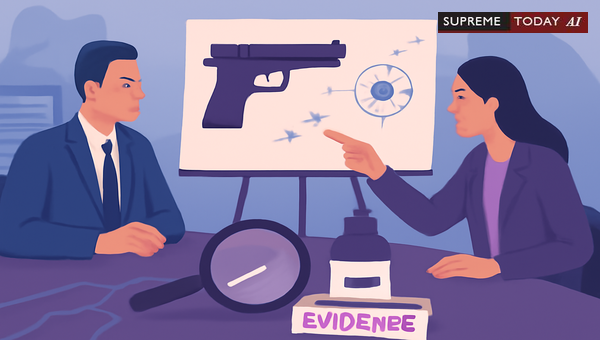
Cross-Examine Ballistic Experts in Gunshot Cases: Key Strategies
In high-stakes criminal trials involving firearms, the testimony of a ballistic expert can make or break the prosecution's case. Defense attorneys often face the challenge of questions for cross examination of ballistic expert in a gunshot case. Effectively dismantling their opinions requires precision, knowledge of , and pointed questioning. This post explores proven strategies drawn from legal precedents, focusing on evidence collection, ballistic matching, residue analysis, and more. While this provides general insights, consult a qualified attorney for case-specific advice.
Why Cross-Examine the Ballistic Expert?
Ballistic experts opine on critical aspects like firearm identification, firing distance, , and (GSR). However, their conclusions rely on the investigating officer's (IO) evidence handling. targets inconsistencies in scene reconstruction, , and forensic procedures to create . For instance, courts have noted that the ballistic expert proved that the empty cartridge forwarded by the Investigating Officer was not fired from either of the recovered weapons1975 0 Supreme(SC) 452. Such mismatches can undermine the entire case.
Effective questioning challenges the expert's reliance on potentially flawed data, exposing lapses that may weaken the prosecution’s evidence regarding the proximity of firing2019 0 Supreme(MP) 709.
Scene Investigation and Evidence Collection
Start by probing the foundation: the crime scene. Did the IO accurately document distances, positions, and physical evidence? Key questions include:
- Did you measure the distance from the shooter to the victim?
- Was a detailed scene sketch prepared, including ?
- Were the victim's clothes seized to examine gunshot marks?
Legal documents emphasize that the position of the gunshot entry wound as well as the gunshot marks on the clothes are the best evidence to prove the distance from which the gunshot was fired2019 0 Supreme(MP) 709. The police should have seized the clothes of the deceased and prepared a map with measurement2019 0 Supreme(MP) 709. Failure here invites doubt, as in cases where witnesses described accidental forest shots but evidence was mishandled 2023 0 Supreme(J&K) 554.
Cross-examine on whether the expert considered scene photos or measurements, especially for trajectories like the trajectory was obliquely downwards from the left side of the chest2025 0 Supreme(SC) 645.
Handling of and
Ballistics hinge on weapons, cartridges, and bullets. Challenge:
- Was the proper followed for weapons and cartridges?
- Were ballistic tests conducted per standard protocols?
- Did the recovered cartridge match the firearm?
Experts may falter if the IO sent mismatched evidence, as seen when the ballistic expert proved that the empty cartridge... was not fired from either of the recovered weapons1975 0 Supreme(SC) 452. In another instance, only one cartridge had been fired from the gun and the same gun had first hit the deceased2025 0 Supreme(Gau) 736, questioning multiple shots claimed by witnesses.
Ask: Did you follow the proper for the weapons and cartridges? Any gaps, like unsealed samples or poor labeling, erode credibility 2025 0 Supreme(SC) 645. Sources highlight recoveries at the accused's instance, but the recovery of the gun and cartridges at the instance of the appellant was proved only if chain intact 2025 5 Supreme 705.
(GSR) and Firing Distance
GSR tests determine range and self-infliction possibilities. Vital questions:
- Were GSR swabs collected from victim and accused hands?
- What were the test results, and do they align with the firing distance?
- particles were detected on the swab from the right hand of the accused2025 0 Supreme(SC) 645.
The expert might claim the expert proved that the shot was fired from a range of approximately 3 feet2025 0 Supreme(SC) 645, but cross on absences: tests for and trace metal detection should be performed2022 0 Supreme(Gau) 835. No blackening around wounds suggests longer range, as in his , he stated that gun shot injuries had no blackening around them2022 0 Supreme(All) 225.
Trajectory, Weapon Type, and Forensic Knowledge
Test the expert's grasp of physics:
- Does the match witness accounts?
- Could injuries result from ricochet or multiple weapons?
In one case, suspected holes on the garments were only indicative that the holes were caused by a DBBL shot gun which could have been caused by two shots from single barrel gun2024 0 Supreme(J&K) 155. Challenge classifications: I as revolver and I.O. as a pipe gun the same was classified as single shot pistol by P.W.10, an expert2017 0 Supreme(Cal) 152. Or, once, it is not known whether it is pistol fire gun or gun fire, so about distance it cannot be exactly stated2014 0 Supreme(J&K) 356.
Eyewitness inconsistencies amplify this, like failing to explain all injuries: non explanation of the gun shot injury No.6 by these two eye witnesses2024 0 Supreme(All) 849.
Omissions, Irregularities, and Expert Limitations
Highlight procedural failures:
- Why weren't fingerprint or trace metal tests done?
- Did you consult the IO on scene conditions affecting ballistics?
The witness was cross examined on two points, first whether from one gun shot, injuries sustained by both the deceased could have been caused2015 0 Supreme(All) 4015. Courts note lapses don't always invalidate but reduce weight. Exceptions include minor irregularities or uninformed experts.
Integrating Eyewitness and Procedural Challenges
Weave in witness cross: Did they see the accused fire? PW-5 stated that he did not see the appellant holding the gun nor pulling the trigger2025 0 Supreme(Gau) 736. Sequence matters: Brajesh (deceased in cross case) suffered gun shot injury and thereafter, the victims/deceased of this case suffered2021 0 Supreme(MP) 400. Challenge biases or misses, like the second shot fired by A-1 missed the target2024 0 Supreme(All) 849.
Recommendations for Effective
- Prepare targeted questions on evidence handling and forensics.
- Use visuals like scene sketches to highlight discrepancies.
- Question the expert’s awareness of and IO lapses.
- Explore omissions like untested GSR or unseized clothes.
- Test knowledge: from one gun shot, injuries... could have been caused positively or not 2015 0 Supreme(All) 4015.
Key Takeaways
Cross-examining ballistic experts demands scrutiny of foundational evidence. By exposing gaps in collection, preservation, and analysis—such as mismatched cartridges 1975 0 Supreme(SC) 452 or missing GSR tests 2022 0 Supreme(Gau) 835—defense can foster doubt. Remember, effective can expose lapses or inconsistencies that may undermine the prosecution's case. Always tailor to facts; this is general guidance, not legal advice.
References:1. 2025 0 Supreme(SC) 645: Firearm wounds, trajectory, handling.2. 2022 0 Supreme(Gau) 835: GSR and metal detection needs.3. 1975 0 Supreme(SC) 452: Cartridge mismatches.4. 2019 0 Supreme(MP) 709: Scene maps, clothes seizure.5. Additional cases: 2023 0 Supreme(J&K) 554, 2024 0 Supreme(All) 849, 2025 0 Supreme(Gau) 736, 2025 5 Supreme 705, 2022 0 Supreme(All) 225, 2024 0 Supreme(J&K) 155, 2017 0 Supreme(Cal) 152, 2015 0 Supreme(All) 4015, 2014 0 Supreme(J&K) 356.
#BallisticsCrossExam #GunshotCase #ForensicLaw












