


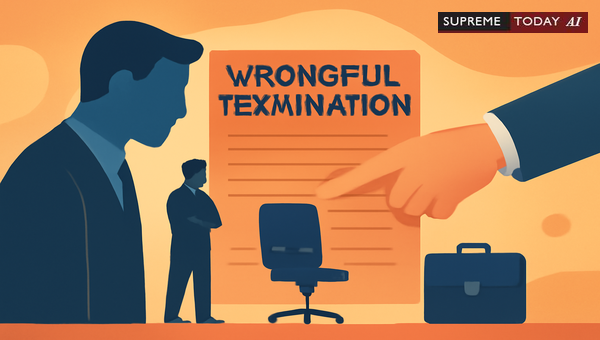
in Disciplinary Termination: Key Insights
In the realm of employment law, few issues strike fear into employees like sudden termination from service, especially when it stems from . Imagine a scenario where an employer or disciplinary authority appears to follow procedure but is actually masking ulterior motives, bias, or victimization. This is where the doctrine of comes into play—a legal principle that courts scrutinize to prevent sham actions disguised as lawful ones.
A common query from employees and HR professionals alike is: Find me judgment where in authority exercised and terminated from services. This blog delves into a landmark ruling and related cases, explaining how such actions can be challenged and overturned. While this provides general insights, it is not legal advice—consult a qualified lawyer for your specific situation.
What is ''?
The term '' refers to when an authority exercises power without genuine lawful intent, often (in bad faith), arbitrarily, or as a pretext to hide true motives like victimization or . It's not about the absence of power but its abuse through pretense or sham.
As established in key jurisprudence, courts and industrial tribunals have the jurisdiction to probe beyond surface-level compliance. They examine if the exercise was (genuine) or merely a facade. This principle ensures fairness in , protecting employees from arbitrary terminations. 1962 0 Supreme(SC) 34
Landmark Judgment on Colorable Exercise
The pivotal case addressing this issue is captured in 1962 0 Supreme(SC) 34, where the affirmed the 's power to intervene. The Court held:
The has jurisdiction to intervene and set aside such termination if it is satisfied that the action taken was a colourable exercise of power, not , or a result of victimization or unfair labour practice.
This underscores that even statutory or contractual powers must be exercised genuinely. The is clear: a mere claim to exercise power isn't enough; it must be . If it's a 'pretence or sham,' tribunals can interfere, leading to reinstatement. 1962 0 Supreme(SC) 34
In this case, the employer's appeal was dismissed, upholding the tribunal's finding of colorable exercise. The Court emphasized:
The requirement of bona fides is essential even in cases of termination of service by notice or payment of wages in lieu of notice, and that the has jurisdiction to intervene and set aside such termination if it is a colourable exercise of power or a result of victimization or unfair labour practice. 1962 0 Supreme(SC) 34
This ruling extends to , where authorities might invoke rules but act with hidden agendas. Tribunals scrutinize real motives, not just procedural checkboxes.
Application to and Termination
In disciplinary contexts, terminations often follow inquiries into misconduct. However, if initiated or pursued , they qualify as colorable exercises. Courts look for signs like bias, arbitrariness, or ulterior motives. A termination that seems procedurally sound can still be quashed if proven sham.
Key points from the jurisprudence:- Tribunals/courts scrutinize if power was exercised or for victimization. 1962 0 Supreme(SC) 34- , arbitrary decisions masking true intent are invalid. 1962 0 Supreme(SC) 34- Even formal compliance fails if motives are concealed. 1962 0 Supreme(SC) 34
The doctrine prevents authorities from bypassing safeguards by cloaking bad faith in legality. As the Court noted:
The 's jurisdiction to intervene and set aside such termination if it is satisfied that the action taken was a colourable exercise of power and that it failed to justify its action before the tribunal. 1962 0 Supreme(SC) 34
Insights from Related Cases: Echoes of Sham Authority
Several judgments reinforce this by highlighting similar abuses, such as lack of independent discretion or pre-determined bias, akin to colorable exercises.
In a case involving suspension under , the court quashed the order because the appointing authority failed to exercise independent discretion as required by . The order merely complied with superior directions, lacking application of mind—mirroring a sham process:
The court found that the suspension order did not reflect any independent discretion by the appointing authority and was passed in compliance with directions from superior officers, thus not fulfilling the requirements of . 2023 0 Supreme(All) 1723
Another instance involved disciplinary penalties where authorities had pre-determined guilt, rendering post-decisional hearings an 'empty formality.' The court set aside orders, noting:
Authorities had pre-determined to impose penalty on the petitioner and proceeded to hold quasi-judicial inquiry giving the post-decisional opportunity of hearing which does not sub serve the rule of . 2024 0 Supreme(Pat) 892
In probationer terminations, stigmatic allegations without proper inquiry under were invalidated, emphasizing over procedural facades. 2024 0 Supreme(Jhk) 318
Bias in inquiries, like dictating terminations without hearings or reasoned orders, was struck down as violative of principles, treating duty descriptions as charges without misconduct proof. 2013 0 Supreme(Cal) 459 2025 0 Supreme(Cal) 994
These cases illustrate how courts invalidate actions lacking bona fides, aligning with the colorable exercise doctrine.
Challenging Colorable Terminations: Practical Steps
If facing such a termination:1. Gather Evidence: Document procedural lapses, bias indicators, or inconsistent motives.2. Approach Tribunal/Court: Industrial disputes acts empower scrutiny under .3. Seek Reinstatement: Successful challenges often lead to back wages and service continuity.4. Highlight Mala Fides: Prove ulterior motives via timelines, superior influences, or exonerations of co-accused.
Remember, outcomes depend on facts; proportionality of punishment and are key. 2014 0 Supreme(Raj) 834
Key Takeaways
- Scrutiny Power: Tribunals can probe beyond procedures for bona fides. 1962 0 Supreme(SC) 34
- Reinstatement Possible: Colorable exercises lead to quashing terminations.
- Broader Application: Applies to suspensions, inquiries, and penalties showing sham intent. 2023 0 Supreme(All) 1723
- Employee Protection: Prevents victimization under legal guise.
This principle upholds fairness in labor relations. For tailored advice, consult legal experts. Stay informed on evolving case law to safeguard rights.
This post is for informational purposes only and does not constitute legal advice.
#ColorableExercise #DisciplinaryLaw #LaborRights





![Director, CSIR-CIMFR [Central Institute of Mining and Fuel Research] VS Mayuresh Dash, S/o. Sri Rabindra Kumar Dash - 2024 Supreme(Jhk) 43](https://supremetoday-s3.b-cdn.net/Jharkhand_3.png)












