


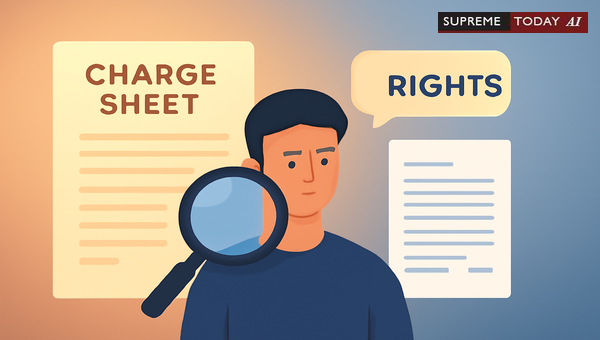
Illegible Documents: Legal Impact Explained
In criminal proceedings, the serves as the foundation of the prosecution's case, outlining allegations and attaching crucial evidence. But what happens if documents attached with are not readable? This seemingly technical issue can raise serious questions about an accused person's right to a . Illegible or unreadable documents may hinder the accused's ability to understand the charges, prepare a defense, or respond effectively, potentially undermining the entire process.
have repeatedly emphasized the importance of legible documents to uphold principles of . This blog post delves into key legal findings, court precedents, and practical recommendations, drawing from landmark judgments. While this provides general insights, it is not legal advice—consult a qualified lawyer for specific cases.
The Fundamental Right to Legible Documents
The right to receive legible copies of charge-sheet documents is considered fundamental to ensuring a . Courts have held that providing illegible copies impairs the accused's ability to comprehend the case against them and mount an adequate defense. For instance, one ruling underscored that the right to receive legible copies is essential for ensuring rights and transparency in the proceedings 2021 0 Supreme(Raj) 1947.
Under , the must include all relevant documents, statements, and materials relied upon by the prosecution. If attachments are blurry, faded, or otherwise unreadable, it may render the defective, especially if it prejudices the accused.
Key Legal Principles
- Readability is Mandatory: Documents must be clear enough for the court and accused to understand the basis of the case. The has clarified that while a need not be a full record of evidence, it must establish the case's foundation clearly 2023 0 Supreme(All) 2892.
- Impact on Proceedings: Substantial illegibility can vitiate proceedings or allow challenges to the 's validity 2023 0 Supreme(All) 2892.
- Guarantee: protects the right to a , which includes access to readable evidence 2021 0 Supreme(Raj) 1947.
Court Rulings on Illegible Attachments
Judicial precedents provide clarity on handling unreadable documents. In a significant case, the court directed authorities to provide legible copies, stressing that illegibility hinders defense preparation 2021 0 Supreme(Raj) 1947.
Another ruling addressed a scenario where the copies supplied to the accused are still not legible and readable, but dismissed the objection as a delay tactic, noting that minor illegibility does not automatically invalidate proceedings unless it prejudices the accused2023 0 Supreme(All) 2892. This highlights courts' pragmatic approach: technical flaws are weighed against overall fairness.
Insights from Decisions
High Courts have echoed these principles in various matters:- In one case, the observed that photocopies of and were not readable even after being attached, and originals were not filed without explanation. This raised concerns, underscoring the need for clear, original or quality copies
.- Another directed the filing of a fresh legible / readable copy of the when support documents were not legible, disposing of the application with clear instructions
.- Courts have also noted that missing or incomplete documents in charge sheets can lead to unfair trials, as seen where material documents are missing from the said charge-sheet and copies were deemed incomplete 2014 0 Supreme(Raj) 85.
These cases illustrate that while perfection isn't required, substantial defects impairing understanding invite scrutiny.
Legal Requirements Under
mandates that copies of documents be furnished to the accused alongside the . Illegibility violates this, as it prevents effective inspection and response. Related provisions like allow summoning necessary documents for adjudication 2015 0 Supreme(Raj) 274.
In analogous to criminal proceedings, employees have rights to inspect charge-sheet documents and prepare defenses, reinforcing the need for readability 2021 0 Supreme(Telangana) 45. Courts have quashed actions where procedures bypassed these rights, emphasizing mandatory enquiries before penalties.
Challenging Defective Charge Sheets
If documents are unreadable:1. Raise Objections Early: Defense counsel should file applications highlighting illegibility and seek replacements.2. Demonstrate : Show how it hampers defense, e.g., inability to verify witness statements or evidence lists 2023 0 Supreme(All) 2892.3. Seek Court Directions: Courts may order fresh legible copies or adjourn proceedings
.
However, minor issues—like a few unreadable words—may not suffice if the core case is comprehensible 2021 0 Supreme(Raj) 1947.
Exceptions and Judicial Discretion
Not every illegibility derails a case. Courts exercise discretion:- Minor Defects: Overlooked if no , to prevent delays 2023 0 Supreme(All) 2892.- Technical vs. Substantive: Pragmatic view where overall evidence is clear
.- Prosecution's Duty: Must explain absences, like failure to file originals
.
In one instance, non-enclosure of 171 documents was contested, but courts upheld proceedings where was followed 2011 0 Supreme(All) 1622.
Practical Recommendations for Stakeholders
To avoid pitfalls:- Prosecutors/Investigators: Ensure high-quality scans or photocopies; file originals where required. Promptly replace illegible documents.- Defense Lawyers: Scrutinize attachments immediately; object if legibility impairs client rights.- Courts: Balance defects against ; direct compliance without undue delays.- Accused: Request legible copies via applications under .
Conclusion and Key Takeaways
Documents attached with a must generally be legible to safeguard rights. While minor illegibility may not vitiate proceedings, substantial issues that the accused can lead to challenges, directions for fresh copies, or even invalidation 2021 0 Supreme(Raj) 1947 2023 0 Supreme(All) 2892.
Key Takeaways:- Legibility upholds constitutional rights and procedural fairness.- Courts prioritize substance over minor technicalities but intervene on .- Proactive steps by all parties prevent disruptions.
Stay informed on evolving jurisprudence. For personalized guidance, consult a legal expert. This overview draws from established precedents to educate on general principles.
References
- 2021 0 Supreme(Raj) 1947: Fundamental right to legible charge-sheet copies.
- 2023 0 Supreme(All) 2892: Minor illegibility vs. prejudicial defects.
: Issues with unreadable photocopies.
: Directions for fresh legible copies.
- 2014 0 Supreme(Raj) 85: Incomplete charge sheets and unfair trials.















