


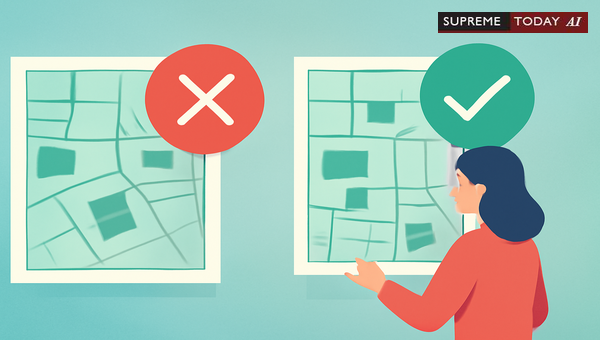
Can a Site Plan Be Declared Wrong Without an Alternative?
In property disputes, construction approvals, and , site plans play a pivotal role. They visually represent , structures, and layouts, often becoming central to legal arguments. But what happens when one party challenges the accuracy of a submitted site plan? A key legal principle emerges: Unless there is an the First One Cannot be Declared Wrong. This concept underscores how courts approach site plan challenges, presuming the initial plan's correctness absent contrary evidence.
This blog post delves into this principle, drawing from and legal analyses. We'll explore the dependencies, implications, and strategies for parties involved in such disputes. Note: This is general information based on case law and not specific legal advice. Consult a qualified attorney for your situation.
Legal Principles on Site Plan Accuracy
Site plans are not mere sketches; they are formal documents submitted for approvals, , or . Courts evaluate their correctness based on evidence, procedural compliance, and alternatives.
Dependence on Alternative Site Plans
The cornerstone is that a site plan's validity hinges on alternatives. Without one, the first cannot be easily declared wrong. As noted, the absence of an alternative plan limits the ability to challenge the initial plan's correctness 2014 0 Supreme(Del) 221.
This presumption protects filers unless challengers provide a credible substitute. For instance, if petitioners fail to file an alternate plan, courts uphold the original as accurate 2014 0 Supreme(Del) 221.
Implications of Filing an Incorrect Plan
Submitting a flawed site plan may signal issues like or . Courts have observed: if plaintiffs possessed the property, they would file accurately; inaccuracies suggest otherwise or concealment 2000 0 Supreme(Del) 719.
In related contexts, site plans prepared post-event (e.g., accidents) aren't definitive if eyewitness testimony contradicts them. Unless there is evidence to disbelieve the eye-witness, only on the basis of site-plan, his testimony cannot be ignored 2022 0 Supreme(Raj) 2243. This highlights site plans' without supporting proof.
When Courts Accept the Original Site Plan
Absence of alternatives strengthens the original's position.
- Presumption of Validity: Courts accept the filed plan unless compelling evidence arises 2014 0 Supreme(Del) 221.
- No Successful Challenge: Without alternatives or proof, declarations of wrongness fail 2006 0 Supreme(Cal) 435.
In injunction suits, site plans like Ext.P-5 evidenced encroachments, leading to demolition orders. Even if prepared by a clerk, it was upheld with corroboration 2022 0 Supreme(HP) 713. Defendants' appeals focused on , implicitly accepting the plan's depiction.
Legal Consequences and Limitations
Formalities and Approvals Essential
Validity requires . Unapproved plans lack authenticity 2014 0 Supreme(Cal) 770 2006 0 Supreme(Cal) 435. don't confer title; a purchaser can't rely solely on them without ownership proof 2024 0 Supreme(Mad) 502. The approval of the layout cannot confer title on the promoter.
Evidence of Bad Faith
Incorrect filings may indicate bad faith but need alternatives for invalidation 2000 0 Supreme(Del) 719. In eviction suits, delayed site plans require explanations under 2023 0 Supreme(HP) 328.
In property sales disputes, site plans marked portions (e.g., Ex. PW1/13) were contested via denials, but courts scrutinized possession claims 2023 Supreme(Online)(DEL) 8744 2023 Supreme(Online)(Del) 18787.
Challenging a Site Plan: What You Need
To declare a site plan wrong:1. File an Alternative: Provide a corrected version with evidence.2. Demonstrate Inaccuracies: Use surveys, photos, or witnesses.3. Prove Procedural Lapses: Highlight missing approvals.4. Corroborate with Records: Revenue docs or Google Maps, as in layout challenges 2024 0 Supreme(Mad) 502.
Appeals can't remand cases lightly; additional evidence under needs justification 2024 0 Supreme(P&H) 1159. Plaintiffs must identify properties precisely, or suits fail 2019 0 Supreme(P&H) 503.
In murder trials, site plans give general ideas, not precise directions, and can't override eyewitnesses 2019 0 Supreme(SC) 1354. Direction... cannot be specifically ascertained from a site plan.
Broader Contexts: Site Plans in Litigation
Site plans appear across domains:- Planning Permissions: Vendor rights don't bind true owners; fresh applications may be ordered 2024 0 Supreme(Mad) 502.- and Possession: Encroachments via paths/rooms demolished per site plans 2022 0 Supreme(HP) 713.- Rent Control/Eviction: Additional plans need '' proof 2023 0 Supreme(HP) 328.- Accident Claims: Not conclusive without eyewitness support 2022 0 Supreme(Raj) 2243.- Title Disputes: Clean hands required; wrong plaint plans scrutinized 2016 0 Supreme(P&H) 2931.
These illustrate courts' cautious approach: site plans aid but don't dictate without alternatives or evidence.
Key Takeaways and Recommendations
- Default Acceptance: No alternative? First plan stands 2014 0 Supreme(Del) 221.
- Risks of Errors: Suggests / 2000 0 Supreme(Del) 719.
- Challenge Strategically: Submit alternatives, ensure approvals 2014 0 Supreme(Cal) 770 2006 0 Supreme(Cal) 435.
Conclusion: Unless an is available and filed, the first cannot be conclusively declared wrong. Courts uphold originals absent contrary proof, emphasizing procedural rigor. In property matters, accurate documentation is crucial—bolster claims with alternatives and evidence to avoid presumptions against you.
For tailored guidance, seek professional legal counsel. Stay informed on evolving case law to navigate these complexities effectively.
#SitePlanLaw, #PropertyDisputes, #LegalPlanning












