


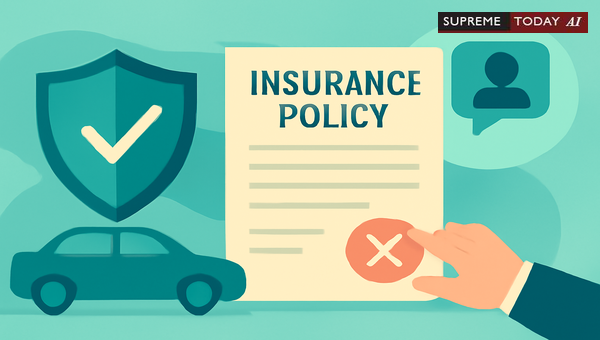
Arguments Favoring Respondents in Insurance Policy Cancellation Disputes
In the complex world of insurance claims, particularly those arising from motor accidents, disputes often center on whether a policy was valid at the time of the incident. Insurers frequently argue that policies were cancelled due to unpaid premiums, such as , leaving claimants without coverage. But what if the insurer fails to prove they notified the insured? This is a common scenario where respondents—often the claimants or insured parties—can mount robust defenses.
This post explores arguments in favor of the based on key legal principles, drawing from established case law and statutory provisions. We'll break down the core contentions, supported by relevant sections and precedents, to help you understand how courts typically approach these matters. Note: This is general information and not specific legal advice; consult a qualified attorney for your situation.
The Central Legal Question
Consider this typical query: Provide me Arguments in Favour of the on the Following Facts with Relevant Sections and Contentions. In a motor accident claim, the insurer (appellant) asserts the policy was cancelled due to a dishonored premium cheque, denying liability. The counters that no notice of cancellation was received, challenging the policy's invalidity. Courts have consistently scrutinized such claims, emphasizing proof of notification. 2009 0 Supreme(Guj) 714
1. Challenging Insurance Policy Validity: No Proof of Cancellation Notice
A cornerstone argument for the is the insurer's failure to demonstrate that the insured received intimation of cancellation. Without this, the policy remains valid. As noted in findings, there was no proof presented by the insurance company to demonstrate that the insured received any intimation regarding the cancellation of the policy. This absence undermines the insurer's position. 2009 0 Supreme(Guj) 714
Under insurance law principles, cancellation requires clear communication to avoid surprises for policyholders. Courts have ruled that insurers cannot escape liability without proper notification to the insured. This aligns with consumer protection norms, ensuring policyholders aren't penalized for administrative oversights. 2009 0 Supreme(Guj) 714
Key Contention
- Lack of Evidence: The insurer bears the to show dispatch and receipt of notice. Mere internal records or cheque dishonor don't suffice without external proof like postal acknowledgment.
2. Relying on Legal Precedents: The Deddappa Case and Beyond
Precedents fortify the 's stance. In Deddappa's Case, arguments favoring the insurer were dismissed because of inadequate notification evidence. The court reinforced: the insurer must provide clear evidence of cancellation and notification. 2009 0 Supreme(Guj) 714
This principle echoes in other domains. For instance, in eviction proceedings under the , courts have held that failure to raise specific objections results in , preventing surprise pleas at later stages. Similarly, here, the insurer's unproven cancellation can't retroactively void coverage. 2023 0 Supreme(P&H) 268
In another context, under , transfers are scrutinized only if explicit conditions (like providing amenities) exist and are breached—absent such stipulations, claims fail. Analogously, without proven notice, cancellation claims falter. 2023 0 Supreme(Kar) 397
3. Under the Evidence Act, 1872
, place the burden on the party asserting cancellation—the insurer. They must prove the insured's awareness. The insurance company failed to produce any evidence that the insured was aware of the cancellation, which is a critical requirement. 2009 0 Supreme(Guj) 714
This burden isn't shifted lightly. In criminal matters, courts quash proceedings where civil disputes are given a criminal colour without ingredients, as in cases under . Here, the insurer's claim lacks foundational evidence, akin to stretching civil lapses into policy voids. 2021 7 Supreme 283
- : Whoever desires a fact to be proved bears the burden.
- : Burden lies on the party denying liability post-policy issuance.
- Practical Tip: Respondents should demand documentary proof during tribunals.
Relatedly, in rent control appeals, non-suited parties succeed if opponents waive objections by silence, preventing appellate surprises. 2023 0 Supreme(P&H) 268
4. Justification for Compensation and Interest Awards
(MACT) often award compensation with interest from the application date when insurers falter. The claimant isn't at fault for cheque dishonor, and unnotified cancellation shields them from insurer-insured disputes. The award is justified as the claimant was not at fault... and should not suffer due to the insurer's internal issues. 2009 0 Supreme(Guj) 714
This upholds equity. In contempt or compliance cases, courts dismiss appeals if procedural bars apply, prioritizing substantive justice. Similarly, MACT awards stand firm absent proof. 2022 0 Supreme(All) 69
5. and Consumer Protection Imperatives
Upholding claims aligns with , protecting consumers from insurer lapses. The insured should not be penalized for the insurer's failure to communicate effectively regarding policy status. 2009 0 Supreme(Guj) 714
Broader jurisprudence supports this. In depositor protection acts, schemes safeguard interests without undue prejudice, mirroring insurance consumer safeguards. 2018 0 Supreme(Bom) 1379 Consumer forums echo: effective communication is mandatory, preventing abuse of fine print.
In senior citizen property transfers, absent explicit maintenance stipulations, protections don't trigger—emphasizing clear terms. Insurers must similarly notify explicitly. 2023 0 Supreme(Kar) 397
Additional Insights from Related Precedents
- Rent and Eviction Contexts: NRI status or bona fide needs require evidence; unraised triable issues bar later contests. Insurers can't introduce unproven cancellations late. 2023 0 Supreme(P&H) 3152
- Contempt Appeals: Limited appealability under , underscores procedural rigor—notification gaps invite dismissal. 2021 0 Supreme(Ker) 47 2020 0 Supreme(Ker) 464
- Criminal-Civil Divide: Avoid criminalizing civil breaches; insurance disputes stay civil unless fraud proven. 2021 7 Supreme 283
These reinforce: evidence rules supreme.
Conclusion and Key Takeaways
Respondents in insurance cancellation disputes hold strong ground when insurers lack notification proof. Core arguments—policy validity, precedents like Deddappa, Evidence Act burdens, justified compensation, and consumer policy—tilt scales favorably. Courts maintain MACT awards, prioritizing fairness. 2009 0 Supreme(Guj) 714
Key Takeaways:- Demand proof of notice always.- Leverage Evidence Act Sections 61-74.- Cite precedents for notification mandates.- Emphasize consumer protection in arguments.- In proceedings, highlight insurer obligations.
Stay informed, document everything, and seek professional guidance. Insurance law evolves, but proof remains king.
References: 2009 0 Supreme(Guj) 714 2023 0 Supreme(Kar) 397 2023 0 Supreme(P&H) 3152 2023 0 Supreme(P&H) 268 2022 0 Supreme(All) 69 2021 7 Supreme 283 2021 0 Supreme(Ker) 47 2020 0 Supreme(Ker) 464 2018 0 Supreme(Bom) 1379















